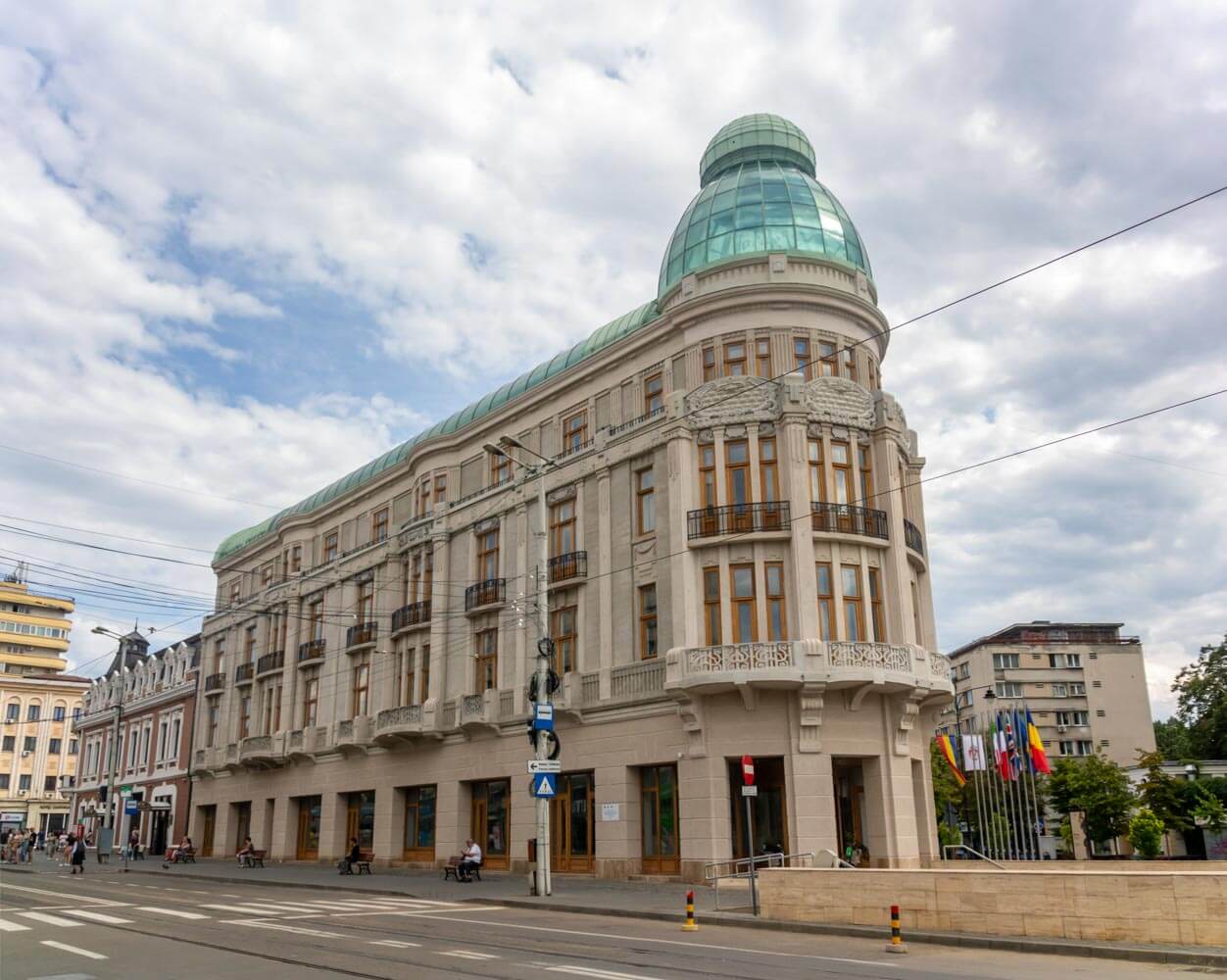
The Braunstein Palace (Palatul Braunstein) is an early 20th-century landmark on Union Square in central Iași, recognizable by its rounded corner façade and tall glass-covered dome. Originally built as a mixed commercial and residential property, the restored building still combines several uses today, including shops, cultural institutions, and exhibition spaces administered by the Queen Marie Municipal Museum.
History
Adolf Braunstein, a Jewish entrepreneur with commercial interests in this part of Iași, commissioned the palace after earlier buildings on the site were destroyed by fire. Construction took place between 1913 and 1915 under architect Herman Clejan, who designed a large multipurpose building suited to its prominent position beside Union Square. Commercial premises occupied the lower levels, while the upper floors provided space for offices, accommodation, and other uses.
The curved corner facing the square became the main focus of the design, with tall windows, projecting balconies, pilasters, and floral ornament wrapping around the façade. Above them, the roof rises into the metal-and-glass dome completed in 1915, which gives the palace its distinctive silhouette. Eclectic historicist forms are combined with Art Nouveau decoration throughout the exterior, while the lighter glazed dome contrasts with the more substantial masonry below.
As ownership and political circumstances changed, the palace was repeatedly adapted to new purposes. Hotel rooms, banking premises, offices, shops, and political organizations all occupied parts of the building at different times, while wartime damage and later earthquakes added to the physical deterioration. After nationalization during the communist period, sections of the upper floors were converted into social housing, although commercial and cultural uses continued at street level, including the Cupola Art Galleries.
By the beginning of the 21st century, decades of subdivision, alterations, and limited maintenance had left the palace in poor condition. A major restoration and structural consolidation returned the building to use in 2022, repairing the historic façades and dome. Shops and other premises continue to occupy parts of the lower levels, while the upper floors accommodate cultural organizations including the French Institute and German Cultural Center, together with exhibition spaces administered by the Queen Marie Municipal Museum.
Visiting Braunstein Palace
Visitors can enter the museum-administered parts of Braunstein Palace with a ticket, but there is no single permanent museum devoted to the building itself. Exhibition rooms on several levels are used for temporary exhibitions and other cultural events covering art, photography, history, and related subjects, so the content of a visit depends on the current program, which can be found on the official museum website.
The restored dome forms the most distinctive interior space. Its exposed metal-and-glass structure encloses an upper-level gallery used for exhibitions and events, while the elevated position opens views across Union Square and the center of Iași.