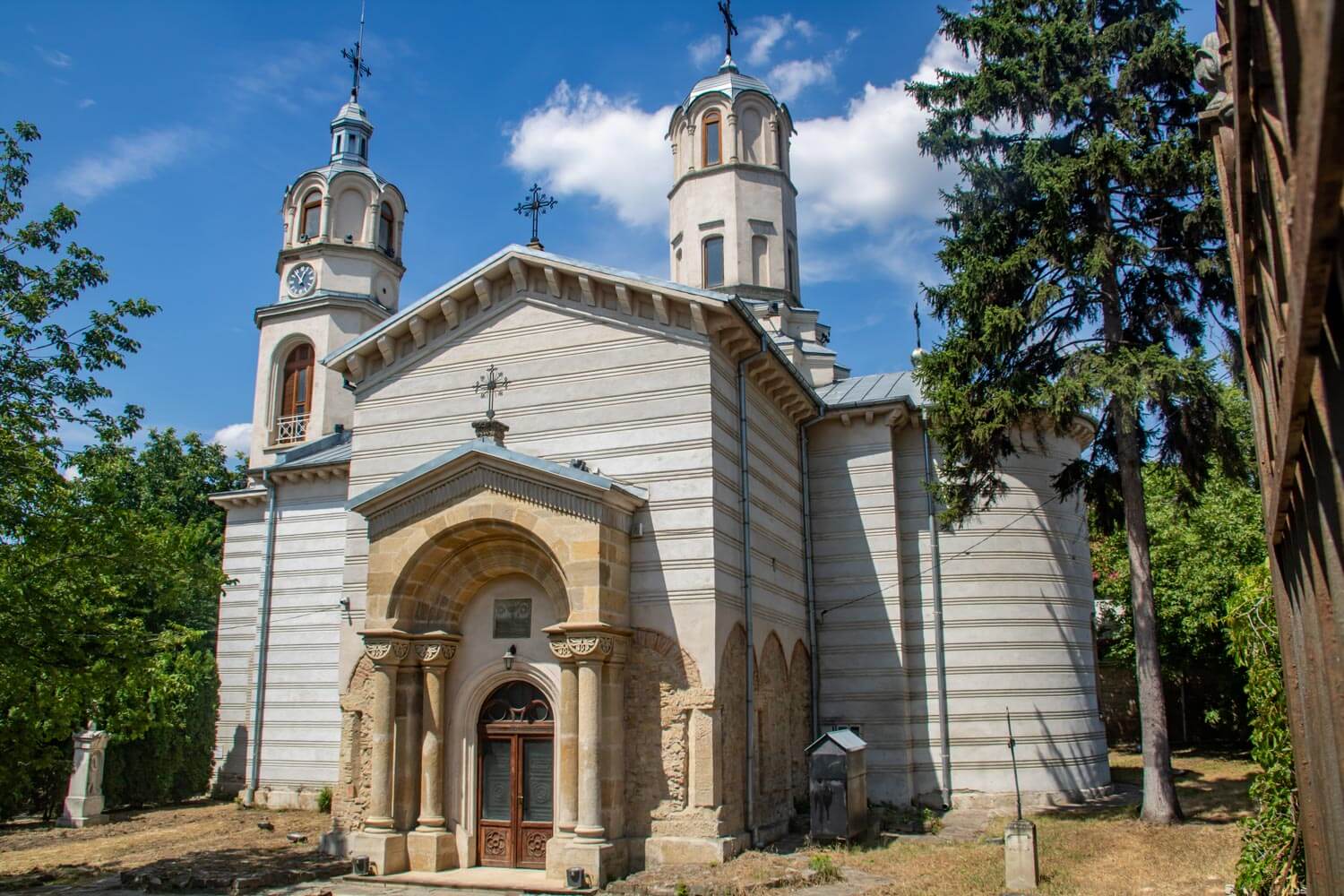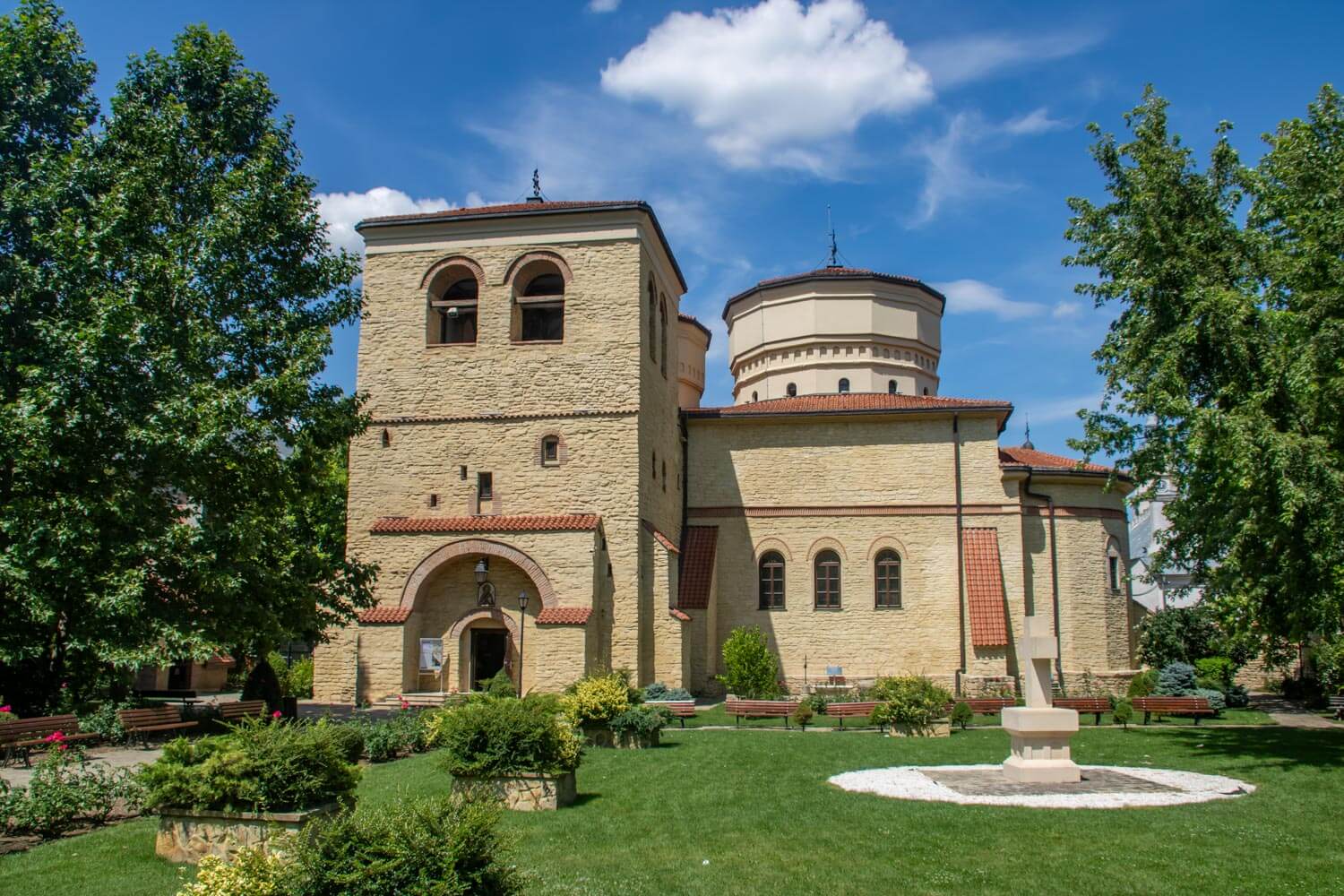


The Saint Sabbas Church (Biserica Sfântul Sava) is a historic Orthodox church and former monastery in central Iași, distinguished by its two unusually broad, low towers and its mixture of Moldavian and Oriental architectural features. Dedicated to the Dormition of the Virgin Mary, it takes its familiar name from Saint Sabbas the Sanctified, whose monastery near Jerusalem originally established the religious community.
In 1583, a group of Greek monks from the Monastery of Saint Sabbas in Palestine received land and several houses from Moldavian Prince Peter the Lame, allowing them to establish a monastery along the old commercial street known as Podul Vechi. They built a church and monastic cells, creating a dependency of the Jerusalem monastery that subsequently became an important center for the administration of Holy Land church properties in Moldavia.
The original church deteriorated rapidly, with further damage following a Tatar invasion in 1624. It was consequently rebuilt from its foundations in 1625 through the patronage of the nobleman Enache Caragea, with construction directed by master builder Gheorghe from Constantinople. The new church retained the original dedication but introduced an architectural design rarely encountered in Moldavia. Its rectangular stone structure is crowned by two exceptionally wide, thirteen-sided towers with shallow domes, reflecting Ottoman architectural influences alongside Byzantine, Moldavian, and Wallachian traditions. The carved stone portals, twisted-rope ornament, decorative brickwork, and surviving foundation inscriptions further enrich its exterior.
The monastery prospered during the following centuries, receiving extensive landed estates and welcoming senior clergy from across the Orthodox world. In 1676-1678, Prince Antonie Ruset rebuilt its surrounding defensive wall, part of which survives along the eastern side. Its cultural role expanded in 1714, when the Princely Academy of Iași opened here alongside a library and a Slavonic-Romanian printing press. The press subsequently produced religious books in Greek and Arabic, while the monastery’s substantial library helped support scholarly and religious education in the city.
Following the secularization of monastic estates in 1863, the complex gradually lost its monastic function. A school opened in the former abbot’s residence in 1864, and the church became a parish church in 1893. Although many of the old monastery buildings disappeared or acquired other uses, the surviving church retained important furnishings and religious objects, including a carved 19th-century iconostasis, historic icons, liturgical textiles, and old religious books. It also received relics of Saints Tryphon and Marina from the demolished Dancu Monastery in 1903.
The church’s interior was substantially restored between 2010 and 2013, when the surviving 19th-century paintings and richly carved iconostasis were conserved. The restoration also incorporated visible sections of the foundations of the original 16th-century church, discovered during archaeological excavations that revealed an extensive former cemetery with more than 300 graves. In the landscaped courtyard, a large stone cross marks the resting place of human remains recovered during the restoration, while the surviving enclosure wall and nearby former monastic buildings recall the much larger religious complex that once occupied this part of Iași.