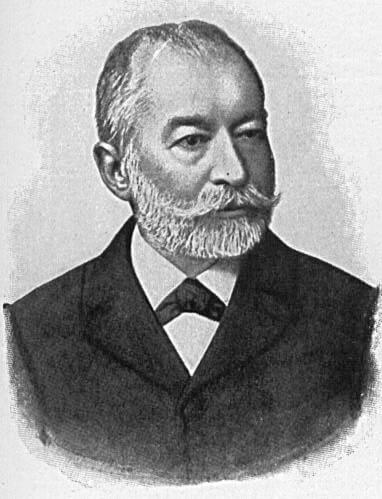
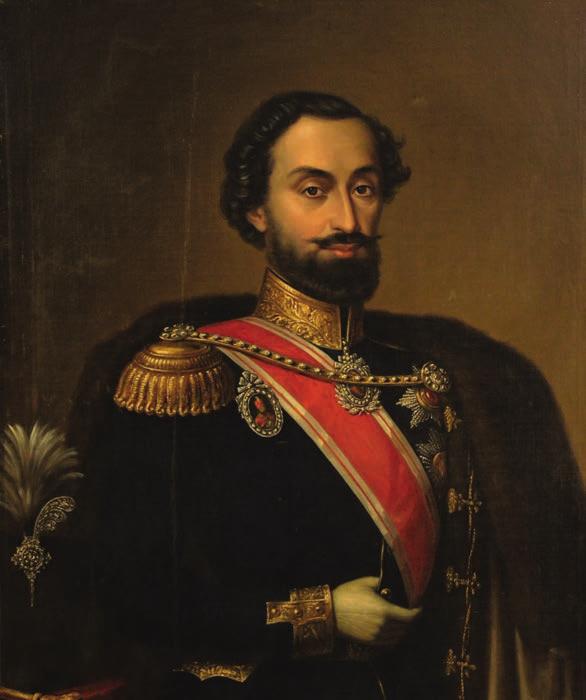
Dimitrie A. Sturdza (1833-1914) was a Romanian politician, historian, and statesman who became one of the leading figures of the National Liberal Party and served four terms as prime minister between 1895 and 1908. His career stretched from the Union era under Alexandru Ioan Cuza to the mature kingdom of Carol I, while his work as a historian and long involvement with the Romanian Academy made him equally important in the development of the country’s cultural institutions.
Sturdza was born at Miclăușeni in Moldavia and studied at the Academia Mihăileană in Iași before continuing his education in Germany, where he focused on economics, finance, and history. He returned at a time when the question of union between Moldavia and Wallachia dominated political life and was elected secretary of the Moldavian ad hoc assembly in 1857. He later served as private secretary to Alexandru Ioan Cuza during the first years of Cuza’s reign and held several ministerial posts in Moldavia.
His relationship with Cuza eventually deteriorated, and Sturdza joined the political opposition that helped bring the ruler’s reign to an end in 1866. Under Carol I, he remained deeply involved in public life and gradually became one of the principal figures of Romanian liberal politics. In 1875 he was among the founders of the National Liberal Party, alongside Ion C. Brătianu and other leading liberals.
Sturdza held a remarkable number of government posts over the following decades, including finance, public works, foreign affairs, education, and war. His repeated appointments reflected both his administrative experience and his reputation for discipline and financial expertise. After the death of Ion C. Brătianu, he eventually became leader of the National Liberal Party and served as prime minister four times between 1895 and 1908.
These governments operated during a period when Romania was consolidating the institutions created after independence and the proclamation of the kingdom. Sturdza generally supported economic modernization, stronger state finances, infrastructure development, and a cautious foreign policy under Carol I. His governments also faced increasingly difficult social tensions, particularly in the countryside, where poverty, land shortages, and unequal access to land remained unresolved.
The most serious crisis came during his final premiership in 1907, when a massive peasant revolt spread across much of Romania. The uprising grew out of long-standing rural grievances and quickly overwhelmed local authorities. Sturdza’s government responded by deploying the army, and the revolt was violently suppressed. The episode exposed the depth of Romania’s agrarian problems and became one of the darkest moments of his political career.
Sturdza’s public life was not limited to government. He was also a serious historian, editor, and collector of documents, with a particular interest in the political history of modern Romania. He helped publish major documentary collections, including volumes relating to the formation of the Romanian state and the Hurmuzaki series of historical documents. He also wrote on finance and numismatics and assembled an important collection of books, maps, manuscripts, coins, and prints.
His connection with the Romanian Academy became one of the longest and most important institutional relationships of his life. Elected a full member in 1871, he later served as vice president, president from 1882 to 1884, and then as secretary general for almost thirty years until his death. He also donated extensive collections and funds to the Academy, helping expand both its research resources and its ability to support scholarship.
A more personal part of his legacy survives in Bucharest, where his former home is turned into the bookstore Cărturești Verona. The historic residence preserves the character of a wealthy late nineteenth-century urban home, with original decorative elements still visible inside. Its later use as one of Bucharest’s best-known bookstores gives the building a very different modern life while preserving a direct link with Sturdza himself.
Sturdza died in Bucharest in 1914 and was buried at Bellu Cemetery. By then he had spent more than half a century in public life, moving from the politics of the Union generation to the leadership of a fully independent kingdom. His legacy combines the institutional world of late nineteenth-century Romanian liberalism with a deep commitment to historical research, archives, and the Romanian Academy, making him one of the figures who helped shape both the political and intellectual structures of modern Romania.