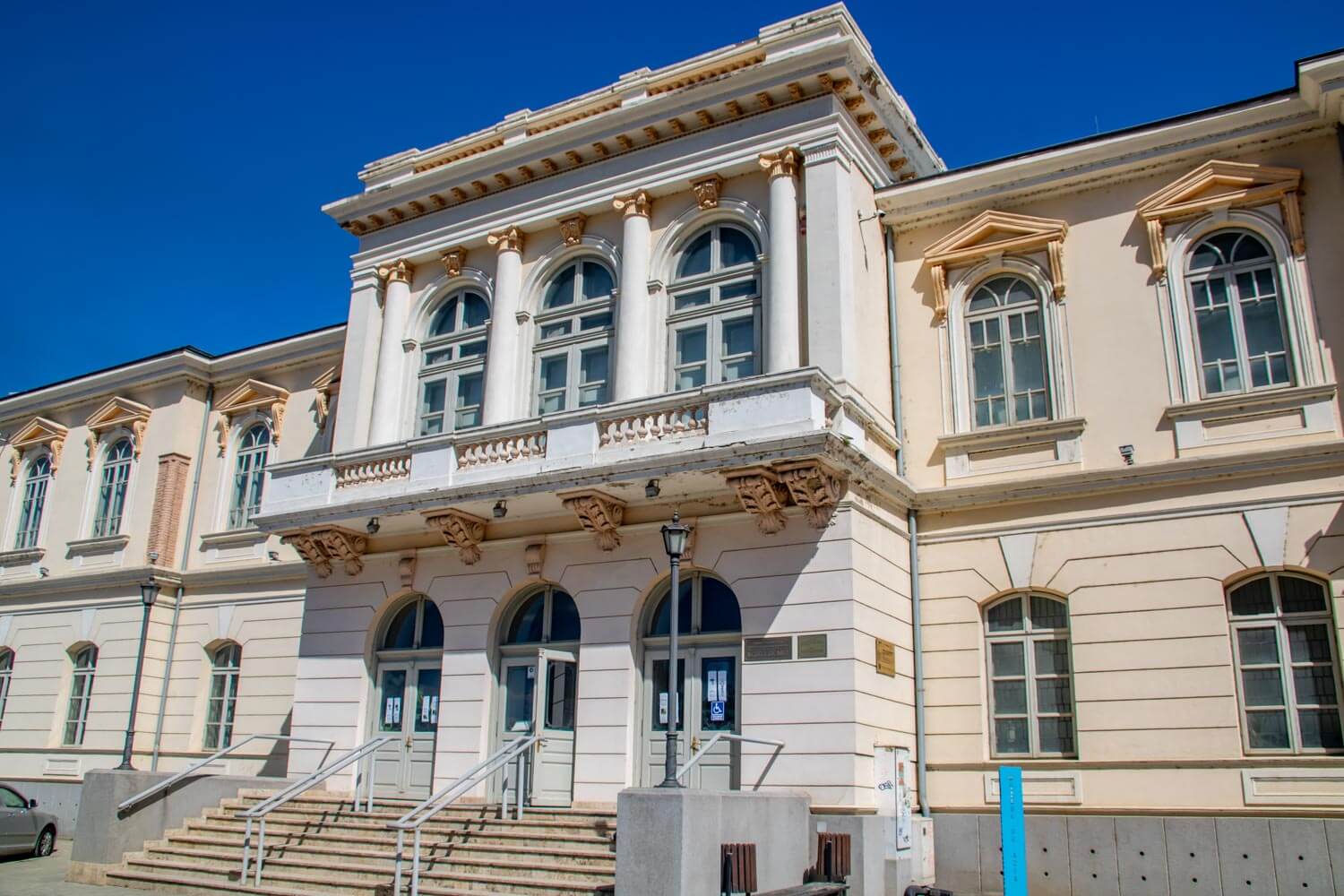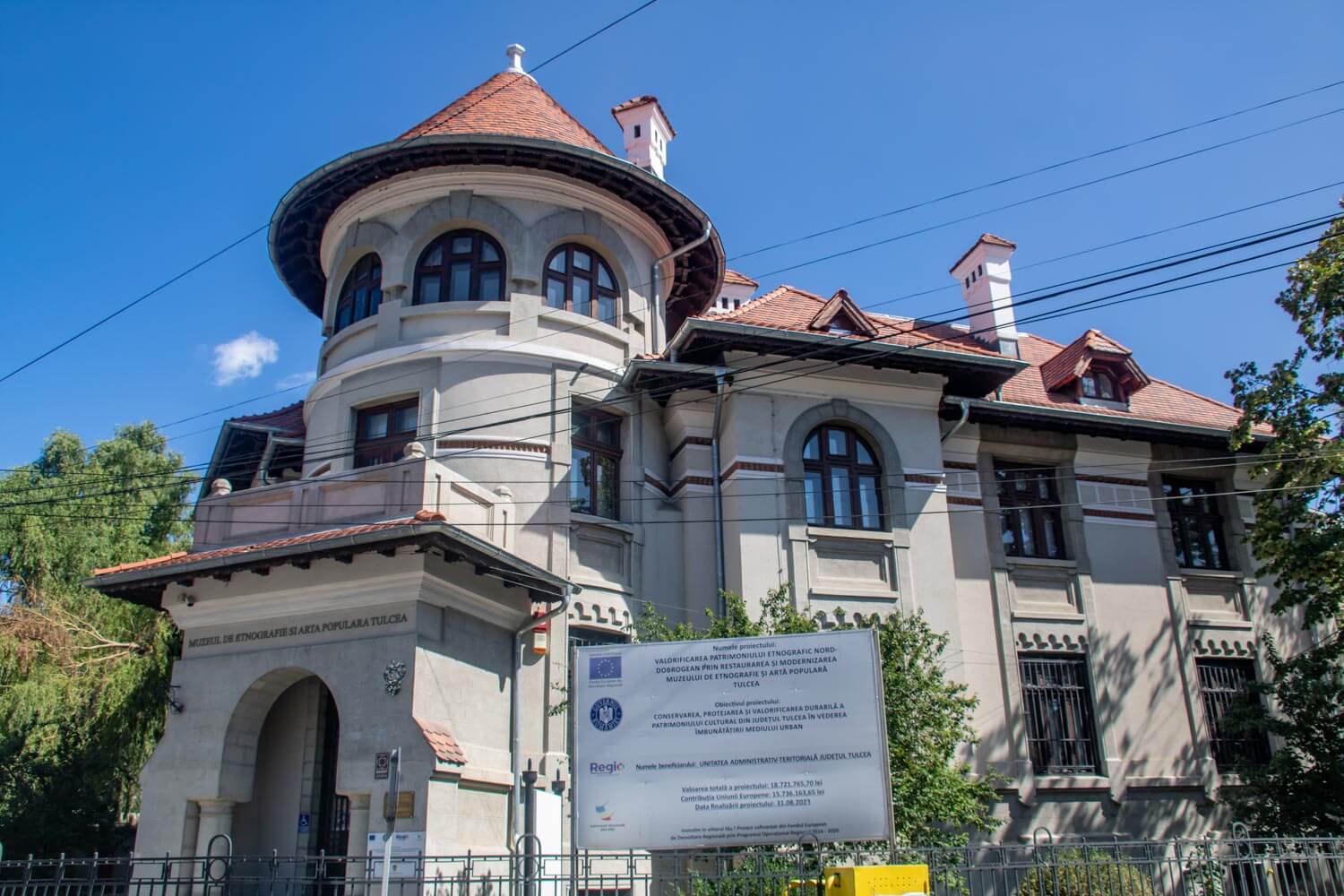
The Museum of Ethnography and Folk Art (Muzeul de Etnografie și Artă Populară) is an ethnographic museum in central Tulcea, housed in the former local branch of the National Bank of Romania. Its collections document rural life, traditional crafts, clothing and decorative arts across northern Dobrogea, with particular attention to the region’s mixture of Romanian and other ethnic communities.
History And Architecture Of The Building
The museum occupies one of Tulcea’s most distinctive interwar public buildings. Designed in 1924 by architects S. Constantinescu and Radu Dudescu and completed in the following years, it was purpose-built for the Tulcea branch of the National Bank of Romania in the Neo-Romanian style.
Its design makes particular use of the corner site. Two asymmetrical wings follow the adjoining streets and meet in a cylindrical tower containing the main entrance, reached through a Neo-Romanian porch. Above it rises a belvedere and conical roof, giving the corner a strong vertical accent. The municipality had deliberately provided the site so the new bank would contribute to the group of monumental public buildings developing in the center of Tulcea during the interwar period.
The bank continued to occupy the building for much of the 20th century before it was adapted for museum use. The Museum of Ethnography and Folk Art moved here in 2005, while a major restoration between 2019 and 2022 repaired the historic structure and reorganized the interiors for exhibitions and visitor circulation.
Museum and Collections
The museum developed from Tulcea’s first postwar museum institution, whose initial exhibition opened in 1950 with archaeological, natural-history and other collections shown together. As the museum expanded, these holdings were gradually separated into specialized branches. An ethnography and folk-art section was established during the 1970s, eventually becoming one of the principal museums within today’s “Gavrilă Simion” Eco-Museum Research Institute.
Its collection now contains around 8,000 objects illustrating everyday life and traditional craftsmanship in northern Dobrogea. Agricultural implements, fishing equipment, beekeeping tools, objects used in viticulture and animal husbandry, and equipment for processing wood, clay, reeds, leather and textiles show how communities adapted their work to the landscapes of the Danube and the delta.
Textiles form one of the strongest parts of the collection, including woven towels, carpets, household fabrics and traditional clothing. Metal vessels and other domestic objects complement these displays, while tools for spinning, weaving, sewing and other household industries explain how many of the finished pieces were produced.
A separate Aromanian folk-art collection contains around 670 objects brought by Aromanian communities who settled in Dobrogea during the 20th century. Particularly notable are the heavy woolen textiles, traditional costumes and silver-alloy jewelry, which preserve distinctive elements of Aromanian domestic and ceremonial dress.