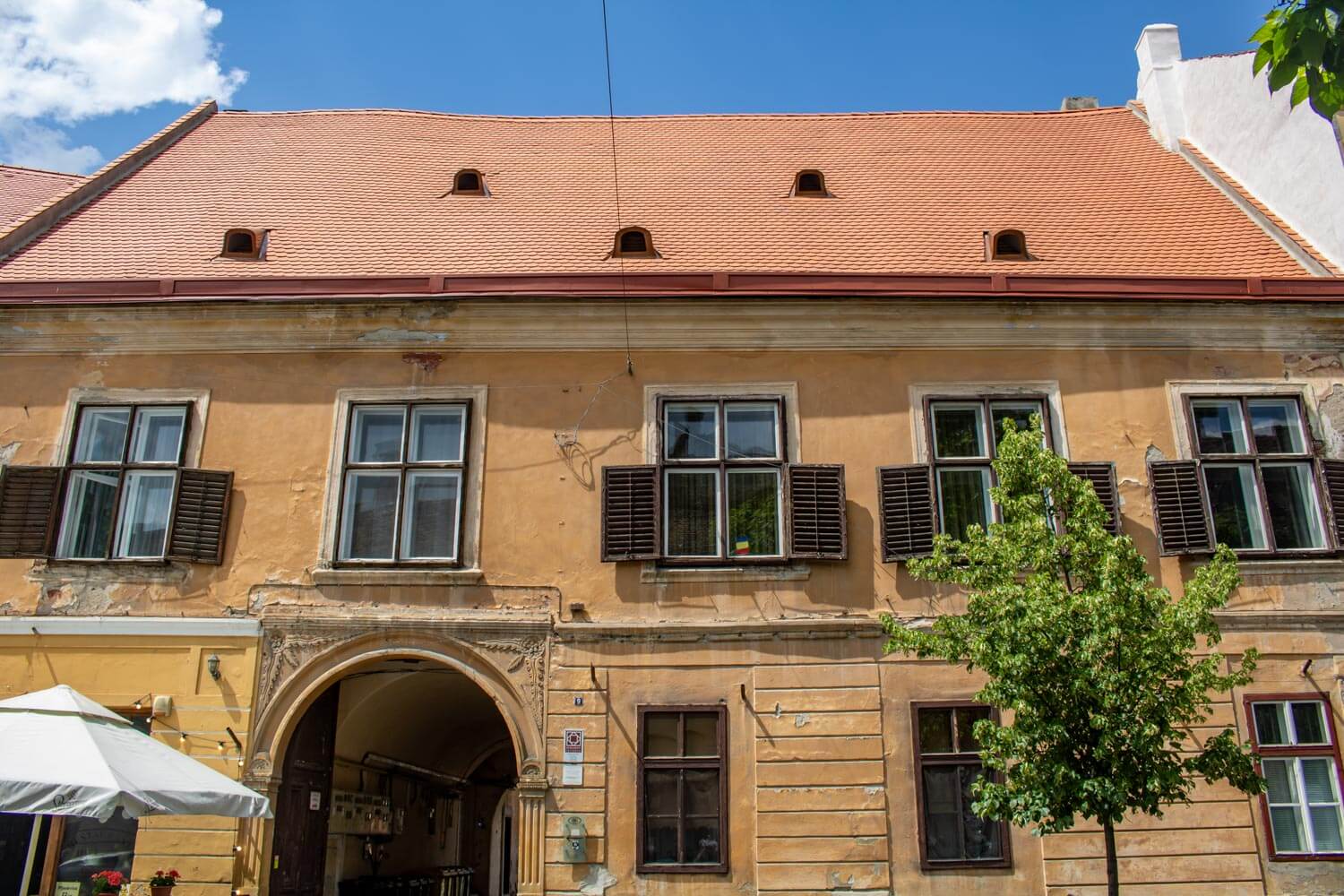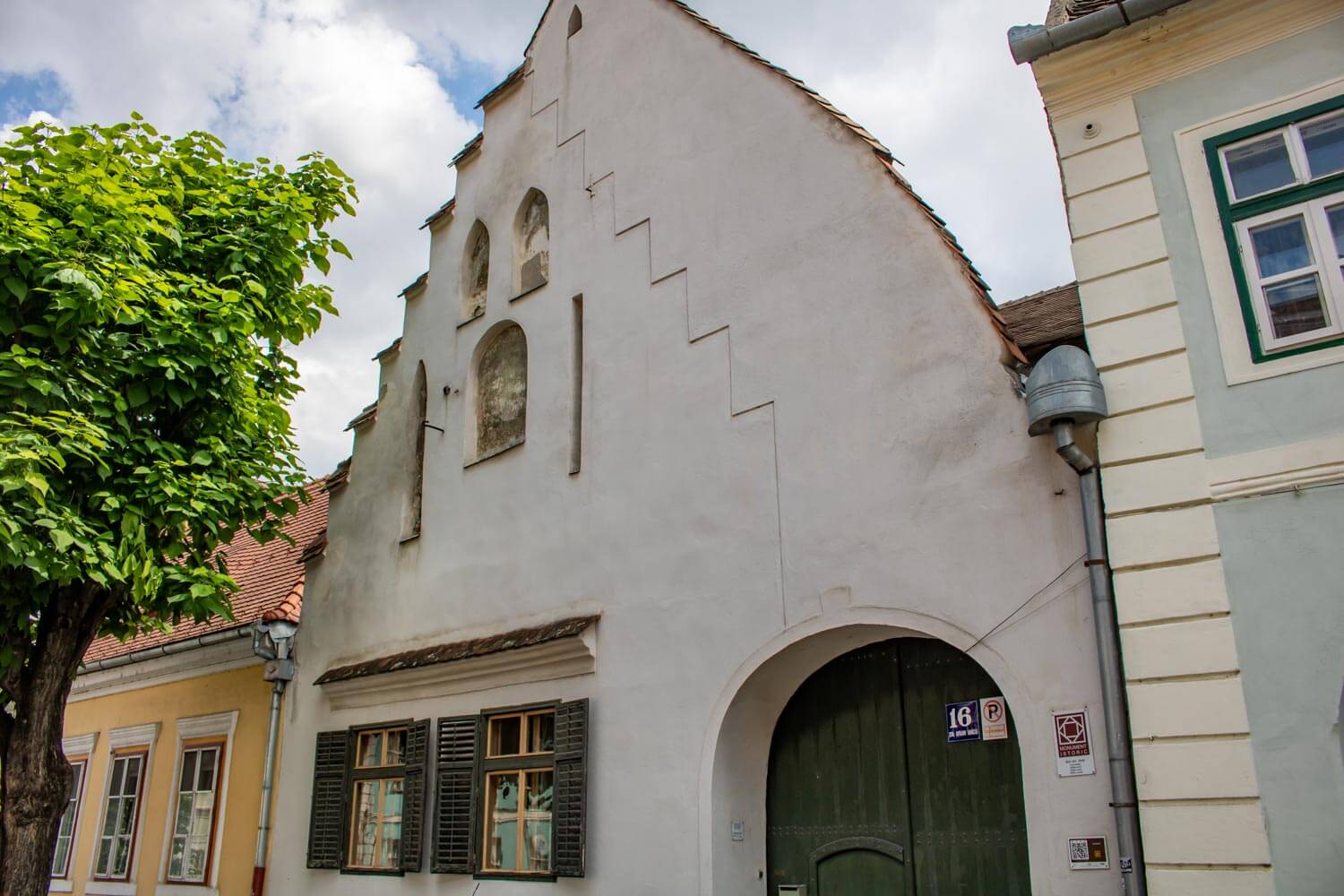
The Böbel House (Casa Böbel) is a medieval house on Avram Iancu Street in the historic center of Sibiu. Dating largely from the 14th century, it is regarded as one of the oldest surviving residential buildings in the city and preserves unusually early elements of Sibiu’s secular Gothic architecture.
Its street-facing section already existed in the 14th century, when the house took shape as a compact medieval residence. Changes in the 15th century altered the gable and extended the roof above the entrance passage, while additional structures were built toward the courtyard in the 18th century. The street façade is dominated by its tall stepped Gothic gable, rising well above the two ground-floor windows and broad arched gateway. Three narrow openings higher in the gable ventilate the attic, a feature more commonly encountered in medieval ecclesiastical architecture. The passage leading into the courtyard and the semi-basement are covered by barrel vaults.
The earliest known owner was a goldsmith named Neugeborn, and the layout suggests that the house may originally have combined residential space with the work or storage needs of a craftsman or merchant. Around 1850 it was acquired by Johann Böbel, head of Sibiu’s bakers’ guild, whose name has remained attached to the building. Böbel built an oven in the courtyard, but his importance in Sibiu extended well beyond his trade. He also produced drawings and paintings of the city, including views of its medieval gates and fortifications, preserving a visual record of structures that were disappearing during the 19th century.
By the end of the 19th century, the Böbel Winery (Vinăria Böbel) operated in the house. It later passed through several owners and uses, including a locksmith’s workshop and bookbinding activities. In 1941, printer Octavian L. Veștemean bought the property and moved his printing business here from Tribunei Street. The premises were used for printing books, newspapers, magazines, official publications, calendars and other material until the printing operation passed to the state in 1949, after which Veștemean continued working here as a bookbinder.