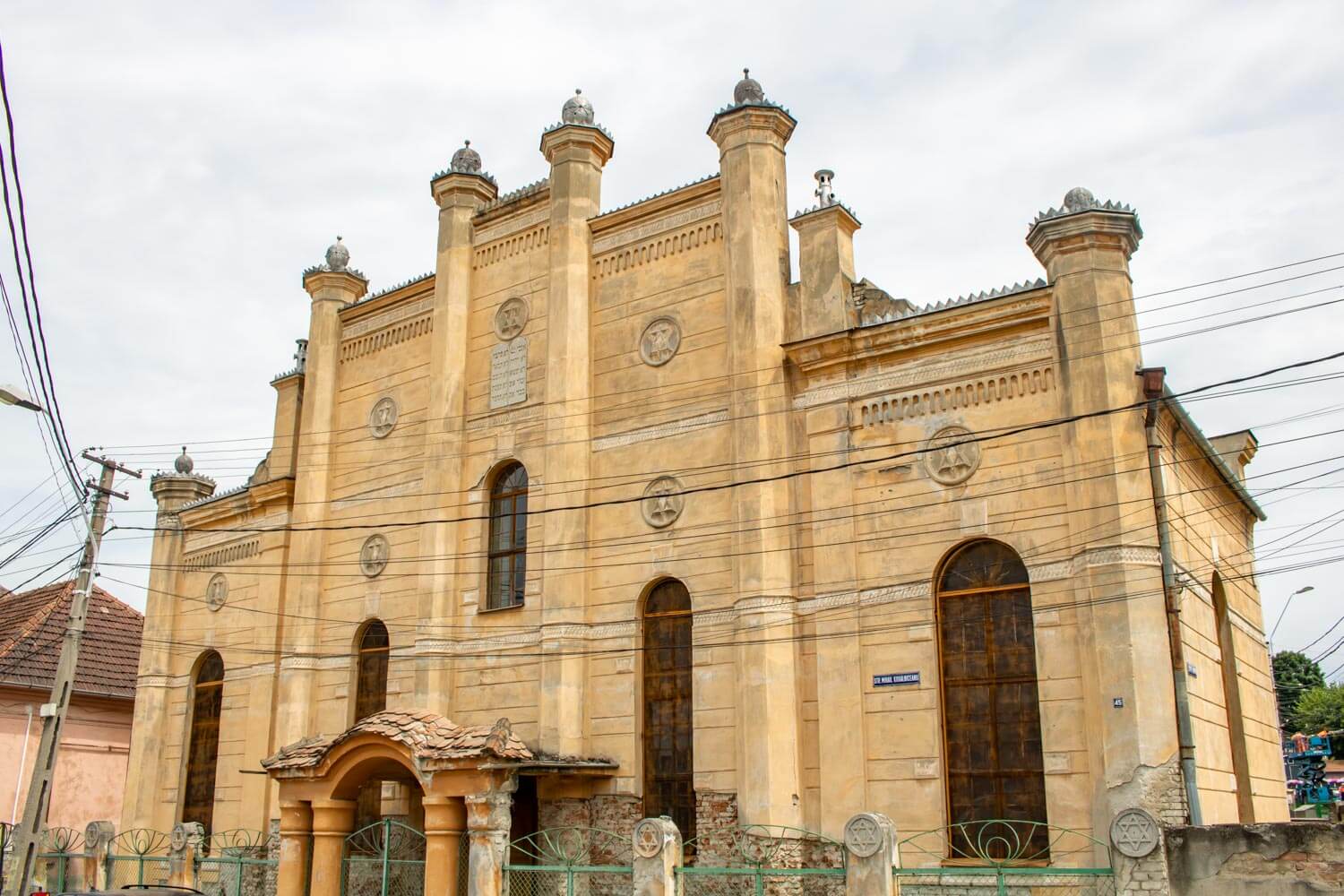
The Mediaș Synagogue (Sinagoga din Mediaș) is a late-19th-century synagogue, located opposite the train station, just outside the medieval core of Mediaș.
The Jewish community of Mediaș developed mainly during the second half of the 19th century, after earlier restrictions on Jewish settlement in Transylvanian towns were relaxed. Families from surrounding villages gradually moved into the city, and by the end of the century the community was large and established enough to build a substantial synagogue of its own. Completed in 1896, the new building stood close to the edge of the old town and could accommodate around 1,000 worshippers.
Its architecture combines the eclectic style of the period with Romantic and Moorish influences, with tall rounded windows, decorative profiles and painted interior surfaces giving the building a distinctive late-19th-century character. The synagogue formed part of a larger communal complex that also included the rabbi’s house, community offices and, from the 1920s, a Jewish school and mikvah.
The community passed through the Second World War without the mass deportations experienced in northern Transylvania, but its numbers declined sharply afterward as many members emigrated to Israel and other countries. By the end of the communist period only a small Jewish population remained in Mediaș, and the local community effectively ceased functioning during the 1990s. The synagogue was no longer used regularly for worship and gradually fell into disrepair.
A new chapter began after the surviving community archive was rediscovered during cleanup work in 2008. Thousands of documents, photographs, registers, prayer books and other records had been stored in the synagogue, particularly in the women’s gallery, and were later catalogued and moved into the former community offices beside the building. The complex has since developed into a center for preserving and presenting the history of Jewish life in Mediaș, with exhibitions, research projects and cultural events taking place around the synagogue and the neighboring House by the Synagogue.
Visitors can see both the architecture of the synagogue and surviving traces of the community that built it. The painted interior remains especially atmospheric despite decades of deterioration, while the adjoining buildings and archive help place the synagogue within the wider story of Jewish life in Mediaș rather than presenting it as an isolated monument.