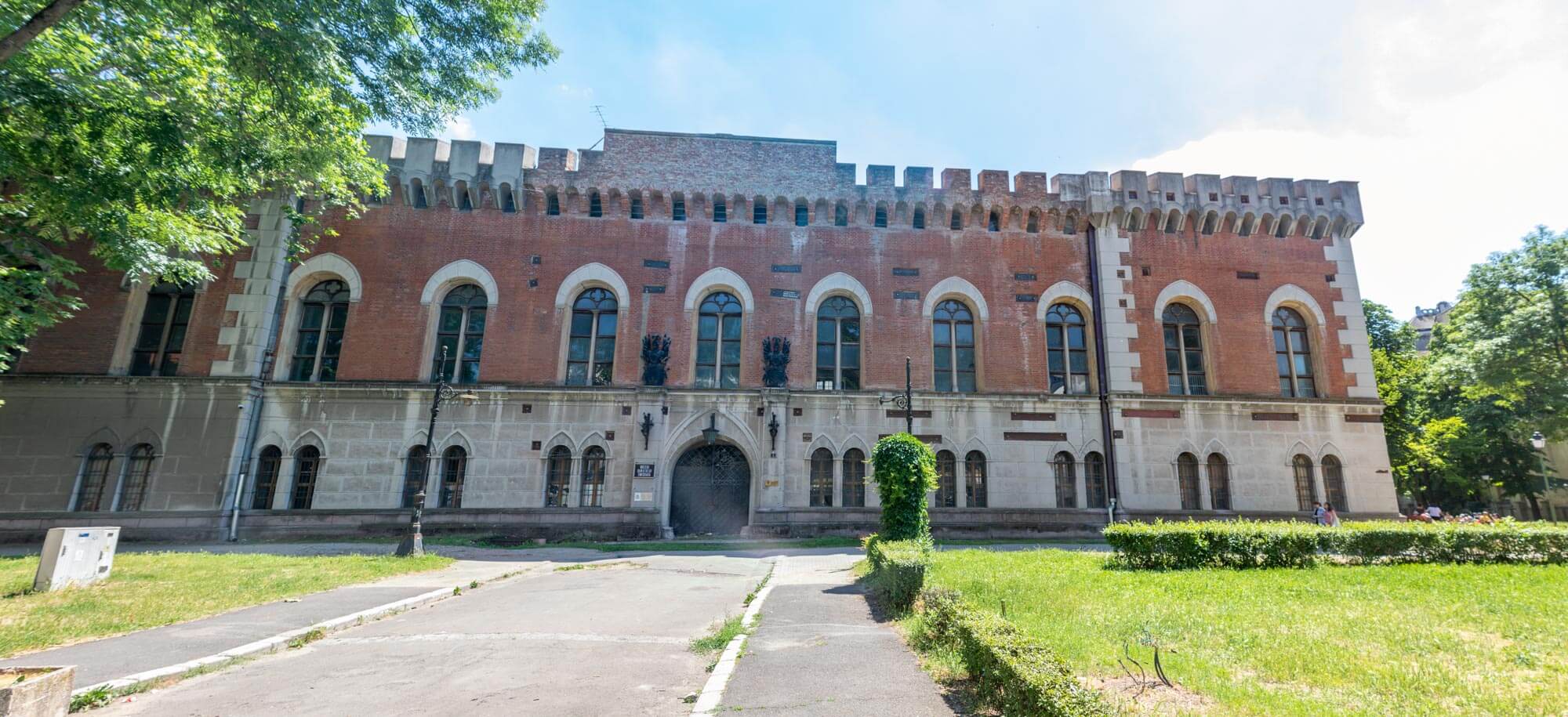
The National Museum of Banat (Muzeul Național al Banatului) is a museum headquartered inside Huniade Castle in Timișoara.
History of Huniade Castle
Huniade Castle was built between 1443 and 1447 by John Hunyadi, the Count of Timișoara, on the site of a former royal castle from the 14th century. The fortress was designed by the Italian architect Paolo Santini de Duccio.
The castle was rebuilt by the Ottomans in the 17th century, but during the siege that lead to the reconquest of Banat by the Habsburg army in 1716, the castle was damaged. Prince Eugene of Savoy reconstructed the castle after which it was used as an artillery barracks and military warehouse.
In 1849 another siege took place, this time by the Hungarian revolutionaries, which destroyed the castle almost completely. The castle was completely rebuilt and finished in 1856, with a romantic-style main facade and neo-Gothic decorations.
Despite the many renovations and changes made over time, the castle has kept its rectangular shape and its organization around a quadrangular courtyard. The design of Huniade Castle shares many aspects with Corvin Castle in Hunedoara.
History of the National Museum of Banat
The National Museum of Banat was founded in 1872 by the Society of History and Archaeology of Banat and over time, it has been located in different buildings across the city. Since 1947 the museum has been permanently located in Huniade Castle. Initially the museum also had an art department, but in 2006 this became a separate museum called the National Art Museum of Timișoara, which is located in the Baroque Palace on Union Square.
Visit the National Museum of Banat
The National Museum of Banat houses the most important collection of archaeological objects in Banat, including the 6,200-year-old Neolithic Sanctuary of Parța. The museum is organized in the following sections: History, Archaeology, and Natural Sciences. The museum also has a laboratory for the restoration of heritage objects.
The museum also has an exposition located inside the Maria Theresia Bastion.