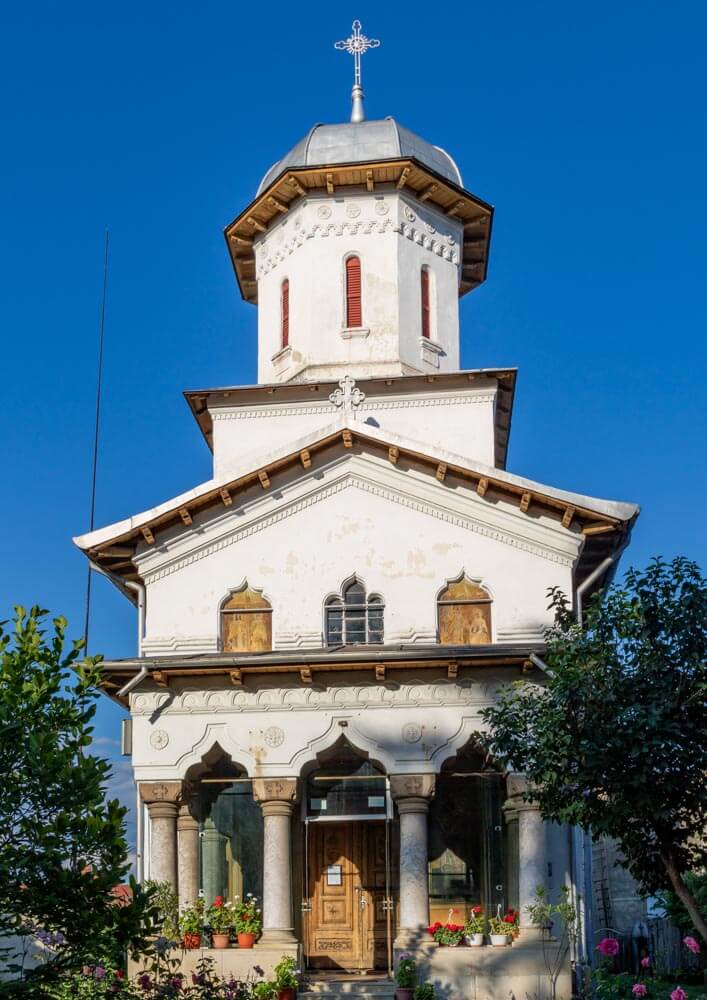
The Saint Mina Church (Biserica Sfântul Mina) is a Romanian Orthodox church dating from 1564 in the historic Ceair neighborhood of Pitești. Also known as the Annunciation Church (Biserica Buna Vestire) or Greeks’ Church (Biserica Greci), it is the oldest surviving church in the city. It was founded by the Wallachian nobleman Ioan Norocea and his wife, Stana, daughter of Prince Mircea Ciobanul, and originally served the wealthy families and merchants of the neighborhood.
Ioan Norocea was an influential Wallachian official who later served Michael the Brave during his campaigns against the Ottoman Empire and his brief unification of Wallachia, Transylvania, and Moldavia. The church was built during the reign of Petru cel Tânăr, Norocea’s brother-in-law, possibly replacing an earlier place of worship from the beginning of the 16th century. Its original dedication was to the Annunciation, while the name Greeks’ Church developed from its proximity to the former Greeks’ Street, where merchants of Greek and Balkan origin had settled. The additional dedications to Saints Constantine and Helena and Saint Mina were introduced during later periods of the church’s history.
The original building had a trilobed plan with a central tower above the nave, typical of Wallachian religious architecture of the 16th century. In 1712, the church was enlarged with an entrance section incorporating a bell tower, financed by the nobleman Hrizea and his wife, Ilinca. Further rebuilding between 1860 and 1863 altered the original structure, while extensive works between 1910 and 1914 raised parts of the building, enlarged the windows, reconstructed the entrance, and added an open porch with columns of marble mosaic from Rucăr. As a result, the church’s present appearance combines its medieval core with several centuries of alterations.
The interior decoration has undergone similar changes, as Painter Iosif Materna redecorated the church between 1868 and 1870, replacing earlier paintings, and Gheorghe Belizarie completed another painting campaign in 1913-1914. During restoration work in 1984, however, conservator Dan Mohanu discovered fragments of the original 16th-century frescoes in the diaconicon, a small chamber adjoining the sanctuary. These paintings, dating from the church’s foundation, survived beneath later layers of decoration, alongside fragments attributed to subsequent periods.
Archaeological investigations have also provided important evidence of the church’s early construction. Research carried out in the 1960s and 1970s identified original masonry formed from alternating bands of horizontal and vertical bricks, confirming that the nave and sanctuary belonged to the 16th-century building. More extensive excavations begun in 2025 uncovered sections of the original brick flooring, later pavement layers, and numerous burials beneath and around the church. Some graves appear to predate the present building, suggesting that the site had been used for religious and funerary purposes before 1564.