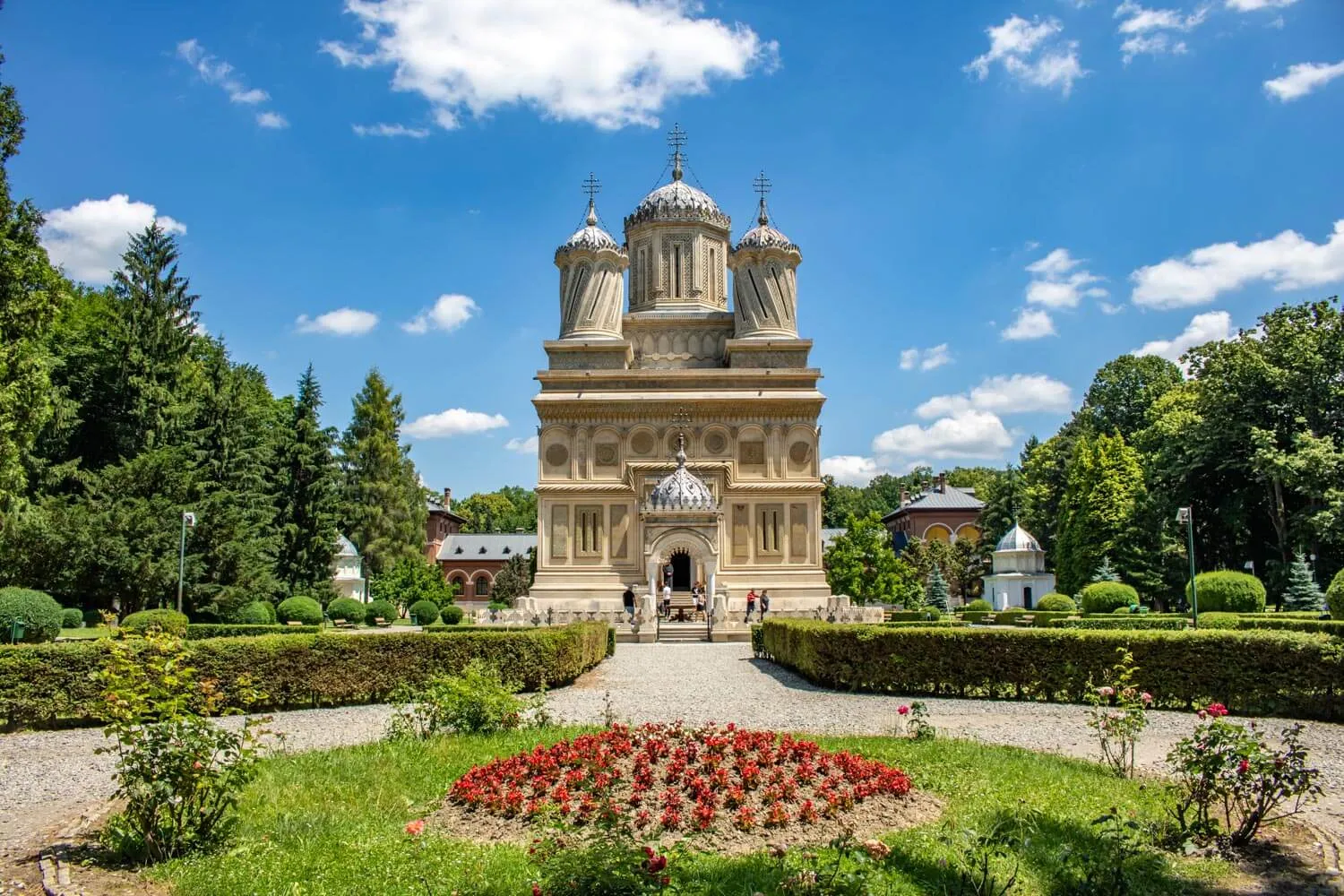
The Church of the Virgin Mary (Biserica Maica Precista) is a historic Romanian Orthodox church in eastern central Pitești, dedicated to the Presentation of the Virgin Mary in the Temple and the Life-Giving Spring. Also known as Precista din Coastă because of its position on a hillside, the church dates from 1794, although the religious history of the site extends considerably further back.
According to the parish’s historical account, a small convent was established here around 1540 by two nuns, Magdalena and Doroteia. Their names were preserved in an old memorial register, while a foundation stone bearing the date 1540 was reportedly discovered during 19th-century repairs. The earliest securely documented church was a wooden building dating from the mid-18th century, which was destroyed by fire. In 1794, the congregation replaced it with a masonry church, establishing the core of the present building.
Earthquake damage subsequently required extensive repairs between 1859 and 1864, during which the church underwent significant alterations. Its interior was painted between 1875 and 1877 by Ilie Zugravul, the father of painter Costin Petrescu, and a pulpit was added in 1887. Further reconstruction between 1930 and 1934 reshaped the roofline, replacing the single western tower with two smaller towers and restoring the central tower above the nave. The entrance was also enlarged, giving the church a substantial part of its present appearance.
Built of brick on a trilobed plan, the church has a central nave flanked by semicircular apses, a narthex, and an open entrance porch. The three towers rise above the roof, reflecting the changes made during successive rebuilding campaigns. The interior paintings were renewed in 1968 by Theodor Petrescu, following earlier interventions that had altered the original decoration.
Among the church’s historic religious objects is an icon of the Virgin Mary, darkened by smoke and subsequently covered with a silver revetment. Its exact age is unknown, but it was already recorded in historical accounts as an object inherited from the earlier church. The church also possessed bells dating from 1768 and 1816, although the larger bell was requisitioned during the German occupation of Pitești in the First World War.