Romania is a beautiful country to explore by car, because in addition to its remarkable cities it also has picturesque mountain landscapes and beautiful nature.
Whether you drive to Romania with your own car or fly and rent a car upon arrival, it is always good to prepare yourself because driving abroad is always just a little bit different.
In this guide you can read everything you need to know about driving in Romania, including the mandatory vignette, which items you are required to have with you, specific and unusual traffic rules, where to park and tips for renting a car.
Advantages Of A Car In Romania
Romania has a very extensive network of trains and buses that allow you to travel easily between the different cities. However, the most ideal way to explore the country is by car.
First of all, several of the most important sights are difficult or even impossible to reach without a car. For example, the fortified churches of Transylvania, the painted churches of Bukovina and the wooden churches of Maramureș are all spread over numerous smaller villages.
Another advantage of a car trip through Romania is that you can see much more in a short time because you are not dependent on train or bus times and you can also make stops along the way wherever you want. It gives you the ultimate freedom to plan your own itinerary that is simply impossible without a car.
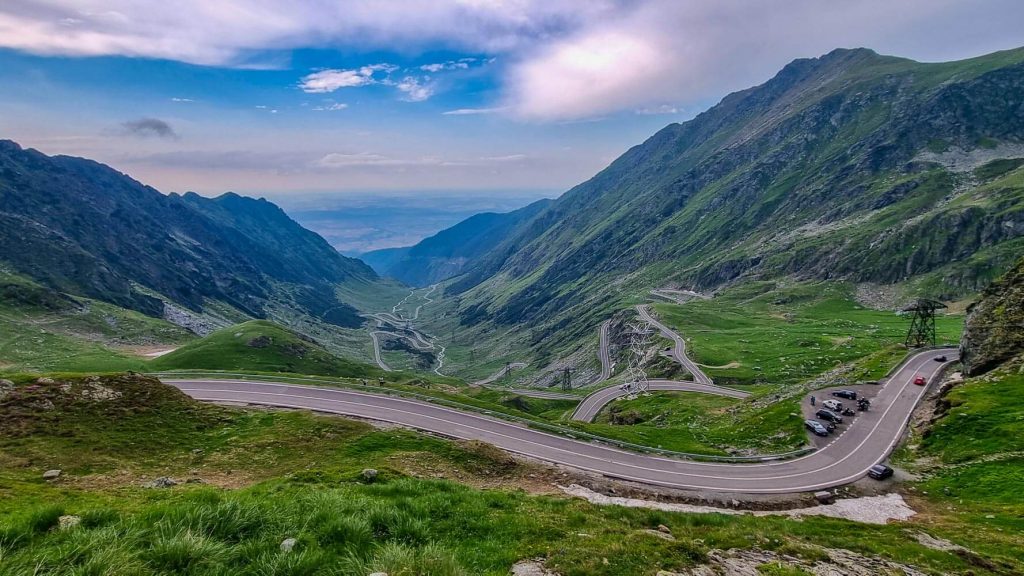
Apart from the practicalities, the journey itself is of course also a destination in itself. Romania has some of the most beautiful scenic roads such as the Transfăgărășan (photo above) and the Transalpina, where you drive through beautiful mountain landscapes with breathtaking viewpoints.
Of course, comfort also plays a role and the advantage of a car is that you always have transport from door to door and therefore do not have to drag your luggage around endlessly.
Toll Roads And Vignettes
For a car trip through Romania you need a toll vignette which is required for almost all main roads. In addition, there are some bridges for which you have to pay a separate toll.
Rovinietă
The so-called Rovinietă is the toll vignette that is required on all motorways (A), expressways (DE) and national roads (DN). This is checked by the traffic police, but there are also cameras that automatically scan license plates to check compliance. The price of the vignette depends on the type of vehicle and the validity. Motorcycles are exempt from the vignette requirement.
The easiest way to buy it is online as an e-vignette via the official website of Roviniete. You do not have to print anything out or stick it on your windshield. Physical stickers are also available at post offices, petrol stations and at the borders. You can buy the vignette with a validity of 1 day, 10, 30, or 60 days, or 1 year.
If you plan to rent a car in Romania, it is normally already equipped with a vignette and you do not need to buy one, but if you come to Romania with a foreign rental car, you will probably have to buy it. In any case, consult with the rental company about the requirements and restrictions for crossing the border with the rental car.
Toll Bridges
Apart from the toll vignette, there are also a number of bridges over the Danube for which an additional toll must be paid for each crossing. This concerns the following routes:
- DN2A / E60: Giurgeni-Vadu Oii Bridge- Payment at the booth
- A2 / E81: Cernavodă Bridge – Payment at the booth or online
- DN5 / E85: Friendship Bridge between Giurgiu (Romania) and Ruse (Bulgaria) – Payment online
- DN56 / E79: New European Bridge between Celafat (Romania) and Vidin (Bulgaria) – Payment at booth
Environmental Zones
Romania has no environmental zones with restrictive measures for traffic. You therefore do not need an environmental sticker in Romania.
Mandatory Equipment For Cars
When driving through Romania, you are required to have the following items with you in the car:
- Warning triangle (2x for vehicles with a Romanian license plate)
- Safety vest (only for vehicles >3,500 kg)
- First aid kit with valid expiry date
- Fire extinguisher with valid expiry date
If you rent a car in Romania (or in another country) to travel through Romania, it’s recommended to check if all mandatory equipment is present when you pick it up.
Mandatory Equipment For Motorcycles
Motorcyclists only need to carry a safety vest and no other equipment such as a warning triangle, first aid kit, or fire extinguisher is mandatory.
Winter Tires And Snow Chains
The use of winter tires is mandatory in Romania when winter weather conditions require it, such as snow, black ice, or slippery conditions due to frost. This obligation applies to all (four or more) wheels.
Winter tires must have a minimum tread depth of 4 millimeters and be provided with the designation M+S, M&S or MS, possibly with the 3PMSF symbol (Three-Peak Mountain Snowflake) added. All-season tires that meet this requirement are also considered winter tires.
In winter, it is also recommended to carry snow chains, especially in mountainous areas. On roads that are indicated with a round, blue traffic sign with a white car tire with a snow chain, the use of snow chains is mandatory if the road surface is covered with snow or ice. Studded tires, on the other hand, are always prohibited.
Traffic Rules
The traffic rules and signs in Romania are largely the same as in other European countries, but we have listed a few rules that might be different compared to other countries.
Speed Limits
Unless indicated otherwise by signs, the speed limits in Romania are as follows:
Cars And Motorcycles
- Within built-up areas: 50 km/h
- Outside built-up areas: 90 km/h
- E-roads: 100 km/h
- Express roads: 120 km/h
- Motorways: 130 km/h
Cars With Trailers Or Caravans
- Within built-up areas: 50 km/h
- Outside built-up areas: 80 km/h
- E-roads: 90 km/h
- Express roads: 110 km/h
- Motorways: 120 km/h
Vehicles >3,500 Kg
- Within built-up areas: 50 km/h
- Outside built-up areas: 80 km/h
- E-roads: 90 km/h
- Express roads: 100 km/h
- Motorways: 110 km/h
Lighting
In Romania, it is mandatory to drive with daytime running lights (DLRs) on during the day. If your car does not have a specific daytime running light setting, turn on your normal low beams. If you are driving in a tunnel or the weather conditions obstruct your visibility, daytime running lights are not sufficient and you must still use your low beams.
Parking
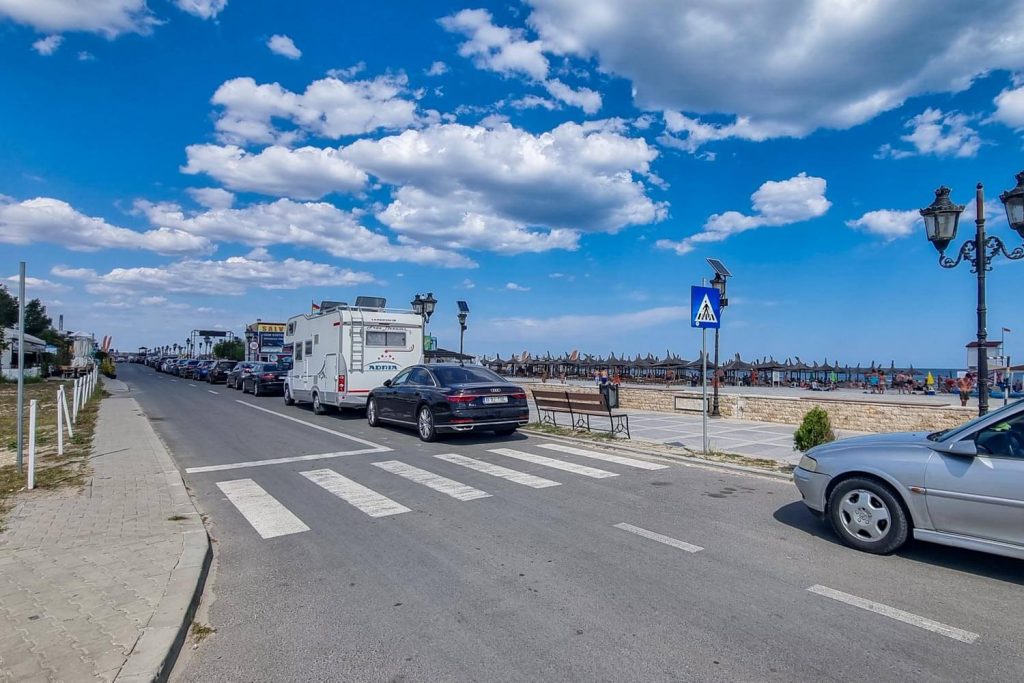
In Romania, parking is not allowed in the following places:
- In tunnels and on bridges.
- Within 5 metres of an intersection or crosswalk.
- Within 15 metres of a bus or tram stop, or a railway crossing.
- If your vehicle is not or poorly visible (for example after a bend) or forms an obstacle to other traffic, including blocking the view of a traffic sign.
- On or in front of a manhole or sewer cover.
Mobile Phones
In Romania, all drivers, including cyclists, are prohibited to hold or use a mobile phone while driving. Hands-free calling is allowed.
Alcohol And Drugs
In Romania, there is an absolute ban on driving a vehicle under the influence of alcohol or drugs. Even one glass of alcohol is strictly forbidden because the limit is really 0.0 ‰.
Paid Parking
In most cities in Romania (or parts of them) paid parking applies and often there are different zones with different rates. In some zones there may also be a maximum parking time. So pay close attention to the signs when you enter a city or street.
Although parking is often relatively inexepensive, the biggest challenge is mostly how to pay because it differs per city. Parking meters where you can pay with cash are few and far between, but sometimes you can pay with your debit or credit card. Paying by SMS is often only possible with a Romanian phone number, but fortunately you can often also pay with a parking app such as TPARK or Pay2Park.
The easiest thing is of course to look for a parking garage so that you can simply pay with your card afterwards, or to book a hotel with (free) private parking. Sometimes it is simply easier to park just outside the paid parking zone and walk a bit.
Petrol Stations
In Romania, there are plenty of petrol stations where you can fill up with unleaded petrol and diesel. Gas (LPG) is also fairly readily available, but you may need an adapter for this. You don’t have to fill up yourself, because there is usually someone at the pump who will do it for you.
Most petrol stations in Romania accept card payments and have long opening hours. There are also petrol stations in busier locations that are open 24/7.
Charging Electric Vehicles
Electric driving has also made its introduction in Romania, but it is not nearly as popular as it is in some other European countries. The Romanian car brand Dacia has not even launched a single electric car on the market.
There are charging points, especially in the larger cities and along the busier routes, but the network is certainly not comprehensive. A tour through Romania with an electric car is certainly possible, but it does require some planning and adjustment. So the question is whether you should want that during your holiday and whether it would not be easier to simply rent a petrol car for your trip.
Calamities
In the event of an emergency while on the road, such as an accident, it is best to call the general emergency number 112.
Car Rental In Romania
Rental cars are available in many places, such as at the airports and city centers of Bucharest, Cluj-Napoca, Brașov and Sibiu. To rent a car in Romania, you often have to be at least 21 years old, or you pay a surcharge if you are between 18 and 21 years old.
To rent a car, you need the following documents:
- Valid ID (passport or identity card)
- Valid driver’s license (an international driver’s license is required for non-EU citizens)
- Credit card in the name of the main driver
Car rentals are generally not expensive in Romania, but prices can fluctuate depending on demand. For example, prices are often higher during holiday periods, but if you book as early as possible you will often get the best price.
Driving A Rental Car Across The Border
If you want to drive a Romanian rental car across the border, or get into Romania with a foreign rental car, you should first inquire about the possibilities with the car rental company.
This is often possible, but there may be restrictions or additional costs involved. Romania and its neighboring countries Bulgaria and Hungary, for example, are all members of the European Union, which makes this easier, but the other neighboring countries, Serbia, Moldova and Ukraine, are not.
You may need to show the necessary papers at the border, such as the green insurance card or a declaration of consent and the rental company may charge administration costs for providing this.