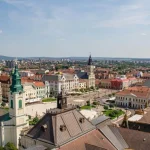
Bucharest is the vibrant capital of Romania and one of the largest cities in the Balkans. It is a city with a turbulent history, but nowadays an attractive modern city that is ideal for a city break or the starting point of a tour through beautiful Romania.
The city, also known as Little Paris, has a lot to offer in terms of architecture, history, and culture. Its somewhat rougher post-communist image, with street art, art galleries, events, hip cafes, and a vibrant nightlife, has even earned the city a second nickname: New Berlin.
So there’s no reason to ever get bored in Bucharest. Below, you can read our tips for the 30 best things to do there.

1. The Old City
The Old Town is the historic center surrounding the famous Lipscani Street (Strada Lipscani) and is therefore also known as the Lipscani neighborhood.
In the past, this was the commercial trading center and home to the Princely Court, but today the Old Town is the epicenter of nightlife and is packed with restaurants, cafes, and nightclubs.
It is also the main tourist area during the day, as it is essentially one large open-air museum featuring beautiful Belle Époque architecture, various other attractions, and a number of museums.

2. Stavropoleos Monastery
One of the most important sights to visit in the old town is the Stavropoleos Monastery. The church was built in 1724 by a Greek innkeeper on the grounds of his inn.

Over time, the inn and most of the monastery were demolished, but the Byzantine church with beautiful Baroque and Oriental decorations and murals has been preserved. The library with more than 8,000 old books and a colonnade with old tombstones can also still be found here.

3. Curtea Veche Church
The Curtea Veche Church (literally: Old Court Church), also known as the Church of Saint Anthony, is the only remaining church of the four churches that once stood in the Princely Court. The church dates from the 16th century, and the bell tower was built in 1691.
Both structures were struck by fires and earthquakes on multiple occasions, but were eventually restored to their former glory.

4. Have Dinner At An Old Inn
In the old town, you can still find four old medieval inns. Two of them are still operational as restaurants where you can enjoy delicious traditional Romanian food.
Hanu’ lui Manuc (Manuc’s Inn) dates back to 1808 and has also been used over time for important political meetings that led, among other things, to the Treaty of Bucharest of 1812 and the Grand Union of 1918.
Caru’ cu Bere (The Beer Wagon) dates from 1899 and features a beautiful interior with wood carvings and murals.

Hanul cu Tei (The Linden Tree Inn), dating from 1833, currently houses several art studios and galleries, a conference room, and a pub, while Hanul Gabroveni (Gabroveni Inn), dating from 1739, is now a cultural center with student accommodation.

5. Little Paris Museum
At the Little Paris Museum (Muzeul Micul Paris), you can see how the wealthy, aristocratic population lived during that time. This small museum in the heart of the old city consists of a number of rooms furnished with furniture, decorations, clothing, and other items from the Belle Époque.

Bucharest received the nickname “Micul Paris” (Little Paris) during the Belle Époque, the era of the second half of the 19th century and the beginning of the 20th century, in which the city was heavily influenced by the Paris of that time in terms of architecture, culture, and fashion.

6. Victory Avenue
Victory Avenue (Calea Victoriei) is Bucharest’s most famous street and the first road paved with wood in 1692. The historic boulevard stretches from the old center to Victory Square in the north.
Victory Avenue is one large open-air museum featuring beautiful architecture, primarily from the Belle Époque. A walk here is highly recommended, as the route takes you past beautiful facades of chic hotels, palaces, and villas belonging to the former aristocratic population.


Among the highlight are the former Royal Palace, the Carol I Central University Library, the Romanian Athenaeum, the National Military Circle, and the Odeon Theater.
Moreover, Victory Avenue is one of the city’s liveliest streets, as it is also home to plenty of shops, cafes, and restaurants.

7. Revolution Square
Also located on Victory Avenue is Revoultion Square (Piața Revoluției), originally the Palace Square (Piața Palatului), named after the Royal Palace in front of which it stands.
The square is best known as the epicenter of the Romanian Revolution of December 1989. After the fall of the Berlin Wall, Eastern European unrest reached Romania, and dictator Nicolae Ceaușescu thought he could calm tempers with a speech in which he made various promises, such as wage increases.
To fill the square, a crowd of about 100,000 workers was arranged to convey his popularity on national television with flags and cheers. However, the opposite happened, as the gathering escalated into a massive uprising.
People came out of their homes en masse to demonstrate, and eventually the Communist Party building (now the Ministry of the Interior) was stormed, with Ceaușescu fleeing by helicopter from the roof. Later, he was arrested and sentenced to death.

After the revolution, the square was renamed Revolution Square, and a monument was erected in memory of the events and the victims. The Memorial of Rebirth (Memorialul Renașterii) represents the rebirth of the country and consists of an enormous white column piercing through a dark cloud, symbolizing the Romanian people who survived through communism.

8. Romania Athenaeum
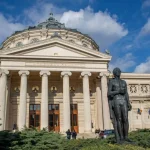
A bit further north on Victory Avenue stands the Romanian Athenaeum (Ateneul Român), considered one of the most beautiful buildings in Bucharest. This dome-shaped concert hall was built in 1881 based on the design of the French architect Albert Galleron.
Inside, the dome is beautifully decorated, featuring, among other things, an enormous mural measuring 75 by 3 meters, depicting various scenes from Romanian history. In front of the entrance stands a statue of the national poet Mihai Eminescu.

Of course, the best way to experience this is by attending a classical concert, but as an alternative, you can also buy a ticket for a few lei to visit the building outside of performances.

9. Palace Of The Parliament
When visiting Bucharest, you can hardly miss the enormous Palace of the Parliament (Palatul Parlamentului), because this is the largest government building in Europe and, after the Pentagon, the largest in the world.
However, the enormous complex, which is also called the House of the Republic or the People’s Palace, has a dark past, because its construction required the demolition of a large part of the city.
After the major earthquake that hit Bucharest in 1977, Nicolae Ceaușescu saw his opportunity to rebuild the city with imposing buildings and wide and long boulevards as he had seen during his visits to China and North Korea.
The enormous palace was to become his own presidential residence, but construction was not yet completed when the 1989 Revolution threw a spanner in the works of his controversial plan.


The palace was eventually completed and currently houses the Senate and the Chamber of Deputies of Romania. The building is also used as an exhibition center, and house the National Museum of Modern Art.
Visitors can take a guided tour of part of the building, during which you can visit some of the beautiful halls.

10. Ceaușescu’s Mansion
A visit to Ceaușescu’s Mansion, the former villa of Nicolae Ceaușescu and his wife Elena, is also worthwhile to learn more about Bucharest’s communist period.
Through a tour of the various rooms of the villa you can get an insight into the extravagant lifestyle of the former dictator and his family. Peacocks, Ceaușescu’s favorite animal, still roam the garden.

The house is also called the Spring Palace (Palatul Primaverii) and was built in 1965, during the time of Ceaușescu’s predecessor Gheorghe Gheorghiu Dej, for official meetings.
Ceaușescu later used it as his permanent residence and had the house expanded and modernized with all kinds of luxurious amenities such as a swimming pool, a sauna and even his own hair salon.

11. Bucur Church
At first glance, the Bucur Church on the banks of the Dâmbovița River appears to be just another church, yet this small church is regarded by some as the oldest church in the city.
There is, however, some controversy surrounding the church’s origins. According to some historians, the church was not built until the 17th century, while others believe it was built in 1568 by a shepherd named Bucur. According to a legend, this Bucur founded the city with the construction of the church, and Bucharest was therefore named after him.
Whatever the truth may be, the Bucur Church, with its mushroom-shaped dome, is in any case a remarkable historical church.

12. Radu Vodă Monastery
On the hill right next to the Bucur Church, you can also visit the Radu Vodă Monastery, which was founded in 1508 by Mihnea cel Rău and rebuilt in 1568 by Alexandru II Mircea, the great-grandson of Vlad Dracula.
During the brief Ottoman occupation at the end of the 16th century, the church was converted into a mosque. When the Ottomans had to withdraw, they set the church on fire.
The current new church was built in 1625 by Radu Vodă Mihnea, and thus the monastery received its name. Next to the church, there is also a bell tower and a school building.

13. Royal Palace Of Bucharest
The former Royal Palace of Bucharest is also highly recommended for a visit. Today, the palace houses the National Museum of Art of Romania, featuring the country’s most important and largest historical art collection.
The museum consists of three parts: the national collection with religious art pieces and works by famous Romanian artists, and two European collections.

The regular European art collection is grouped by country, and includes works by painters from France, Italy, the Netherlands, and the United Kingdom.
Finally, there is a collection of European decorative art, including furniture, textiles, ceramics, glassware, and other decorative art.

Even if you do not like art, it is worth visiting the palace, as you can purchase a separate ticket to visit only the beautiful ceremonial halls: the Throne Hall, the Royal Dining Room, and the Princely Staircase.

14. Cotroceni Palace
Another former royal palace to visit is the Cotroceni Palace, currently the residence of the President of Romania.
Unfortunately, simply dropping by for coffee with the president is not an option, as this complex consists of multiple buildings and wings, and only a portion of it can be visited via a guided tour. Reservations are required, and you must also bring your passport or identity card.

15. Bărăția Church
Just outside the old town, across from Bulevardul Ion C. Brătianu, stands the Bărăția Church, whose beautiful bell tower is particularly striking. What makes this church special is that it is the oldest Catholic church in the city. Although the church has been rebuilt several times, its history dates back to the 14th century.

16. New Saint George Church
A little further on stands the New Saint George Church, whose history dates back to the 15th century. The current version of the Orthodox church was built in 1705 on the orders of the Wallachian Prince Constantin Brâncoveanu. It is therefore no surprise that the church features a typical Brâncovenesque style.
The Kilometer 0 Monument, the reference point for distances between Bucharest and other cities in Romania, can also be found in the park surrounding the church.

17. National Museum Of Romanian History
If you want to learn more about the history of Romania, you should definitely visit the National Museum of Romanian History, which is located in the monumental post office in the old town.


The museum consists of about 60 exhibition spaces and covers an area of over 8,000 square meters, so you can easily spend quite some time here. The museum starts with prehistory and takes you through time using archaeological finds and historical objects.
The museum also houses a treasury with beautiful jewelry, gold and silver objects, and crowns of the royal house, as well as a lapidarium featuring, among other things, a replica of the Column of Trajan.

18. Bucharest Municipality Museum
The Bucharest Municipality Museum focuses specifically on the history of the city itself and is housed in the monumental Suţu Palace from 1835.
The exhibition takes you from prehistory through key events such as the Great Fire of 1847 and the subsequent reconstruction with Parisian influences, the communist era and the earthquake of 1977, and Ceaușescu’s subsequent plans for the demolition and reconstruction of large parts of the city.

19. Stroll Through The Jewish Neighborhood
To the southeast of the old center lies the Jewish quarter of Bucharest. This is the perfect neighborhood to get off the beaten path as you won’t find many tourists here, which is exactly why it is interesting to walk through and discover its hidden gems.
Bucharest had a flourishing Jewish community, particularly from the 19th century onwards, but since the Second World War and the exodus to Israel, the remaining community is small.
The most important surviving synagogue is the Choral Temple from 1864, the only one that is still active as a house of prayer.

Other surviving synagogues that are no longer used as such are the Great Synagogue, which currently houses the Romanian Holocaust Museum, and the Holy Union Temple, now the Museum of Jewish History of Romania.
To the east of the old town, you can also visit the Holocaust Memorial, which consists of a central monument, a memorial column, and various symbols including a Roma wheel and a Star of David.

20. Enjoy The Tranquility In The Many Parks
Bucharest is a busy city that can be somewhat overwhelming, but between the traffic and the concrete building there’s actually also plenty of greenery. Some of the city parks are even gigantic, offering an ideal escape from the hustle and bustle without having to travel far.
Right next to the old center lies the Cișmigiu Garden, with beautiful flowers and a huge pond where you can rent pedal boats. To the north lies the gigantic King Michael I Park surrounding Lake Herăstrău, where there is plenty to do, such as cycling and boat tours.

To the south are the Youth Park, with a lake and an amusement park for children, and the Văcărești Natural Park, a pristine nature reserve.
In addition, there are countless smaller parks, so there is always a patch of green nearby, which makes the city very livable.

21. Triumphal Arch
Bucharest is not called Little Paris for nothing, as it even has its own Arc de Triomphe. This 27-meter-high Triumphal Arch (Arcul de Triumf) was built in 1922 to commemorate the Romanian victory in the First World War and the coronation of King Ferdinand I.

22. Bellu Cemetery
When planning a city trip, visiting a cemetery isn’t the first thing that comes to mind, yet the Șerban Vodă Cemetery, better known as the Bellu Cemetery, is an interesting place to take a stroll.
This is not just any graveyard, but the largest and most important in the city. Consequently, it is the final resting place of many famous figures from Romanian history, such as prominent politicians, wealthy aristocrats, inventors, famous writers and poets, and various artists.
Here, you will rarely see boring gravestones, but rather complete works of art and tombs, each one more beautiful than the last.

23. National Village Museum Dimitrie Gusti
In good weather, a visit to the Dimitrie Gusti National Village Museum is highly recommended. This open-air museum in the King Ferdinand I Park offers en immersive glimpse into the historic Romanian countryside more than 100 typical traditional houses from all parts of the country.
The original houses date from the 17th to the 20th century and have been moved to the museum from various regions, representing the different cultures and architectural styles of Romania.


Some houses are open and furnished with traditional furniture and other items so you can see how people used to live in the countryside. There are also several other buildings on display, such as churches, windmills, and watermills, as well as wooden wagons, plows, and other agricultural tools.

24. National Museum Of The Romanian Peasant
Another place to discover more of Romanian rural life is the National Museum of the Romanian Peasant, which offers a mostly indoor experience.
This museum has a collection of more than 100,000 items related to traditional rural peasant life, including traditional clothing and other textiles, furniture, tools, woodcarvings, ceramics, and other ethnographic objects.

The museum also houses a traditional wooden house furnished like a typical household, and in the museum’s courtyard stands an 18th-century wooden church.

25. Patriarchal Cathedral And Palace
Just south of the old center lies Metropolitan Hill (Dealul Mitropolitiei), an important historical, religious, and political site in the history of Bucharest.
In the 17th century, the Wallachian Prince Constantin Șerban built a monastery here that grew into a place where the city’s aristocratic elite met and made important decisions.
The Patriarchal Cathedral of Bucharest is one of the original buildings of the complex that has survived the test of time. The cathedral, dedicated to the Holy Emperors Saint Constantine and Helena, has undergone a significant metamorphosis over the years.

In 1907, the Palace of the Chamber of Deputies was built to replace the older meeting rooms that were no longer adequate. After the Chamber of Deputies moved to the Palace of Parliament in 1997, the monumental building was transferred to the Orthodox Church.
The neoclassical building, with its beautiful colonnade and enormous dome, is now the Palace of the Patriarchate.
Next to the cathedral and the palace stands the Patriarchal Residence and Chapel, which also belong to the original buildings but have been expanded over time.

26. National Military Museum
Over the centuries, many wars and battles have been fought in the territory of present-day Romania, so it makes sense that there is also a museum dedicated to warfare in the capital.
At the King Ferdinand I National Military Museum, housed in a former military barracks, you can view an extensive collection of weapons ranging from prehistory to modern times.

27. Dâmbovița Promenade
The Dâmbovița is the river that flows right through the center of Bucharest, and despite the potential this offers, there are still very few places for recreation along this river.
The only place where you can sit comfortably by the water with a snack or a drink is on the Dâmbovița Promenade. This boulevard is located on the east side of Piața Unirii, and various cafes and restaurants with terraces can be found here.

28. Watch The Fountain Show On Union Square
Union Square (Piața Unirii) is located directly south of the historic center and is part of the massive Union Boulevard built by Ceaușescu, intended to be the socialist equivalent of the famous Champs Élysées in Paris (but longer, of course).
In the median strip of this boulevard, no fewer than 44 fountains are spread over a length of 1.4 kilometers, the longest series of synchronized choreographed fountains in the world.
During the summer period, a beautiful fountain show takes place here on weekend evenings. The fountains spray to the rhythm of music and are illuminated in various colors.

29. Enjoy The Nightlife
Bucharest didn’t earn the nickname ‘New Berlin’ for nothing, as the city is known for its vibrant nightlife that continues into the early hours. The Old Town, in particular, is popular among tourists due to the enormous number of bars, pubs, and clubs, and it is therefore always busy here, especially on weekends.
Elsewhere in the city, countless trendy cocktail bars, craft beer pubs, and nightclubs can also be found, such as in and around Calea Victoriei, but there are also several nightclubs along Lake Herăstrău that are particularly popular among the local nightlife crowd.

30. Therme Bucharest
If you really want to unwind (for example, after a heavy night out), you can relax wonderfully at Therme Bucharest. This enormous spa resort complex truly has everything for a day to yourself, such as thermal baths, saunas, and massages.