The Princely Church of Saint George (Biserica Domnească Sfântul Gheorghe) is a historic Romanian Orthodox church in the center of Pitești, built in 1656 by Constantin Șerban, Prince of Wallachia, and his wife, Doamna Bălașa. Its foundation inscription records the completion of the church on May 13, 1656, during the prince’s short reign from 1654 to 1658. Dedicated to Saint George, it was one of the major princely foundations of the period, alongside the church built by Constantin Șerban on the site of the present Patriarchal Cathedral in Bucharest.
The church also played a role in the religious and educational life of Pitești. A princely school operated beside it from at least the mid-18th century until the reorganization of public education in 1864. Its status as a princely foundation gave it particular prominence among the town’s churches, and in 1862 the municipal council recognized its precedence over Mavrodolu Church in a dispute concerning the right to serve as the city’s cathedral.
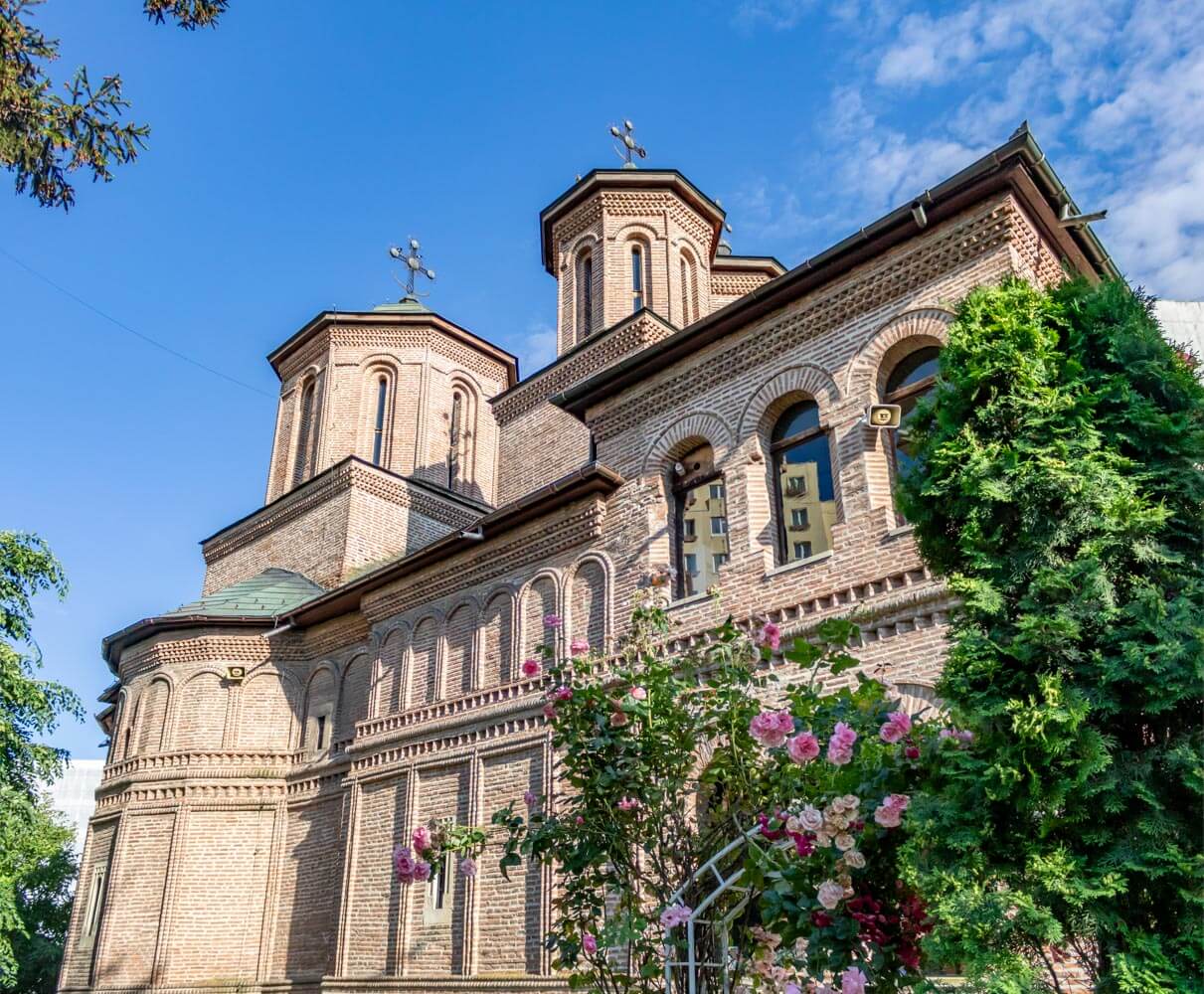
Built on a trilobed plan, the church has a large central tower above the nave and two smaller towers above the narthex. Its exterior is distinguished by exposed brickwork, with rows of blind arches, recessed panels, ornamental brick bands, and carved stone surrounds around the doors and windows. The most unusual architectural feature is the two-story entrance porch, where a raised gallery supported by brick columns also serves as the bell tower. This arrangement was an innovation in 17th-century Wallachian church architecture, combining the entrance porch and bell tower in a single structure. The lower level has seven rounded arches resting on octagonal columns, while the upper gallery has a series of smaller, more slender arches.
The church underwent major alterations following a devastating fire that swept through Pitești in August 1848. The flames destroyed its wooden roof and damaged the bell tower, causing the bells to fall, although the main masonry structure survived. Repairs during the following decades introduced architectural changes, including a new bell tower with Neo-Gothic and classical elements, an additional entrance space, and alterations to the original towers. By the late 19th century, the building had lost several features of its 17th-century appearance.
During the communist-era redevelopment of central Pitești, the church narrowly escaped demolition in 1962. Instead, a major restoration was undertaken between 1964 and 1969 under architect Ștefan Balș. Later additions were removed, the original two-story porch gallery was reconstructed using surviving architectural evidence, and the two smaller towers above the narthex were rebuilt. The restoration gave the church its present appearance, with the historic brick building standing among the modern structures surrounding Central Park and Vasile Milea Square.
Inside, the narrow narthex opens into the nave through three arches supported by octagonal columns, while the small windows create a relatively subdued interior. The paintings in the nave were executed in a neoclassical stylein the 19th century by Gheorghe Stoenescu, a pupil of Gheorghe Tattarescu. They include large representations of military saints and scenes from the life of Christ. The frescoes in the narthex were completed between 1971 and 1974 by Gheorghe Popescu and Niculina Dona, including a votive portrait of Constantin Șerban and Doamna Bălașa. The carved wooden iconostasis, decorated with floral motifs and twisted columns, is another prominent feature of the interior.