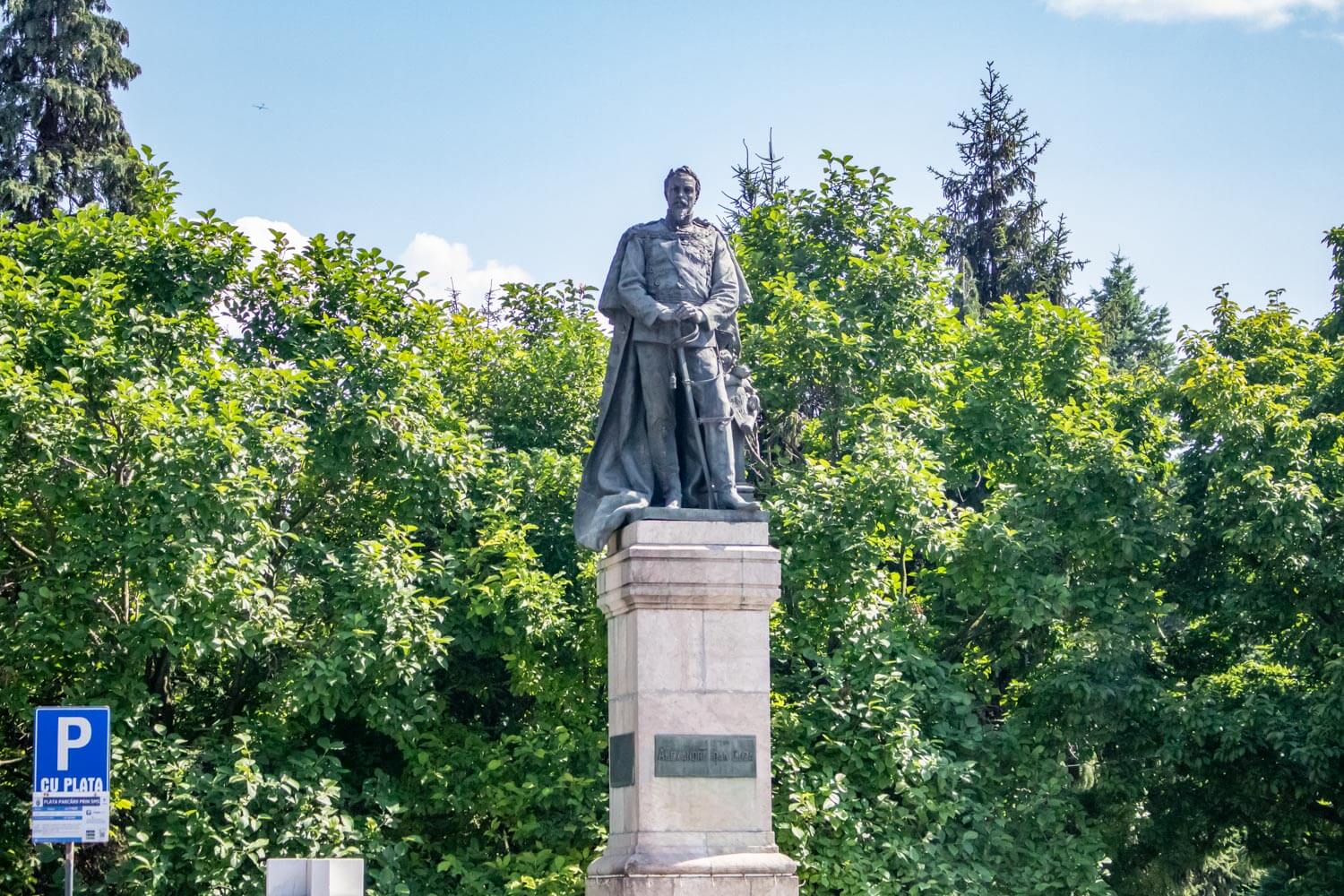
The Statue of Alexandru Ioan Cuza (Statuia lui Alexandru Ioan Cuza) is a bronze monument at the northern edge of the English Park in central Craiova, created in 1912 by Italian sculptor Raffaello Romanelli. It depicts Alexandru Ioan Cuza, who ruled Moldavia and Wallachia from 1859 to 1866 and laid the foundations of the modern Romanian state. Standing in military uniform with a princely cloak over his shoulders, Cuza holds a sword with both hands. The stone pedestal bears inscriptions describing the political, social, and educational reforms of his reign.
The monument was commissioned by Craiova politician Mișu N. Popp, who wanted to honor Cuza’s achievements despite opposition from influential local figures who had resisted the ruler’s reforms. Romanelli produced the statue in Florence, using the same figure he had created for the monument to Cuza in Iași. When the bronze arrived in Craiova in 1912, the municipal authorities refused to provide a suitable public location, forcing Popp to store it in a shed on his property.
During the German occupation of Craiova in 1917, soldiers seized the statue and transported it to Germany to be melted down for military use. Popp appealed to Prime Minister Alexandru Marghiloman, whose intervention with the German military authorities secured its return. Even after the war, the statue spent years in storage because the municipality continued to delay its installation.
In 1935, the city finally provided a site near Hotel Minerva, where the statue was erected on a stone pedestal. Its official unveiling was repeatedly postponed until 1939, although a storm had already blown away its covering several years earlier. The monument was subsequently moved to its present position beside the English Park, opposite the Craiova City Hall.