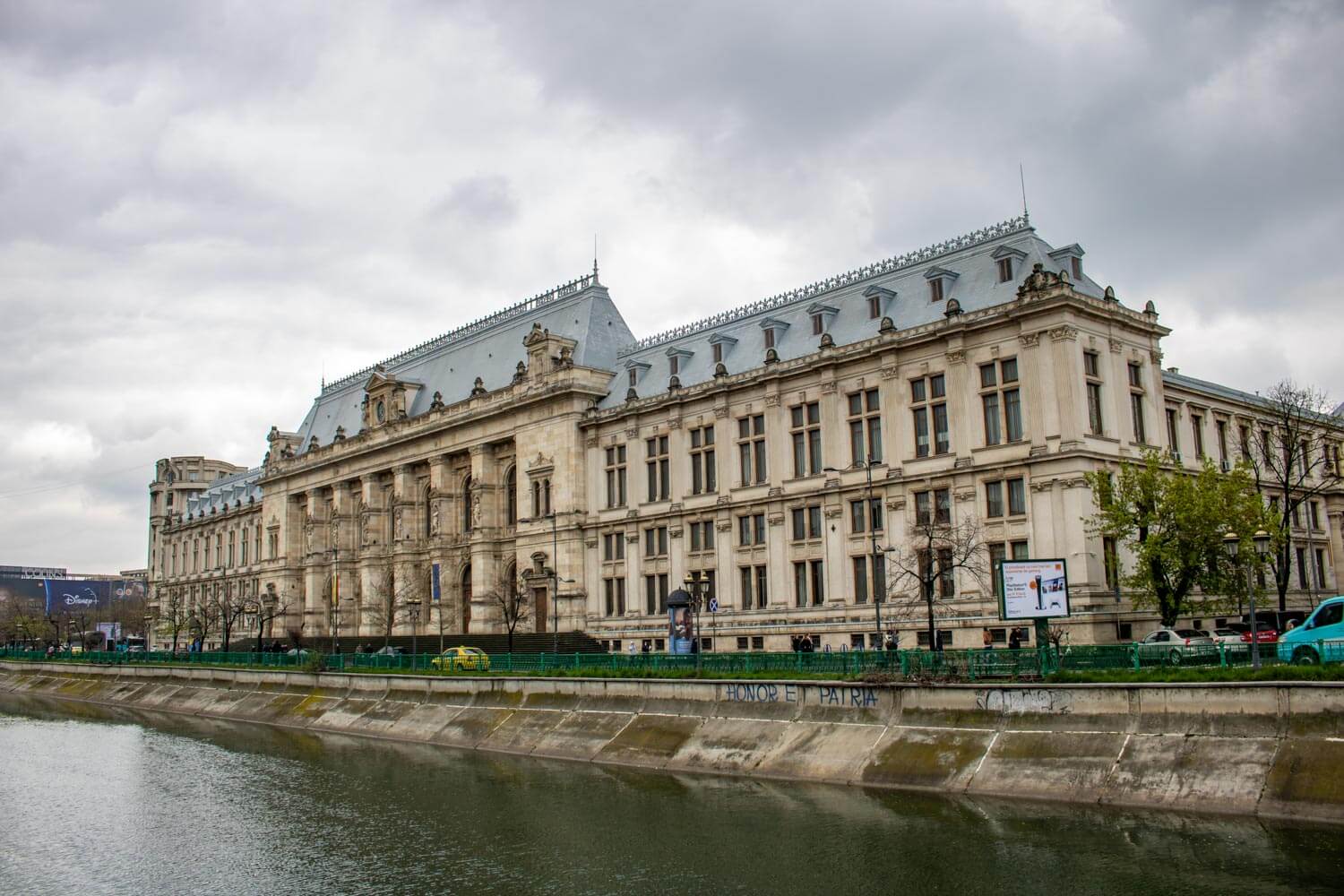
The Bucharest Palace of Justice (Palatul Justiției din București) is a historic monument located on the banks of the Dâmbovița River in the heart of Bucharest.
The building was designed by the architects Albert Ballu and Ion Mincu and contains 690 rooms with a total area of 33,235 m2. The foundation stone was laid by King Carol I on 7 October 1890 and the building was inaugurated on 4 October 1895.
The architectural style of the building is French Renaissance. The central part of the facade is slightly declined and marked by six strong pilasters. Above the main entrance, six allegorical statues are placed, which are the works of the sculptors Karl Storck and his brother Frederic Storck, Wladimir Hegel, and George Vasilescu. From left to right, the statues depict Attention, Vigor, Law, Justice, Eloquence, and Truth. The clock on the roof is flanked by two more statues depicting Strenght and Prudence.
Just like the Palace of the University of Iași, the Bucharest Palace of Justice also has a Hall of Lost Steps, which has the size of a third of one floor of the building. The hall is nicknamed Hall of the Clock, because a clock was installed to measure the ‘course of processes’.
A combination of repeated seismic movements and the fragility of the ground on which the palace was built required frequent reinforcements and restorations of the building. The earthquakes of 1977 and 1986 also caused severe damage and due to its poor condition and a lack of funds for restoration works, the building was vacated in 1988. After the 1989 Revolution it was revealed that Ceaușescu had planned to demolish the Palace of Justice.
The building remained empty for a while, but in July 2003 an extensive renovation project was started which took three years. Now the Palace of Justice houses the Bucharest Court of Appeal and several other judicial institutions.