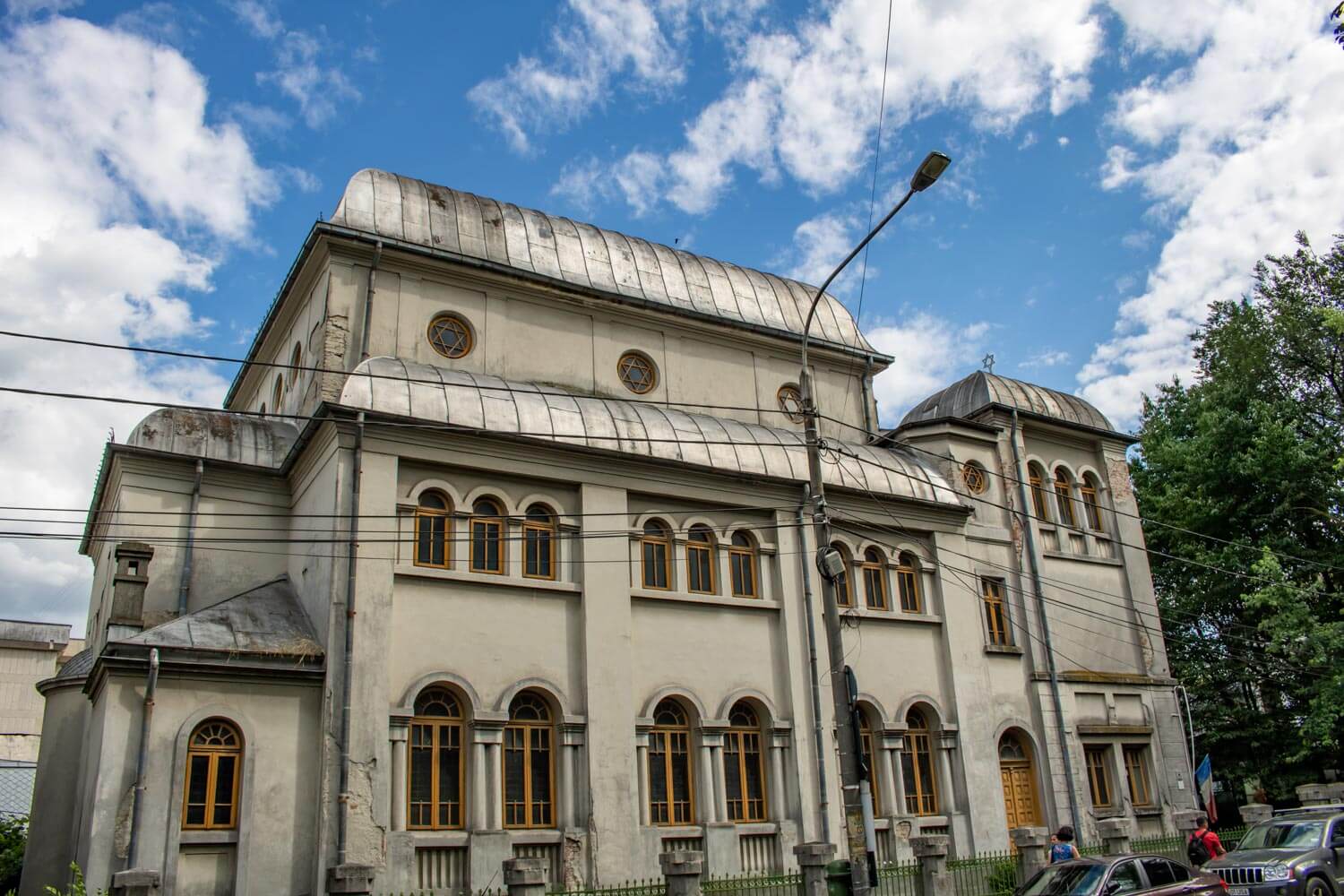
The Pitești Synagogue (Sinagoga din Pitești) is a historic Jewish place of worship built in the early 1920s in central Pitești. Its distinctive architecture combines Moorish Revival influences with elements inspired by traditional Romanian architecture, reflecting the prosperity and established presence of the city’s Jewish community during the early 20th century.
Jewish settlement in Pitești dates back to at least the late 18th century, with the community expanding considerably during the following century. By the middle of the 19th century, it had established a synagogue, ritual bath, and primary school in the town center, providing both religious and educational facilities for its members. The community grew alongside Pitești’s commercial development, with Jewish merchants, craftsmen, and professionals contributing to the local economy. In 1881, the city had approximately 1,500 Jewish residents, representing more than a tenth of its population.
As the community developed, plans emerged in the late 19th century to replace its original synagogue with a larger building. The project eventually proceeded in the early 1920s, when the older synagogue and school were demolished to make way for a new religious and educational complex. Construction was supported by the Jewish community and local benefactors, with the synagogue designed by Austrian architect Jakob Gartner. The adjoining Jewish school was also rebuilt, providing classrooms beside the new place of worship.
The synagogue is a substantial brick building with a tall central prayer hall, whose raised, vaulted roof gives the structure its distinctive profile. Its architecture incorporates Moorish Revival elements, while the exterior decoration draws on Romanian Neo-Brâncovenesc forms and the geometric detailing of early 20th-century architecture. The principal façade faces the square, with its symmetrical composition, arched openings, and ornamental details giving the synagogue a prominent position among the surrounding buildings.
During the Second World War, the Jewish community of Pitești was subjected to discriminatory legislation, economic restrictions, and close surveillance by the Romanian authorities. Its population had already declined from its late 19th-century peak, numbering approximately 400 people during the war. Further emigration, particularly to Israel during the communist period, reduced the congregation considerably, and regular religious services eventually became difficult to maintain.
With only a small Jewish community left in Pitești, the synagogue was closed for extended periods, although it continued to be maintained as a place of worship. In 2021, the building reopened for a religious celebration marking its centenary, accompanied by a concert. Subsequent cultural events, including choral performances, have brought occasional public activity back to the synagogue, while Jewish religious services are held for major holidays.