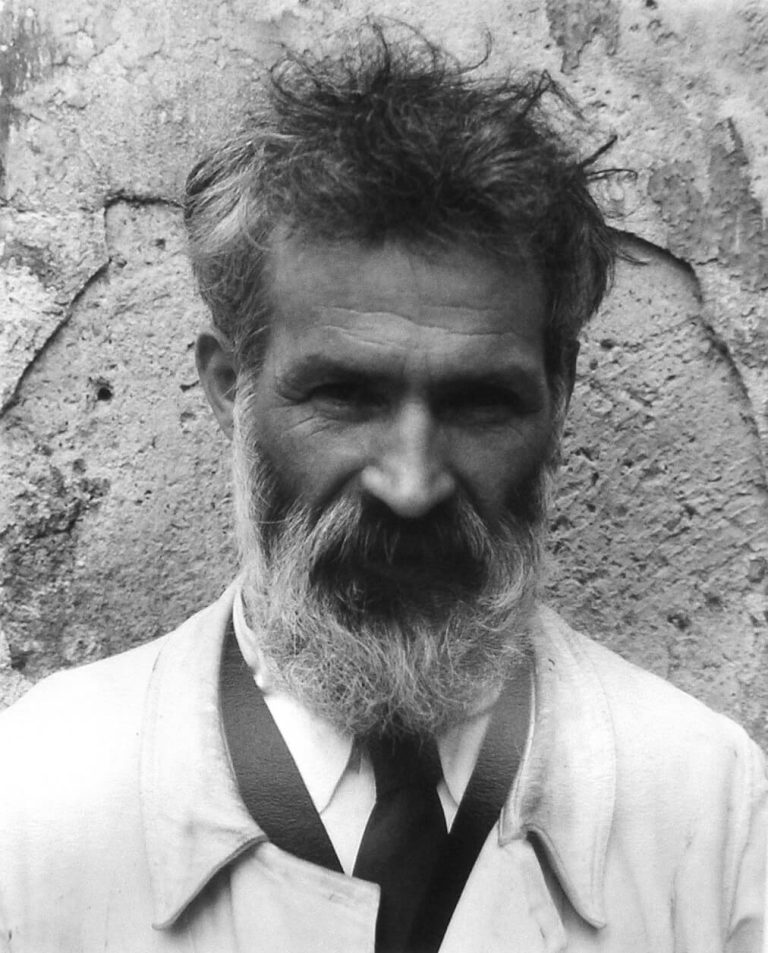
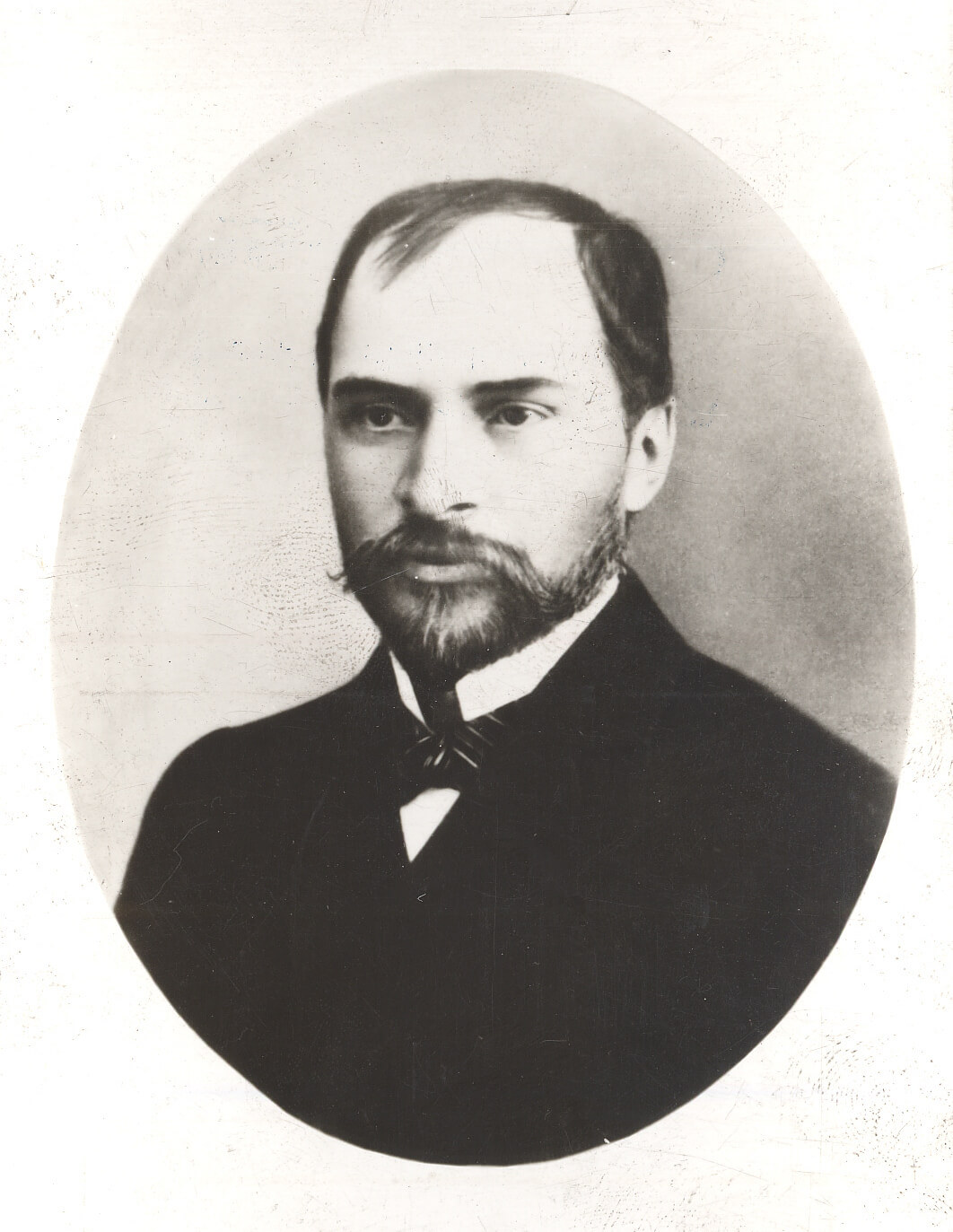
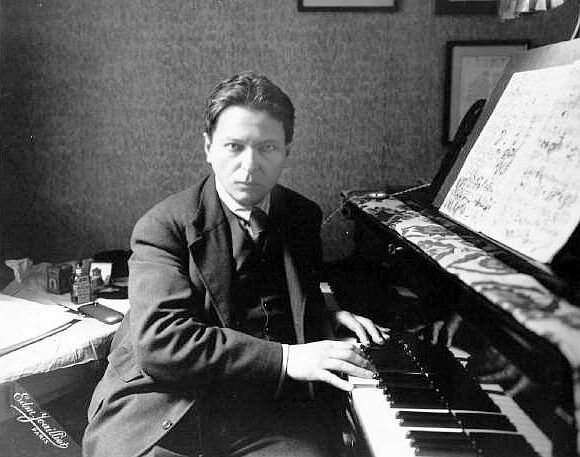
Constantin Brâncuși (1876-1957) was a Romanian sculptor who became one of the most influential figures in the development of modern sculpture. Working in wood, stone, marble, and polished bronze, he gradually reduced people, animals, and natural forms to simple shapes that suggested their essential character rather than reproducing their outward appearance. Works such as The Kiss, Măiastra, Bird in Space, Mlle Pogany, and the Infinity Column placed him at the forefront of twentieth-century modernism and made him one of the most internationally important Romanian artists.
Brâncuși was born in Hobița, Gorj County, and grew up in a rural environment where carved wood, handmade furniture, gates, tools, and other forms of traditional craftsmanship were part of everyday life. After leaving home while still young, he worked in Craiova and eventually entered the city’s School of Arts and Crafts, where his skill as a woodcarver developed into formal artistic training. He continued at the School of Fine Arts in Bucharest, graduating in 1902 before leaving Romania for Western Europe.
When Brâncuși arrived in Paris in 1904, he entered the artistic world that would shape the rest of his career. He studied at the École des Beaux-Arts and briefly worked in the studio of Auguste Rodin, already the dominant sculptor of the period, but soon chose to work independently. Rather than following Rodin’s highly modeled surfaces, Brâncuși moved increasingly toward direct carving in wood and stone, allowing the material itself and the act of carving to play a much greater role in determining the final form.
As he simplified his sculptures, the subjects became less literal without losing their identity. In The Kiss, two human figures merge into an almost single compact block; portraits such as Mlle Pogany reduce the face to an oval, enormous eyes, and a few carefully controlled lines; while the bird sculptures progressively lose wings, feathers, and other anatomical details until Bird in Space becomes a slender vertical form that evokes flight rather than literally depicting a bird. Brâncuși repeatedly returned to the same subjects over many years, changing proportions, materials, surfaces, and bases rather than treating each version as a simple reproduction.
Those increasingly radical forms soon attracted attention far beyond Paris. Brâncuși exhibited at the Armory Show in New York in 1913, gained important collectors in the United States, and became part of the artistic circles surrounding figures such as Marcel Duchamp, Amedeo Modigliani, Fernand Léger, and Man Ray. His polished bronzes and abstracted forms also challenged contemporary ideas about what sculpture was supposed to look like, most famously when a version of Bird in Space became the subject of a United States customs dispute over whether an abstract object could legally be considered a work of art.
The way Brâncuși displayed his sculptures became just as important as the objects themselves. Blocks, geometric bases, carved stools, and other forms were combined and rearranged in his Paris studio so that each sculpture related to the works around it and to the surrounding space. Over time, this concern with sculpture as part of a larger environment moved beyond the studio and reached its most ambitious expression back in Romania.
In 1937-1938 he created the Brâncuși Monumental Ensemble of Târgu Jiu to commemorate those who had died defending the city during the First World War. Rather than designing a single conventional monument, Brâncuși arranged a sequence extending through the city: the Table of Silence, Alley of Chairs, Gate of the Kiss, and the Infinity Column, connected along an axis of about 1.5 kilometers. The ensemble brought sculpture, landscape, engineering, and urban space together into one continuous work and became the only large-scale public project of his career.
Several of the forms used at Târgu Jiu grew directly from ideas he had been developing for years. The repeated rhomboid modules of the Infinity Column evolved from earlier wooden columns and suggest continuation beyond the physical limits of the sculpture, while the Gate of the Kiss transforms the embracing figures of his earlier Kiss sculptures into a monumental form that visitors physically pass through. In Târgu Jiu, ideas that had first developed in individual studio pieces became part of an entire public landscape.
Brâncuși spent most of the rest of his life in Paris and became a French citizen in 1952, but his artistic identity continued to draw on several worlds at once. Romanian folk carving and rural craftsmanship remained important references, alongside African, archaic, and other non-academic artistic traditions and the experimental culture of modern Paris. He died in 1957 and was buried at Montparnasse Cemetery, while his Paris studio and its contents were eventually preserved as part of the collection of the Centre Pompidou.
His work remains especially visible in Romania through the ensemble at Târgu Jiu, which was inscribed on the UNESCO World Heritage List in 2024. The ensemble is the clearest place to experience the scale of his ideas, because there the simplified forms of his sculpture expand into architecture, landscape, movement, and commemoration rather than remaining isolated objects. His birthplace region in Gorj and works held in Romanian museums add other chapters to that story, but Târgu Jiu remains the fullest expression of how radically Brâncuși changed the possibilities of modern sculpture.