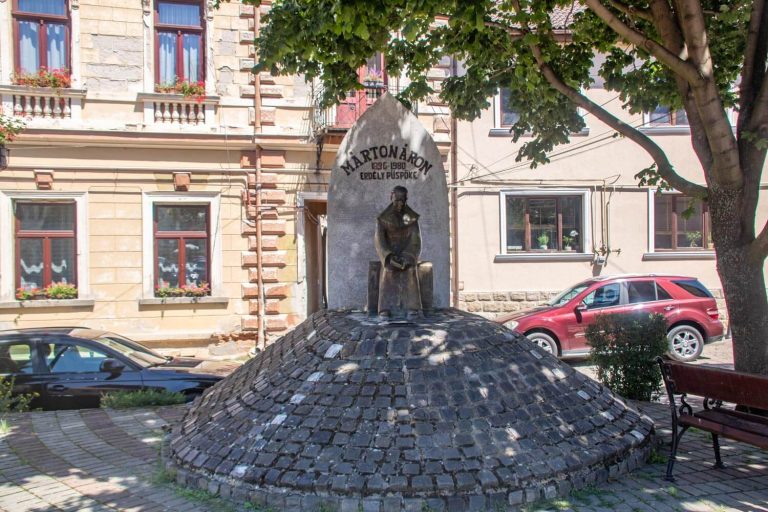
Áron Márton (1896-1980) was the Roman Catholic Bishop of Alba Iulia and one of the most important religious figures in twentieth-century Transylvania. He became widely respected for publicly opposing the persecution of Jews during the Holocaust, resisting communist attempts to control the Catholic Church, and enduring years of imprisonment and house arrest rather than compromise with the regime.
Márton was born in Csíkszentdomokos, today Sândominic in Harghita County, into a Székely Catholic family. His early life was interrupted by the First World War, in which he served in the Austro-Hungarian army and was wounded several times. After the war he entered the priesthood, studied theology at Alba Iulia, and was ordained in 1924, beginning a pastoral career that took him through several Transylvanian communities before he became bishop of Alba Iulia in 1938.
His episcopate began just as Central Europe was moving toward war and dictatorship, and the territorial changes of 1940 placed his diocese across two countries. Northern Transylvania passed to Hungary, while Alba Iulia remained in Romania, forcing Márton to lead a Catholic community divided by a new frontier. That unusual position made his response to the persecution of Jews in Hungarian-controlled Transylvania especially important.
In May 1944, while visiting Cluj, Márton preached in the Saint Michael’s Church against the deportation and persecution of Jews at a time when the city’s Jewish population was already being confined in a ghetto. He subsequently protested directly to the Hungarian authorities and was declared persona non grata in Northern Transylvania, forcing him to return to Alba Iulia. His intervention stood out because it was a public condemnation delivered while deportations were actively under way, not a retrospective statement made after the danger had passed.
The end of the war brought a new confrontation when the communist regime began tightening control over religious institutions. Márton opposed state interference in the Roman Catholic Church and also supported Greek Catholic clergy and believers after their church was outlawed in 1948. His refusal to accept a state-controlled Catholic hierarchy eventually led to his arrest on June 21, 1949.
After two years of detention and interrogation, Márton was sentenced in 1951 to life imprisonment for high treason. He was held at Jilava, Aiud, and Sighet Prison, joining the large group of bishops, politicians, priests, and intellectuals imprisoned there by the communist authorities. When officials later suggested that he request a pardon, he refused because doing so would have implied admitting guilt.
Márton was released in 1955, but freedom remained heavily restricted. After returning to Alba Iulia he resumed his episcopal duties and continued resisting attempts to force the Church into cooperation with the regime, which led the authorities to confine him to the episcopal residence from 1957 onward. Those restrictions were repeatedly extended, leaving him under effective house arrest for years while he continued directing the diocese from Alba Iulia.
Even under those conditions, his influence extended beyond the Roman Catholic community. He supported clandestine Greek Catholic seminarians and clergy, including young men who were secretly admitted to theological studies after their own church had been suppressed. His position made Alba Iulia one of the important centers where Catholic religious life survived despite sustained political pressure.
The restrictions on Márton gradually eased during the later communist period, allowing him to resume pastoral visits before declining health forced him to reduce his activities. He died in Alba Iulia in 1980 after more than four decades as bishop and was buried in the crypt of Saint Michael’s Cathedral, the center of the diocese he had led through war, dictatorship, imprisonment, and political repression.
The places that preserve Márton’s story today reflect the different phases of his life. In Sândominic, his native village, a memorial house and local commemorations focus on his childhood and early years. In Alba Iulia, Saint Michael’s Cathedral contains his tomb and remains the most important setting for understanding his long episcopate, while the Roman Catholic Archbishop’s Palace recalls the years in which he continued leading the diocese under house arrest. At the Memorial of the Victims of Communism and of the Resistance in Sighetu Marmației, his imprisonment is presented within the wider story of the bishops, priests, politicians, and intellectuals persecuted by the communist regime.
Recognition of Márton has continued well beyond those memorial sites. In December 2024, Pope Francis recognized his heroic virtues, an important step in the Catholic Church’s process toward possible beatification, and Romania designated 2026 as the “Year of Bishop Márton Áron.” These later honors reflect the same qualities for which he was already respected during his lifetime: his public opposition to the persecution of Jews, his refusal to submit the Catholic Church to political control, and his willingness to accept imprisonment and isolation rather than abandon those positions.