
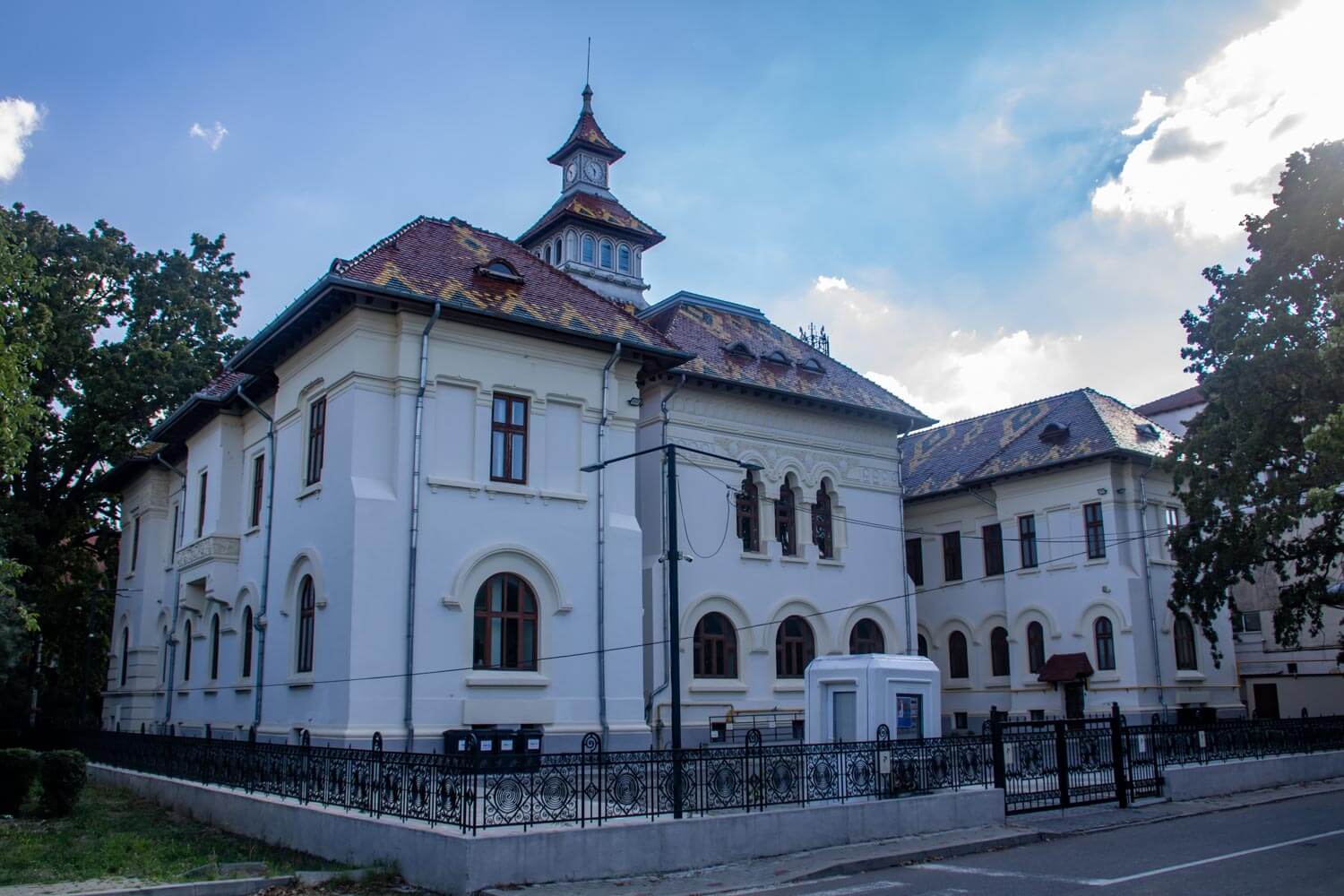
The Putna Administrative Palace (Palatul Administrativ din Putna) is a historic government building in Focșani, constructed between 1913 and 1919 as the headquarters of the former Putna County administration. Designed in the Neo-Romanian architectural style, the restored palace now houses university facilities, including the Focșani location of the Alexandru Ioan Cuza University of Iași.
During the 19th century, the Putna County Prefecture operated from several properties before acquiring the former Caramălău Inn, which also accommodated the county tribunal and other public services. As the old building deteriorated, the county authorities decided to replace it with a purpose-built administrative palace. The inn was demolished in 1912, and construction began the following year according to plans prepared by architects Daniel Renard and Simion Vasilescu. Work was delayed by difficulties with the foundations and the First World War, but the building was provisionally accepted in October 1915 and formally completed in 1919.
The palace served as the Putna County Prefecture until the administrative reorganization of Romania in 1950. A serious fire in 1948 had damaged the roof and parts of the facade, prompting repairs that altered its original appearance. The building subsequently accommodated local government offices and municipal services, but further damage during the earthquakes of 1977 and 1986 eventually forced its closure. After standing unused for many years, it underwent extensive restoration and was made available for university activities in 2021.
The building has a U-shaped plan with a basement, ground floor, and upper story, arranged around a central entrance hall. Its Neo-Romanian facade features an elaborate entrance framed by decorative stonework, with an upper loggia supported by six columns and three-lobed arches. Inside, a large entrance hall with columns leads to two staircases and an upper gallery providing access to the former administrative rooms. The steep tiled roof is decorated with geometric patterns inspired by traditional motifs from northern Moldavia.


