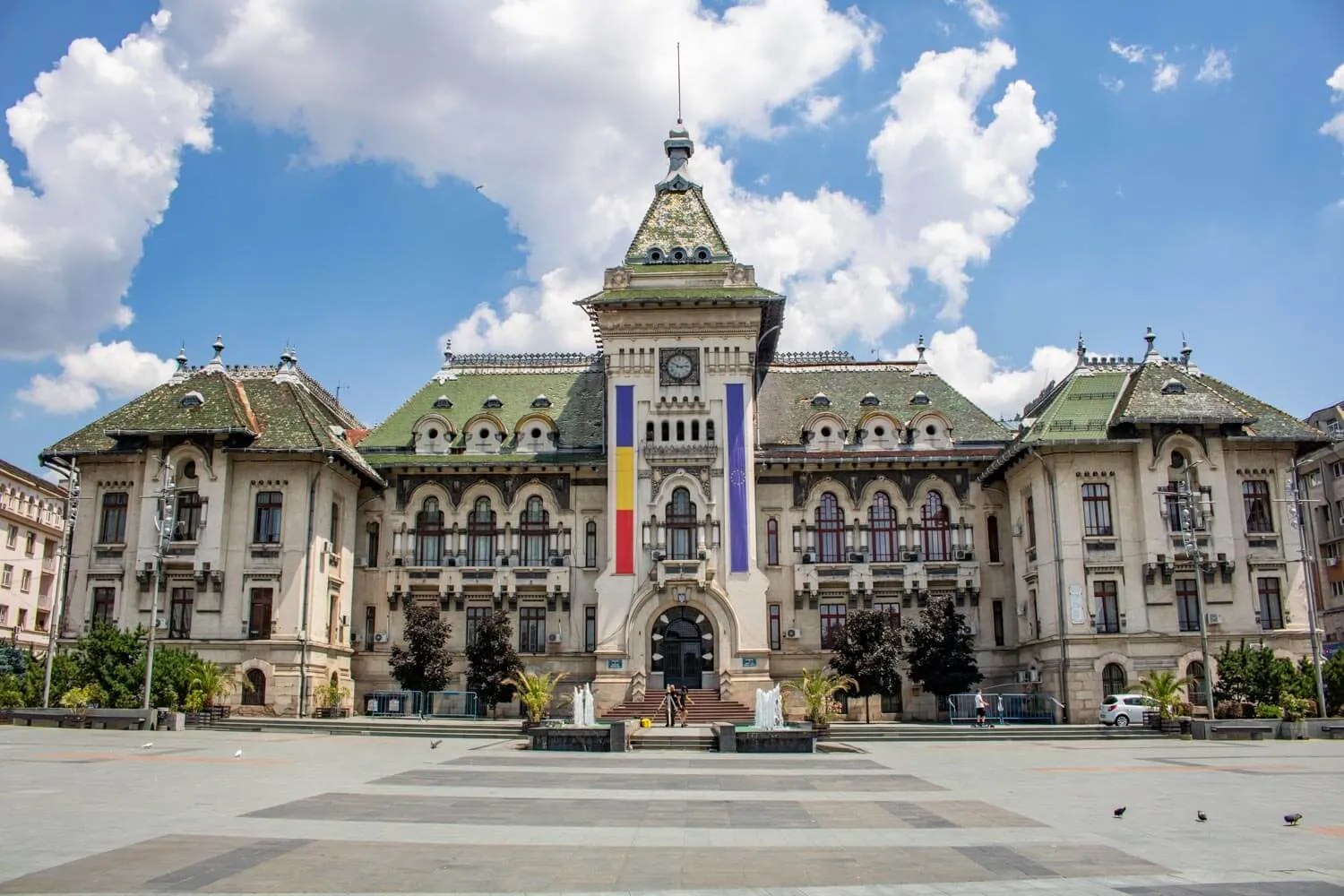
The Vâlcea County Tribunal (Tribunalul Vâlcea) is housed in the former Palace of Justice (Palatul de Justiție), a monumental Neoclassical building in central Râmnicu Vâlcea. Constructed between 1898 and 1900, it was designed to accommodate the county’s judicial institutions and is one of the city’s most prominent historic public buildings.
The palace was built on land acquired by Vâlcea County from the Munteanu and Băbeanu families. Construction began on February 27, 1898, under the supervision of chief engineer Panait, with Ioniță Năstăsescu as contractor. Completed in March 1900, the building was officially inaugurated on September 1 of that year, providing a purpose-built seat for the county tribunal.
The tribunal operated here until 1955, when the building was reassigned to cultural activities and subsequently housed the Râmnicu Vâlcea House of Culture and the Vâlcea County Library. In 1980, it was transferred to the Ministry of National Defense and became the Army House (Casa Armatei), a military cultural institution. Following legal proceedings in 1997, the building was returned to the Ministry of Justice in 1998 and underwent restoration. On November 20, 2000, the Vâlcea County Tribunal moved back into its original premises after several decades in the neighboring former Administrative and Financial Palace.
The palace has an imposing symmetrical façade inspired by classical temple architecture. A broad staircase leads to the central portico, where four Corinthian columns support a triangular pediment above the main entrance. The façade is framed by two substantial wings with regularly arranged windows and decorative classical detailing. Originally, a statue of Themis, the personification of justice, stood above the entrance, holding scales and a sword. The monumental composition reflects the building’s original purpose as a symbol of judicial authority.