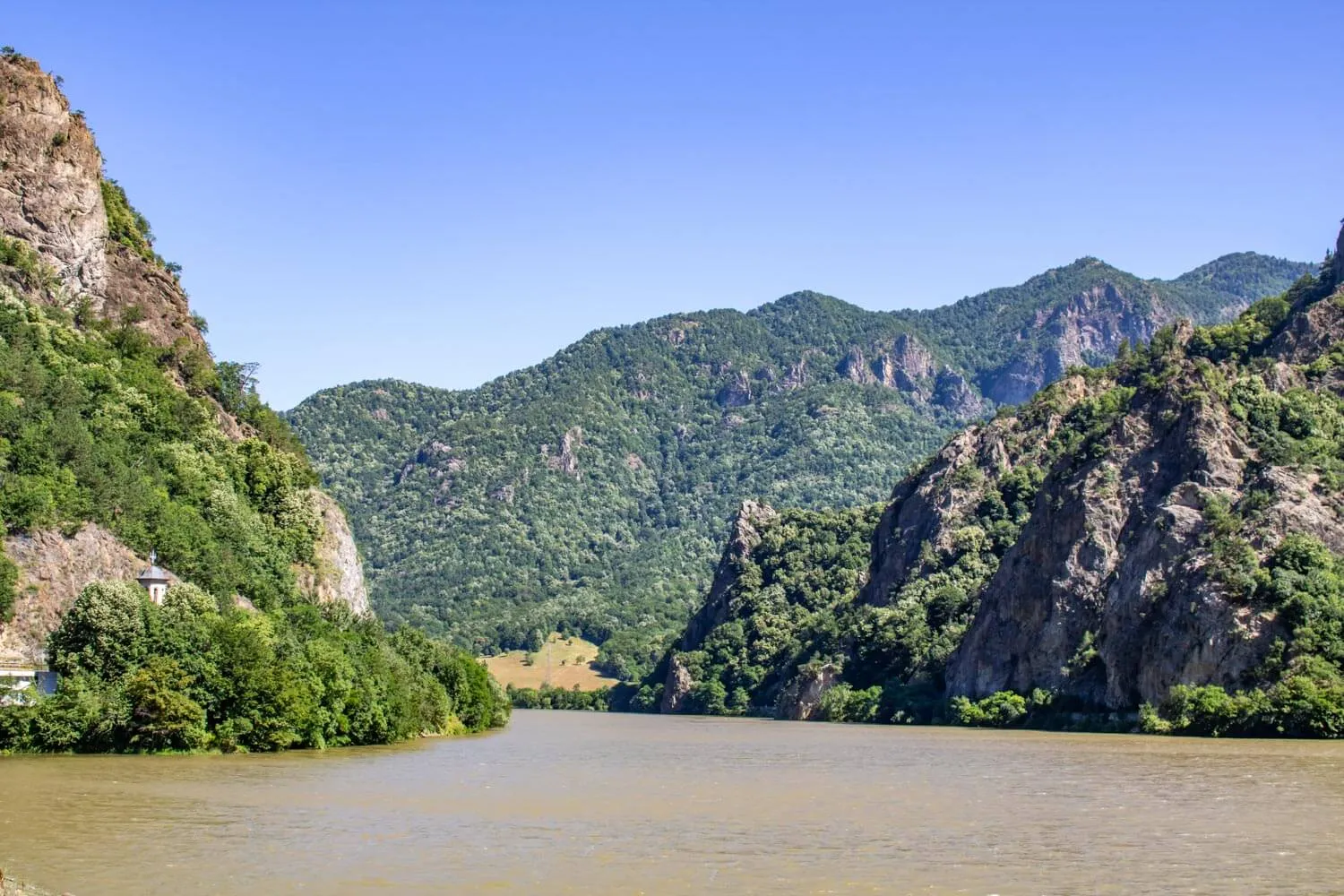
Cornet Monastery (Mănăstirea Cornet) is a Romanian Orthodox monastery in Racovița, Vâlcea County, situated on a rocky slope above the Olt River in the narrow Olt Gorge. Founded in the 17th century, the monastery is known for its historic church, fortified enclosure, and an unusual railway tunnel passing directly beneath its entrance.
The monastery was founded by the Wallachian nobleman Mareș Băjescu and his wife Maria, with construction completed in 1666 under the direction of master mason Dragomir.
The church was dedicated to the Beheading of Saint John the Baptist and built in the architectural style characteristic of churches constructed during the reign of Matei Basarab. Its position on a rocky outcrop above the river provided a naturally defensible setting, reinforced by substantial enclosure walls that gave the monastery the appearance of a small fortress.
The church has a triconch plan, with three projecting apses, a dome above the nave, and a bell tower above the narthex. A smaller stair turret on the northern side provides access to the bells. Its exterior is decorated with alternating bands of exposed brick and plaster, a horizontal ornamental belt, and glazed ceramic details. Inside, the church preserves frescoes from different periods, including paintings completed in the sanctuary in 1761 by Mihai and Radu of Târgoviște and Iordache. Further paintings were executed in the nave and narthex in 1835.
Over the centuries, Cornet Monastery underwent several repairs and reconstructions. A fire in 1808 damaged the complex, while the monastic residential buildings were rebuilt in 1850. A particularly significant change occurred in 1898, when construction of the railway through the Olt Gorge required the demolition of several monastic buildings. The railway was routed through a stone tunnel beneath the monastery’s entrance, creating the distinctive arched structure still visible today. Parts of the historic enclosure, including its defensive walls and a pavilion overlooking the Olt River, survived these alterations.
The monastery suffered further damage during the First World War, when bombardment destroyed the church’s dome and part of the sanctuary. Reconstruction followed between 1923 and 1925, including repairs to the exterior and window surrounds. Another major restoration took place during the 1960s. Later hydroelectric development along the Olt River also threatened the monastery, but protective engineering measures allowed the historic complex to be preserved.