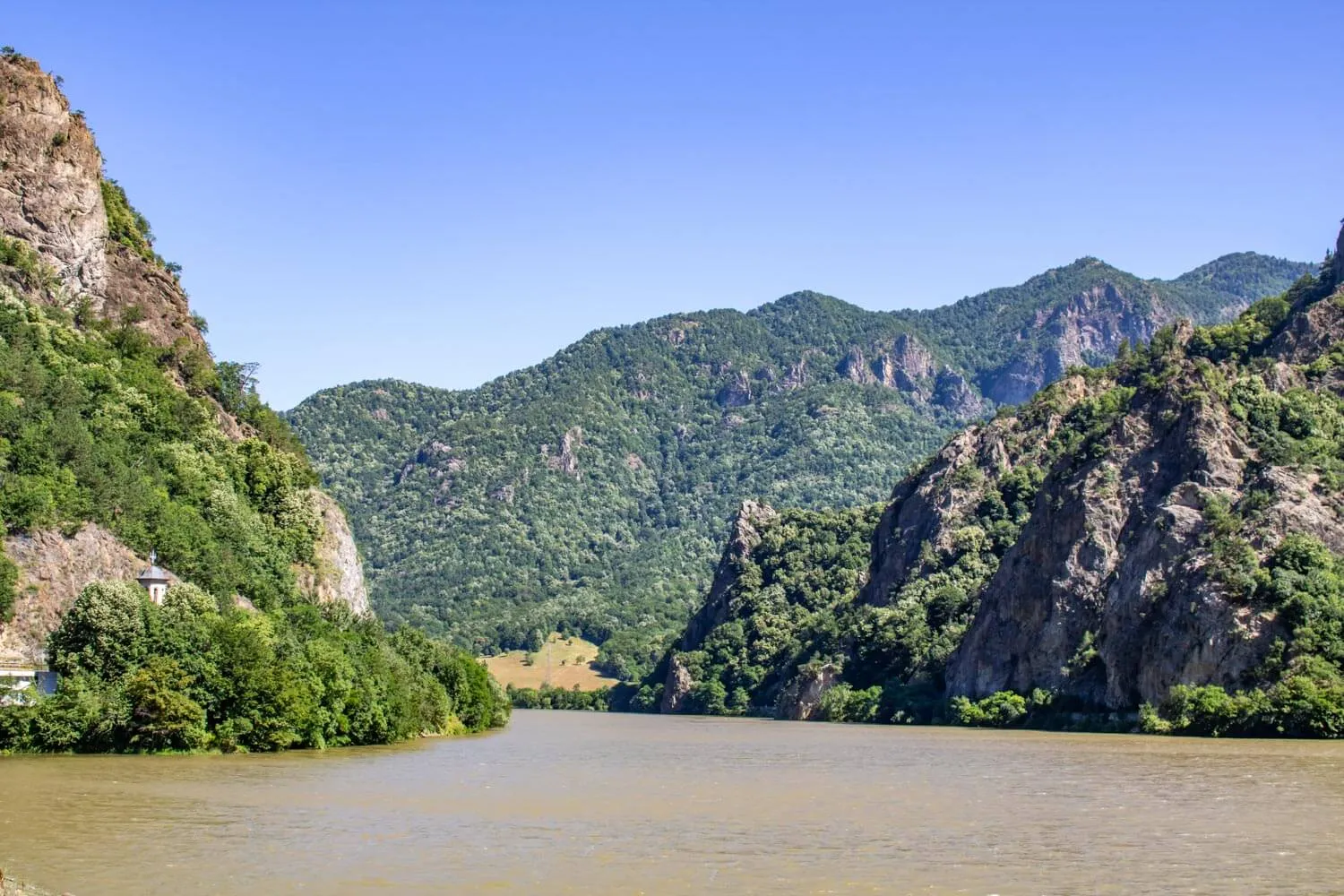
Turnu Monastery (Mănăstirea Turnu) is a Romanian Orthodox monastery at the foot of the Cozia Mountains in Călimănești, Vâlcea County. Situated near the Olt River, approximately two kilometers upstream from the Cozia Monastery, the complex includes two historic churches and several rock-cut hermit cells that preserve the origins of monastic life at the site.
The monastery developed from a community of hermits who settled on the slopes of Mount Cozia during the 15th and 16th centuries. Among them were the monks Daniil and Misail, who lived in small cells carved directly into the rock. Around the middle of the 16th century, Misail gathered a small religious community and established a wooden church dedicated to the Presentation of the Virgin Mary. This became the Turnu Hermitage, which was initially accessible only by mountain paths or by crossing the Olt River.
In 1676, Metropolitan Varlaam of Wallachia, a former abbot of Cozia Monastery and bishop of Râmnic, replaced the wooden church with a small building of stone and brick. The relics of Daniil and Misail were placed beneath its foundations. Originally built without a tower, the church was subsequently modified and decorated, acquiring an appearance modeled on the older church at Cozia Monastery. Dedicated to the Presentation of the Virgin Mary, it stands near the entrance to the complex, surrounded by historic monastic buildings and the surviving rock-cut cells.
The monastery underwent considerable expansion under Bishop Gherasim Timuș of Argeș, who established his summer residence here. Between 1897 and 1901, he commissioned a larger church dedicated to the Transfiguration of Jesus, designed by the Polish architect Anton Lipinschi. Unlike conventional Romanian monastery churches, the new building incorporated the church into the upper floor of a substantial two-story structure, with a refectory below and residential facilities alongside it. The church’s elevated position and central dome give the building its distinctive appearance. Following its consecration in 1901, Turnu was formally elevated from a hermitage to a monastery.
A devastating fire in 1932 destroyed several buildings and severely damaged the old church, including its tower, iconostasis, and interior paintings. Reconstruction began the following year, with the church receiving new frescoes by the painter Belizarie during the mid-1930s. Additional residential buildings were constructed as the complex was restored and expanded.
During the communist period, monastic life was interrupted when the monastery was closed in 1961 and converted into a rest facility for church personnel, following state measures that severely restricted religious communities. It regained its monastery status in 1988, and subsequent restoration and construction work further developed the complex.
Among the most distinctive features are the surviving hermit cells of Daniil and Misail, reached from the monastery grounds and carved into the rocky mountainside. Their small interiors illustrate the secluded conditions in which the first monks lived, contrasting with the larger churches and residential buildings that developed around the original hermitage.