The Saint John Hermitage (Schitul Sfântul Ioan) is a small Romanian Orthodox religious complex on the banks of the Olt River in Căciulata, part of Călimănești in Vâlcea County. Situated north of Cozia Monastery, beside the Turnu hydroelectric reservoir, it is also known as Old Cozia (Cozia Veche). Its present church is a reconstruction of an earlier monastic settlement whose origins are still uncertain.
The hermitage has sometimes been identified as an early predecessor of the Cozia Monastery, possibly founded by Radu I, the father of Mircea the Elder, during the 14th century. However, archaeological investigations have not confirmed this attribution, and the surviving ruins were dated to the 17th century. The earliest documented reference to the hermitage dates from 1601, when Teofana, the mother of Michael the Brave, mentioned two of its monks in a donation to Cozia Monastery.
By the middle of the 17th century, the hermitage had an established religious community and a church dedicated to the Nativity of Saint John the Baptist. In 1657, Patriarch Macarius of Antioch and his traveling companion Paul of Aleppo visited the settlement, describing its church and the hermit who lived there. The church was restored in 1670 and reconsecrated by Metropolitan Teodosie of Wallachia, a former abbot of Cozia Monastery. During the following centuries, the hermitage depended on Cozia, but earthquakes and deterioration eventually left its buildings in ruins during the first half of the 19th century.
During the construction of the Turnu hydroelectric reservoir, the hermitage was relocated to protect its historic ruins from the rising water. Following the relocation in 1986, the church was reconstructed with brick and stone masonry, decorative arches, and a tower above the nave, preserving the architectural character of the earlier building. The interior received new paintings and a carved wooden iconostasis, while a bell tower and additional monastic buildings were erected nearby.
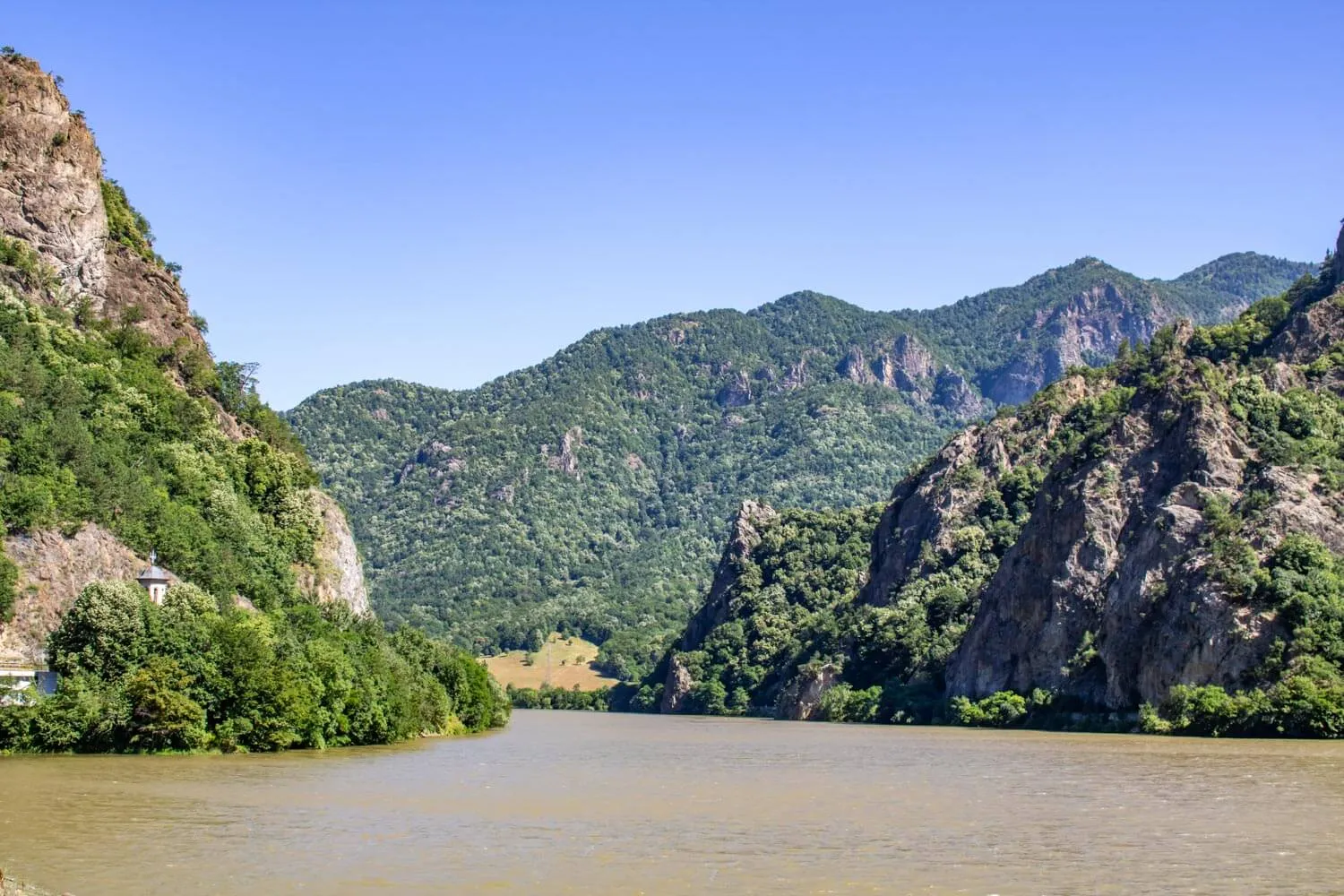
The small complex stands on a narrow stretch of land overlooking the reservoir, with the forested slopes of the Olt Gorge rising behind it. Near the hermitage are the ruins of a Roman tower and a rock known as Trajan’s Table (Masa lui Traian), now partly submerged in the reservoir.