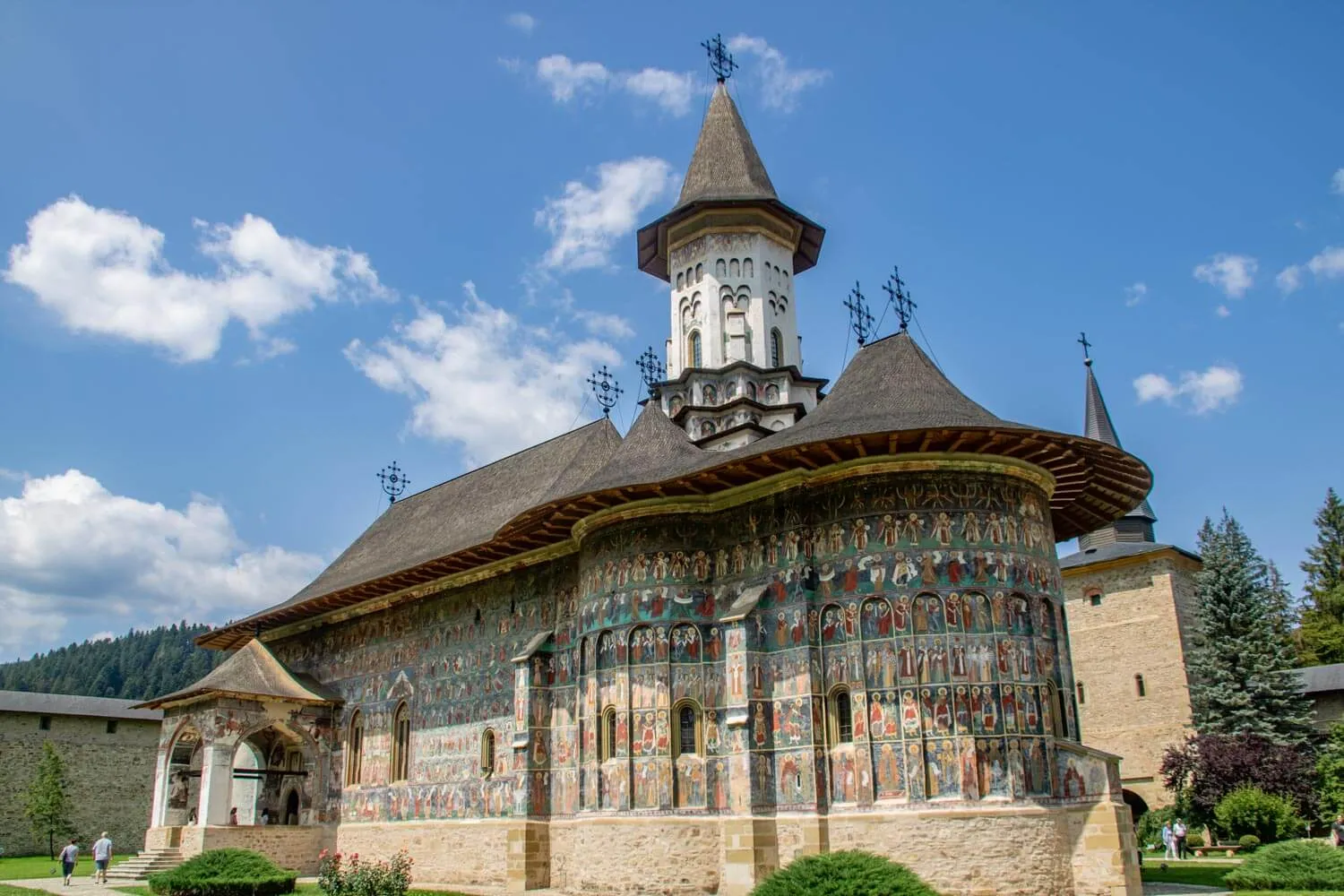
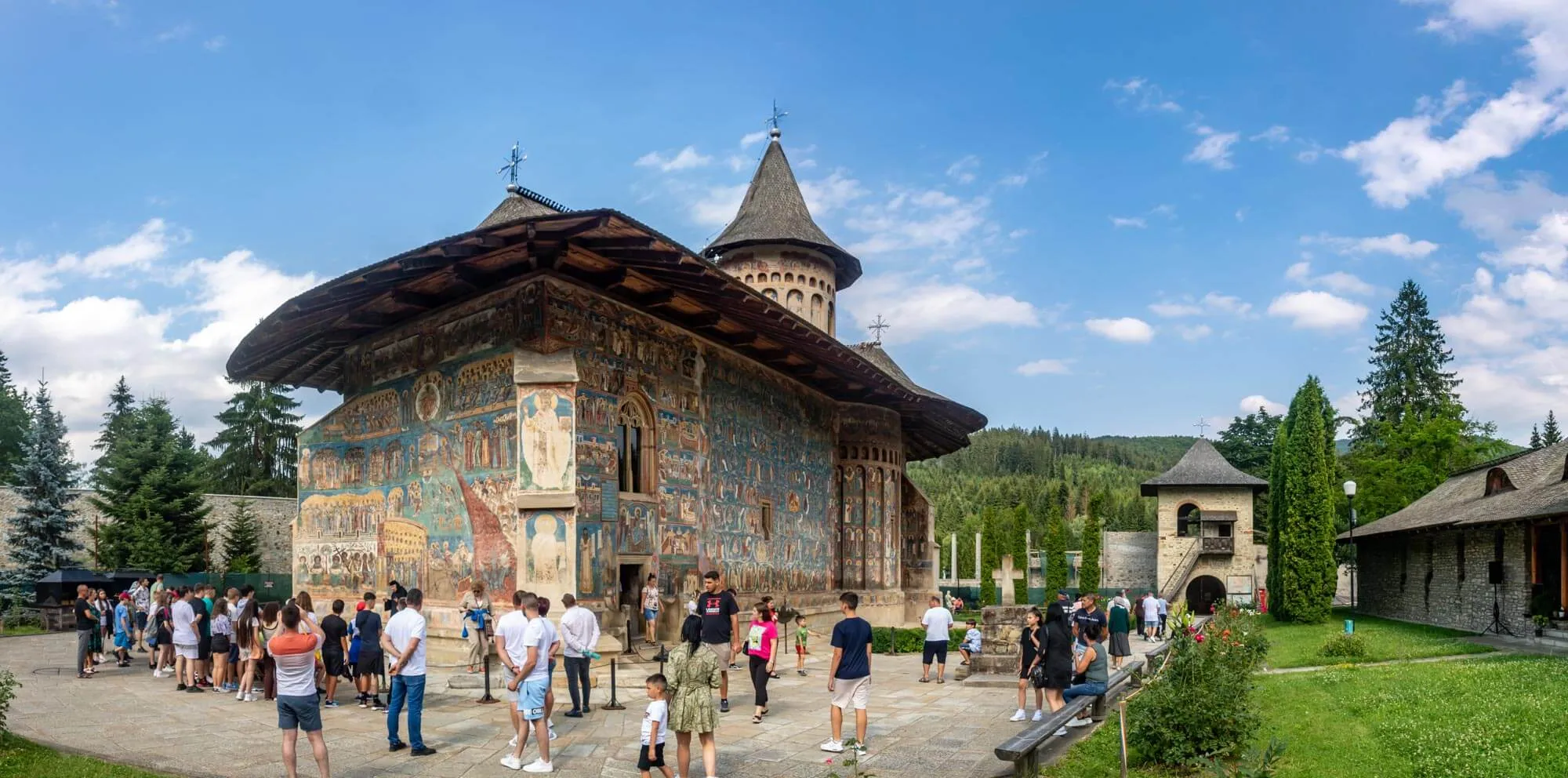
The Moldovița Monastery (Mânăstirea Moldovița) is a Romanian Orthodox monastery in the village of Vatra Moldoviței, Suceava County. The monastery church is known for its fresco paintings which are typical for the historical Bucovina region. The monastery is one of the 8 churches and monasteries that make up the Churches of Moldavia UNESCO World Heritage Site.
History Of Moldovița Monastery
It is not exactly known how far back the history of the Moldovița Monastery goes, but an earlier monastery already existed under the reign of Alexander the Good (Alexandru cel Bun) and probably under earlier voivodes of the House of Bogdan-Mușat. The monastery was, however, ruined due to a landslide at the end of the 15th century. Its ruins can still be found about 500 meters away from the current monastery.
Petru Rareș, the Prince of Moldavia, who continued the habit from his father, Stephen the Great (Ștefan cel Mare), to build churches, wanted to continue the legacy of the Moldovița Monastery and built a new church in 1532. The church took over the dedication to the Annunciation from the old monastery church.
At the same time, the church was enclosed by a defensive wall with towers, turning it into a medieval fortress. Other buildings with monastic functions were erected as well and the internal and external paintings were done by Toma from Suceava and his disciples in 1537.
Between 1610 and 1612, bishop Efrem from Rădăuți conducted some restoration works, added the abbot’s house, and founded a school in the monastery. Later in the 17th century, a fire caused severe damage to the monastery.
After the annexation of Bucovina by the Habsburg Empire in 1775, the monastery was abolished and the Annunciation Church became a parish church. In 1931, the monastery was re-established and became a nunnery.
Restoration and consolidation works were carried out between 1954 and 1960, and between 1985 and 1986. In 1993, UNESCO included the Moldovița Monastery in the list of World Heritage Sites as part of the ensemble of Churches of Moldavia.
Description Of Moldovița Monastery
The monastery Church of the Ascension has a typical Moldavian architecural style with Byzantine and Gothic elements and has a three-lobed plan with five rooms: a closed porch, pronaos, tomb chamber, nave, and altar. An octogonal tower with four windows and a pyramid shaped roof is placed on a square base above the nave.
The internal fresco paintings include votive paintings of Petru Rareș and his family in the nave and other biblican scenes that are typical for Moldavian churches, including the Last Supper in the altar apse and the Crucifixion in the nave. The external fresco paintings have been well-preserved and are predominantly gold and yellow against a blue background, with a post-Byzantine style with Gothic and Renaissance influences. Although the paintings contain signatures, it is thought that they have been created by the court painter of Petru Rareș, Toma from Suceava and his disciples, who were monks that might have left out their names out of humility.
Among the graves in the tombs room is the tombstone of bishop Efrem from Rădăuți, who was buried in the church in 1619.
The enclosure of the monastery has an almost square plan with walls of around 40 meters in length, 6 meters high, and 1.2 meters thick. Only the southern wall has been partly demolished and incorporated into later constructions. Three defense towers are incorporated into the eastern wall, of which the one in the middle is the entrance gate and one in the southeast is the bell tower.
The Moldovița Monastery has a small museum which is located in the north-western corner of the complex. The museum collection includes 15th century manuscripts and other valuable items from the times of Stephen the Great and Petru Rareș and subsequent centuries. In front of the museum you can see a statue of Petru Rareș.
How To Get To Moldovița Monastery
The Moldovița Monastery is located just off the road DN17A in the village of Vatra Moldoviței, about a 70 kilometer or a 1 hour and 20 minute drive from Suceava. Due to its remote location, you would need your own transportation, rent a car, or book a guided tour to get there.
If you are also planning to visit some of the other painted churches on the UNESCO list on the same day, you can easily combine Moldovița Monastery with the Sucevița Monastery, which is located 31 kilometers to the northeast. The monasteries of Voroneț (34 km) and Humor (37 km) in the southeastern direction are also relatively closeby.