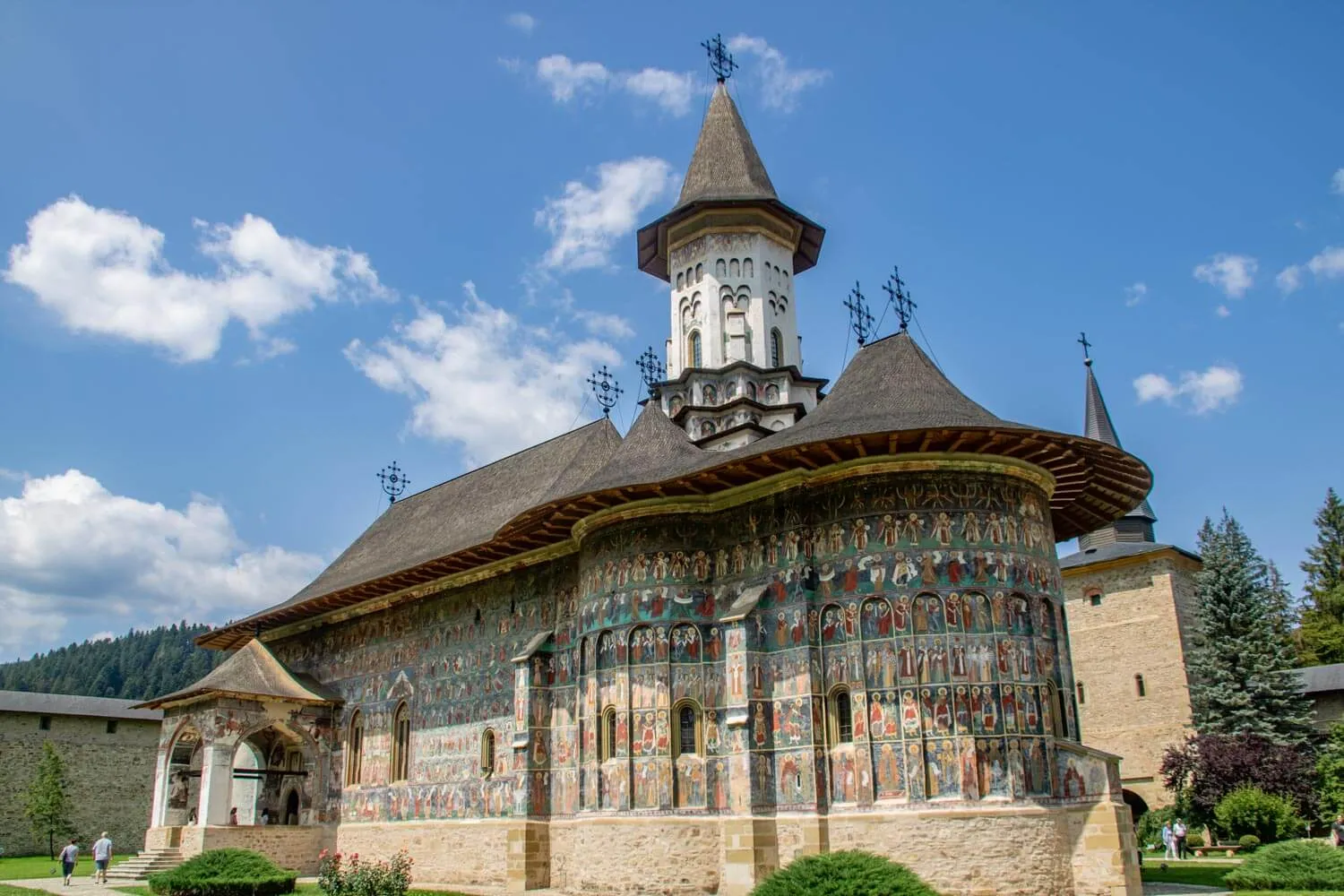
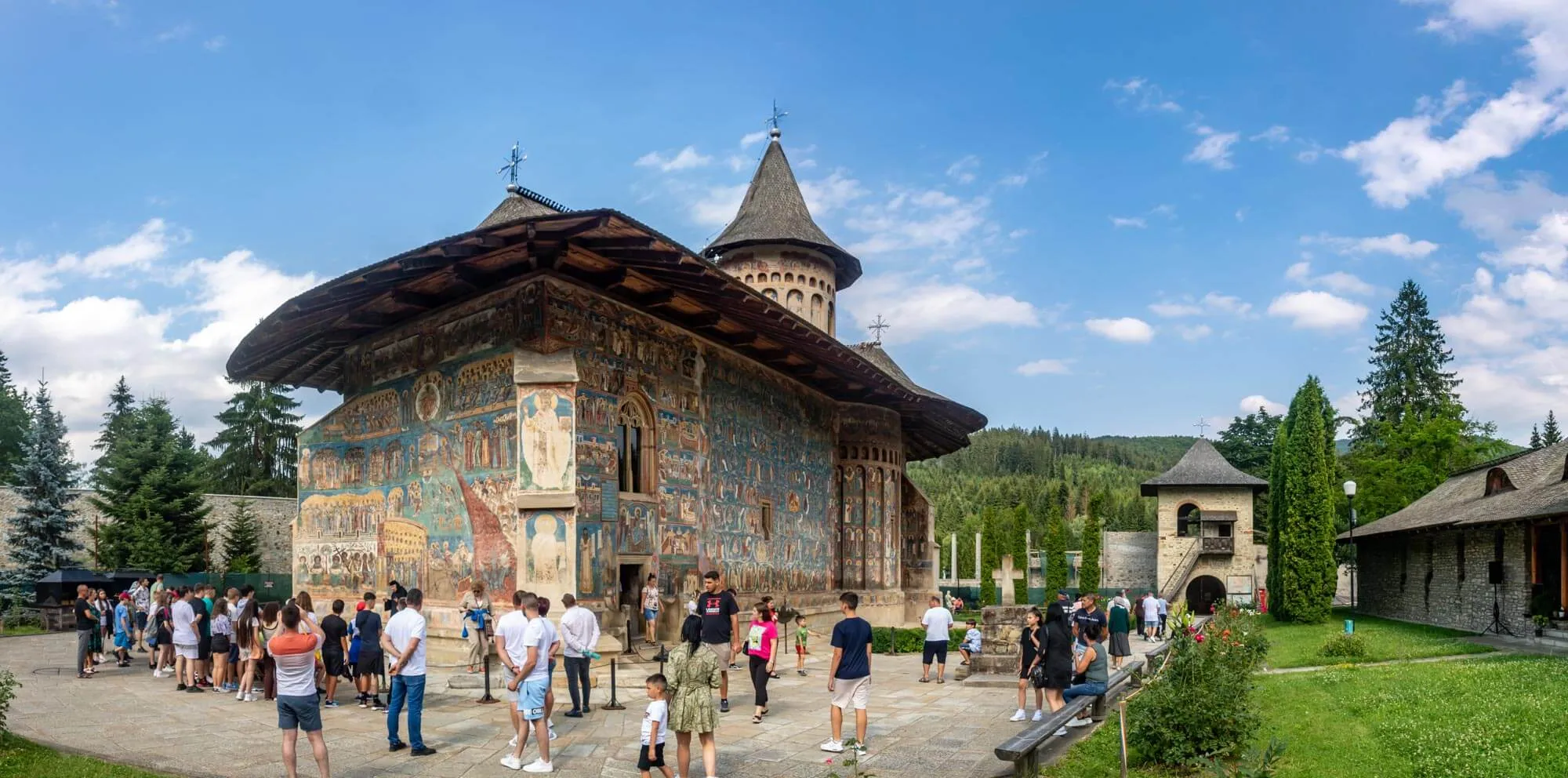
Sucevița Monastery (Mănăstirea Sucevița) is a Romanian Orthodox convent in the village of Sucevița, Suceava County. The monastery church is known for its fresco paintings which are typical for the historical Bucovina region and it is one of the 8 churches and monasteries that make up the Churches of Moldavia UNESCO World Heritage Site.
History Of Sucevița Monastery
The monastery was built in several phases in the last decades of the 16th century by the Movilă family, mainly the two brothers Ieremia and Simion, who succeeded each other as voivode (prince) of Moldavia around the 1600s. Between 1582 and 1584, under the reign of Petru Schiopul, the Movilă brothers erected the church as the first building of the complex at the initiative of Metropolitan Gheorghe Movilă. The church was built in a typical Moldavian style with Byzantine and Gothic elements.
In 1595, when Ieremila Movilă ascended to the throne he added two small porches to the north and south side of the church. He also fortified the complex with enclosure walls and towers and added a princely residence. During this time, the church was painted on both the inside and outside by the two Moldavian brothers Ioan and Sofronie Zagravul.
Later the main porch was closed as was typical for the Stephen the Great era. The iconostasis, carved in yew wood in a Baroque-Rococo style, was added in 1801. Between 1958 and 1969, an important restoration took place.
Sucevița Monastery is considered a monument of great historic importance and in 2010 UNESCO included it on the list of World Heritage Sites as part of the ensemble of Churches of Moldavia. It was the 8th addition to the ensemble of 7 churches initially listed in 1993.
Legend Of Sucevița Monastery
According to a legend, a woman wanted to redeem her sins and offered her help to build the monastery, in the hope she would be buried in the church. Without interruption, she brought down stones with her cart pulled by buffaloes for thrity years, but in the end, she wasn’t granted the honor. Instead, a strange figure representing the woman was placed in stone on the tower of the belfry.
Description Of Sucevița Monastery
The monastic complex has an almost square plan with dimensions of 100 by 104 meters, which is surrounded by 6-meter-high walls which are 3 meters thick. The enclosure has a tower on each of its four corners,of which the tower on the northwest corner also doubles as the bell tower. Another fith tower can be found at the entrance of the complex. This gate tower also houses a chapel dedicated to the Annunciation.
The monastery church is dedicated to the Resurrection of the Lord and is obviously the main attraction of the monastery. The church is almost fully covered on both the inside and the outside by beautiful fresco paintings depicting scenes from the Old and New Testament, as well as paintings of the Movilă family. This heritage has an indisputable artistic, cultural, historical, and spiritual value which is unique in the world.
In the Chamber of Tombs you can see the tomb slabs of the Movilă brothers, which are made of Rușchița marble.
The easter enclosure wall houses most of the residential buildings, the abbot, cells, a chapel, and the former council room which has been turned into a museum. Here you can see a collection of religious art pieces, embroideries, and other historical objects.
The princely residence, of which only ruins remain, can be found on the northern side.
How To Get To Sucevița Monastery
Sucevița Monastery is located along the main road DN17A in the village of Sucevița, about 18 kilometers southwest of Rădăuți, and a 1-hour drive from Suceava. Due to its remote location, you would need your own transportation, rent a car, or book a guided tour. Free parking is available in front of the entrance of the monastery. There are also a few shops, public toilets, and food stalls at the parking lot.