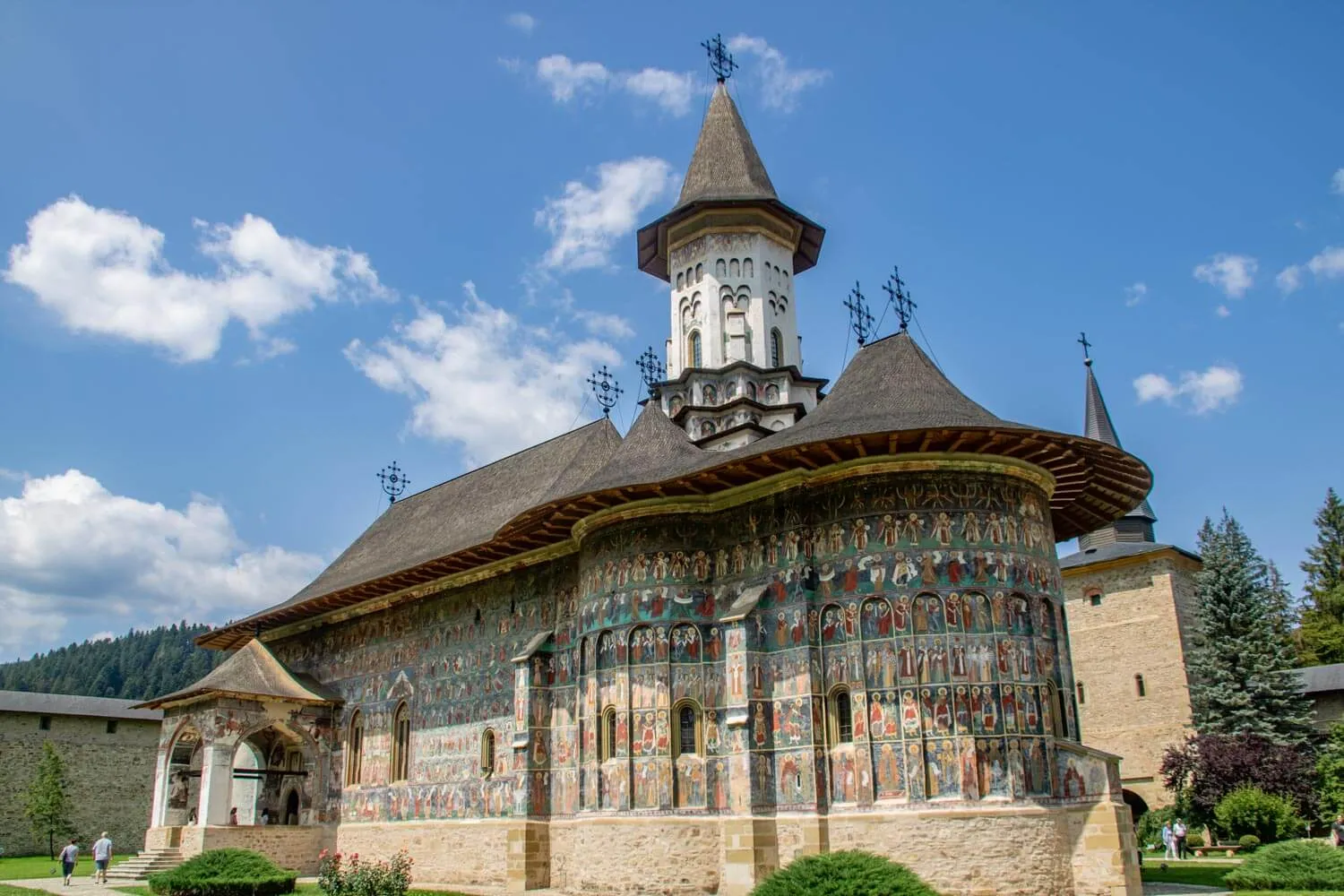
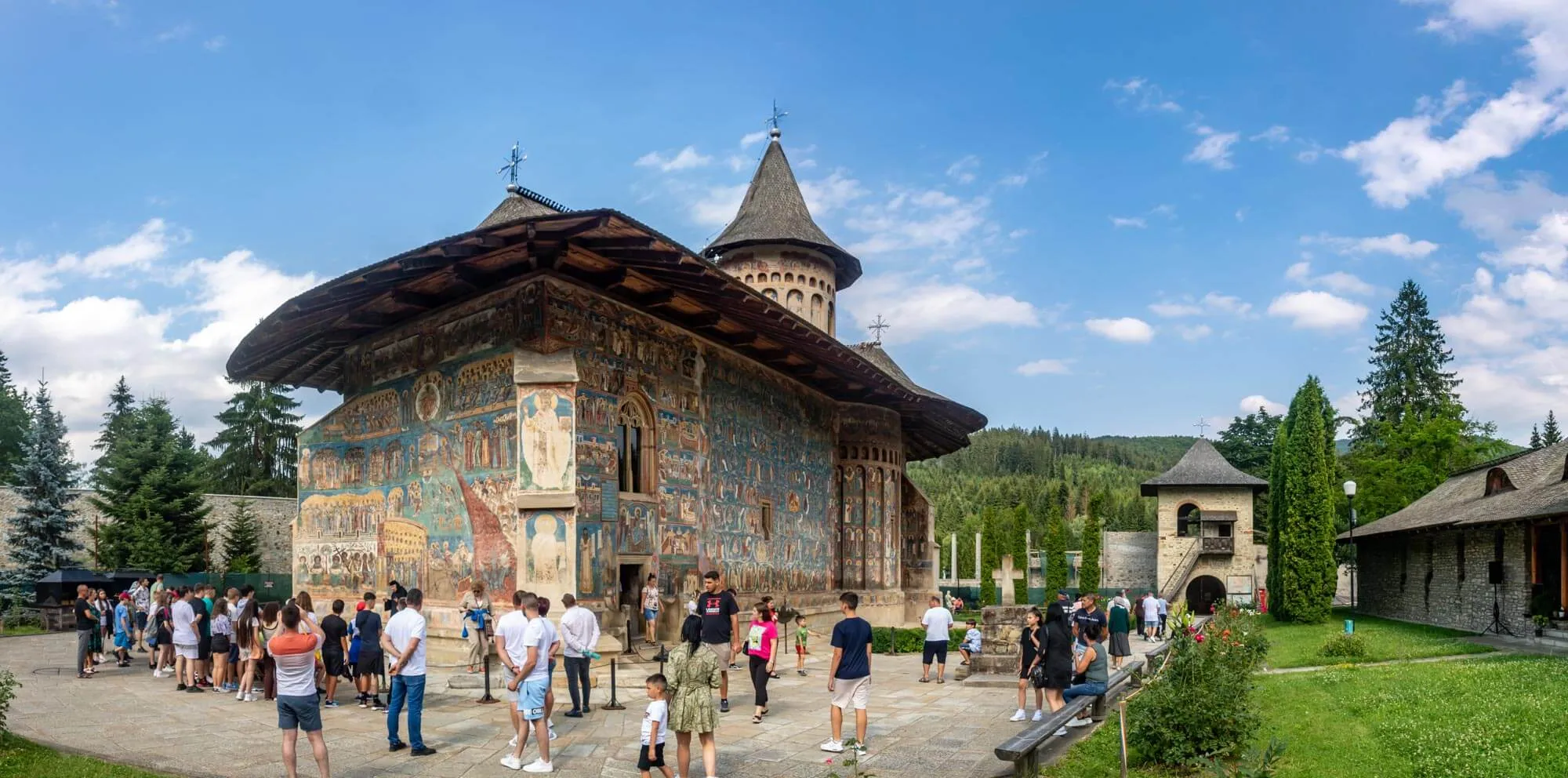
The Monastery of Saint John the New (Mănăstirea Sfântul Ioan cel Nou din Suceava) is a Romanian Orthodox monastery in Suceava, Suceava County. The monastery church is known for its fresco paintings which are typical for the historical Bucovina region and it is one of the 8 churches and monasteries that make up the Churches of Moldavia UNESCO World Heritage Site.
History Of The Monastery Of Saint John The New
In 1513, the Mirăuți Church, which served as the metropolitan cathedral of Suceava, was destroyed by a fire. The construction of a new church was initiated by Bogdan III, Prince of Moldavia and son of Stephen the Great, which started in 1514. After he died in 1517, the church was completed by his son and successor Ștefăniță Vodă in 1522. The church has since been dedicated to Saint George, who is celebrated on April 23rd of each year.
During the reign of Ștefăniță Vodă (1517-1527), some of the internal paintings were done. Between 1532 and 1534, under the reign of Petru Rareș, more internal and external paintings were added to the church. In 1579, the external porch was added by the Metropolitan Teofan from Râșca.
In 1564, under the reign of Alexandru Lăpușneanu, the capital of the Principality of Moldavia was moved from Suceava to Iași, however, the metropolitan seat remained in the old capital.
In 1589, Prince Petru Șchiopul moved the relics of Saint John the New from the Mirăuți Church to the Church of Saint George, which led to the second dedication of the church. Saint John the New is celebrated on June 24th of each year. At the same time, another porch was added to the church, and the bell tower on the northern enclosure wall of the monastery was erected.
In 1686, the Polish army of King John III Sobieski looted the monastery and took its treasures, including the relics of Saint John the New. In 1677, under the rule of Prince Antonie Ruset, the seat of the Metropolitanate of Moldavia was moved to Iași.
In 1775, the Bucovina region was annexed by the Habsburg Empire ruled by Joseph II, but the Monastery of Saint John the New in Suceava remained under the patronage of the Metropolitanate of Moldavia. Under the Habsburg reign, the relics of Saint John the New were returned, and a church school and a theological institute were founded in the monastery. In 1796, the pediment was replaced and in 1827 restoration works were carried out.
Due to a long-lasting conflict over the patronage of the monastery funds for necessary maintenance and restoration works dried up. However, between 1894 and 1896 several new buildings were erected to house the abbot and to receive guests and pilgrims. Finally, between 1898 and 1910, the church itself was restored by the Austrian architect Karl Romstorfer.
Another restoration took place between 1967 and 1968, and in 1991 a chapel was erected in the courtyard. In the same year the Archdiocese of Suceava and Rădăuți was founded in the monastery and the monastery church became a cathedral. However, the role as the metropolitan cathedral was later taken over by the newly built Cathedral of the Nativity.
In 1993, UNESCO included The Monastery of Saint John the New on the list of World Heritage Sites as part of the ensemble of Churches of Moldavia.
Description Of The Monastery Of Saint John The New
The monastery Church of Saint George resembles the same plan, proportions and several architectural features of the Ascension Church of the Neamț Monastery. It has the typical style of the churches of Stephen the Great with a three-lobed plan with a pronaos, altar and a nave. The entrance has the appearance of a Gothic portal and the pronaos is divided into two compartments by a transverse arch.
The roof has been redone several times with different materials, but its current appearance dates from 1904-1910 and consists of glazed colored tiles. An octogonal tower with four windows and a tiled pyramidal rooftop rises above the nave.
The fresco paintings have a Byzantine style and depict biblical scenes, but the painters are unknown. The internal paintings include the Mother of God and the Communion of the Apostles in the altar, Jesus Pantocrator inside the tower, and paintings of historic figures including Ștefănita Voda, Alexander the Good, and Stephen the Great in the nave.
On the outside, not all of the fresco paintings have survived and some have even been plastered over. On the southern side you can see paintings depicting the Tree of Jesse, Akathist of the Mother of God, the Siege of Constantinople, and scenes from the Parable of the Prodigal Son. Other preserved frescoes include depictions of the Last Supper and the Staircase of Saint John Sinait on the northern aps, and the Last Judgement on the southern facade.
The enclosure wall dates from the second half of the 20th century, although the monastery had been enclosed from its beginning already. Some tombstones with Slavonic inscriptions are embedded in the south-western wall, indicating that this was already a cemetery for important people in ancient times.
The 34-meter-high bell tower from 1589 forms the main entrance gate to the monastery. It has a square plan of 11.8 by 11.8 meters but initially only contained one level. During the restoration of the monastery between 1898 and 1910, another floor and the spire roof with the same style as the church were added.
In the northeast of the monastery there is a chapel, which was built between 1626 and 1629 by the Metropolitan Anastasie Crimca, who also built the similar-looking cemetery church in the Dragomirna Monastery. The chapel has a length of 13.65 meters, a width of 6.15 meters, and a maximum height of 5.2 meters, and was used as a winter chapel. On its western wall there is a painting depicting four scenes of the martyrdom and bringing of Saint John the New to Suceava, painted by Vladimir Mironescu in 1895.
Other structures of the monastery inlude the cells from the 19th century, a priory from 1984-1896, and a stone cross from 1882.
How To Get To The Monastery Of Saint John The New
The monastery is located in the city of Suceava, very near the center. By foot, it’s only a 5-minute walk from the central square of the city.