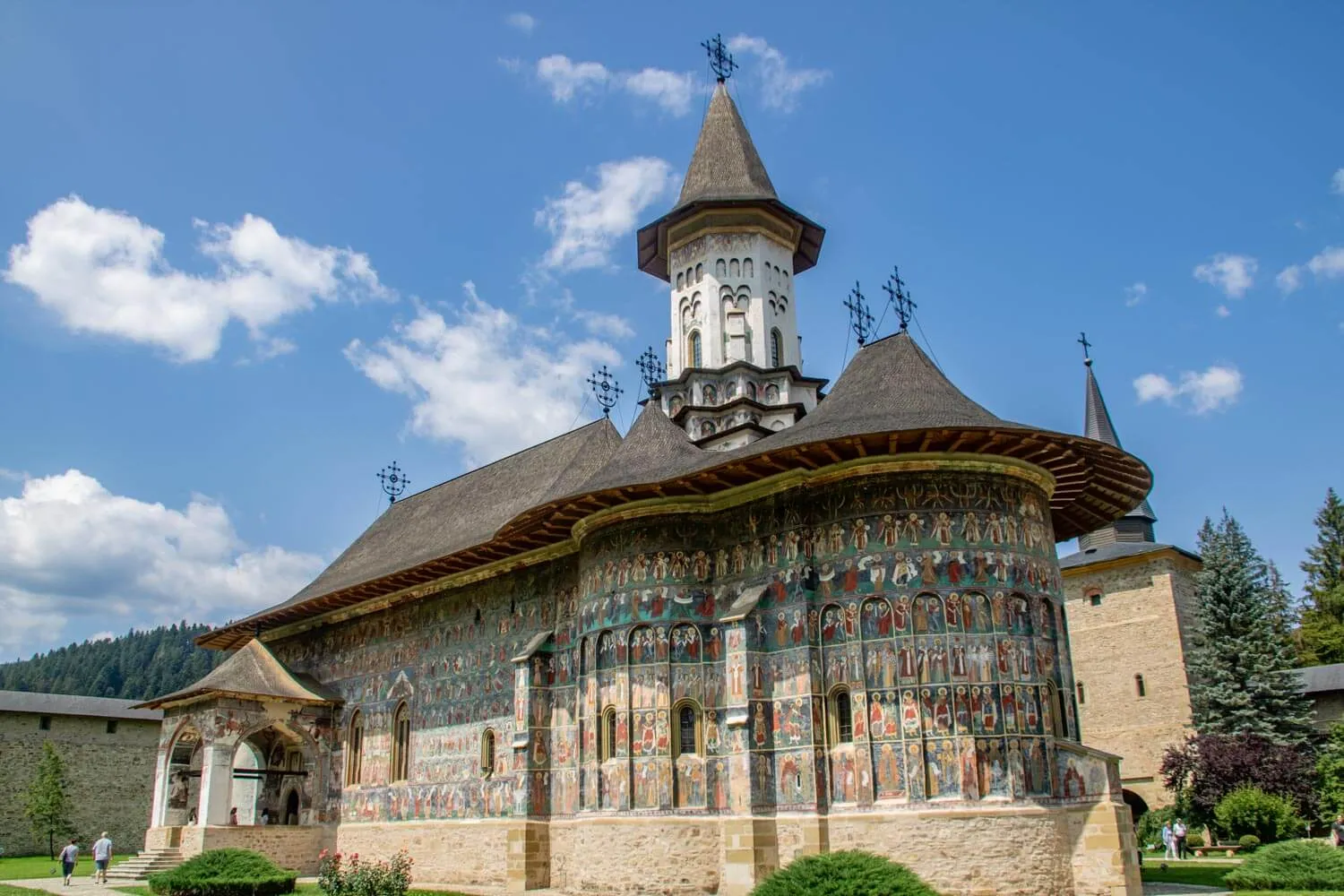
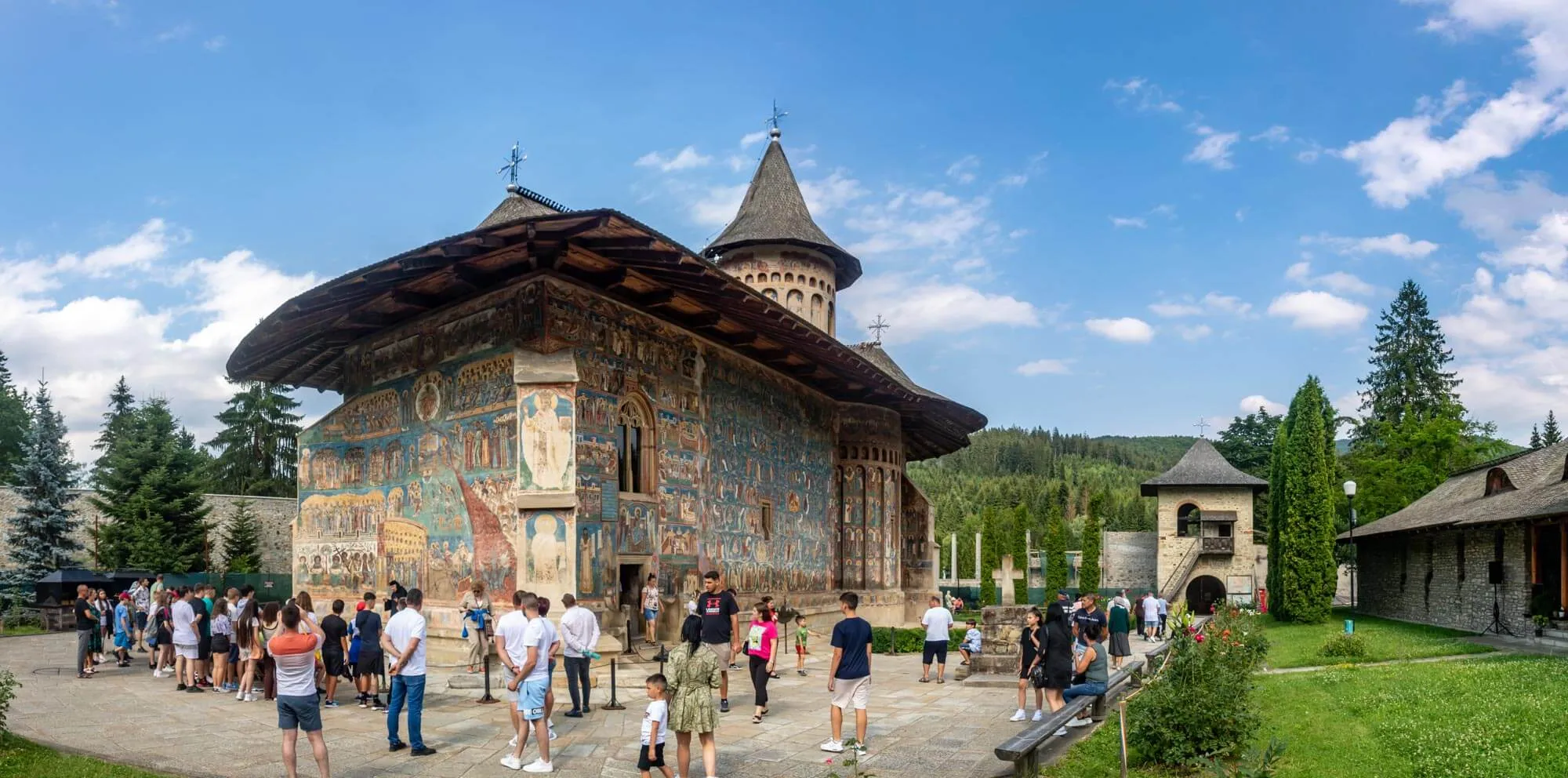
The Putna Monastery (Mănăstirea Putna) is a historic Romanian Orthodox monastery in Putna, founded by Stephen the Great between 1466 and 1469. Set in a valley surrounded by the forested hills of Bucovina, it is one of Romania’s most important religious and historical monuments. The monastery is particularly significant as the burial place of Stephen the Great and several members of his family, while its museum preserves an exceptional collection of medieval religious art. The main church is dedicated to the Dormition of the Mother of God.
History
Construction began on July 10, 1466, during the reign of Stephen the Great, Prince of Moldavia. The church was completed in 1469 and consecrated on September 3 by Metropolitan Teoctist I, in the presence of the Moldavian clergy. Stephen intended Putna to serve as the burial place of his dynasty and endowed the monastery with estates, privileges, and valuable religious objects. The fortified enclosure was developed over the following years, with the Treasury Tower and surrounding walls completed in 1481.
Putna soon became an important center of religious scholarship and artistic production. Its monks copied manuscripts, produced illuminated books, and developed a distinguished tradition of liturgical embroidery. The monastery also served as the burial place of Stephen’s family. His second wife, Maria of Mangup, was buried here in 1477, followed by the prince himself in 1504 and several of his descendants.
The monastery suffered repeatedly from fires, invasions, and earthquakes. A major fire in 1484 damaged the original complex, which was repaired under Stephen the Great. By the mid-17th century, the church had deteriorated so severely that it was dismantled and rebuilt on its original foundations. Reconstruction began under Prince Vasile Lupu in 1653, continued under Gheorghe Ștefan, and was completed during the reign of Eustatie Dabija in 1662. The present church therefore dates largely from the 17th century, although it preserves the general plan and proportions of Stephen’s original foundation.
Further repairs followed a damaging earthquake in 1739, with Metropolitan Iacob Putneanul overseeing an extensive restoration program during the 18th century. After Bukovina came under Austrian rule in 1775, Putna was one of only three monasteries in the region permitted to remain open during the monastic suppressions of 1783. Its buildings underwent further alterations, including restoration by architect Karl Romstorfer in 1901-1902.
During the 19th century, Putna also became an important place of Romanian national remembrance. In 1871, a major gathering commemorating 400 years since the monastery’s foundation brought together Romanian intellectuals and students, including Mihai Eminescu, Ioan Slavici, and Ciprian Porumbescu. The celebrations emphasized Stephen the Great’s historical importance and the cultural unity of Romanians living under different political administrations. Extensive archaeological investigations and restoration work during the 1950s-1970s subsequently helped recover the monastery’s medieval history and preserve its architectural ensemble.
Architecture And Princely Tombs
Putna Monastery is enclosed by stone defensive walls surrounding a rectangular courtyard, with the Church of the Dormition of the Mother of God at its center. The present church follows the traditional Moldavian architectural plan, incorporating a porch, narthex, burial chamber, nave, and sanctuary. Its elongated proportions, carved stone window frames, and tall central tower combine Byzantine religious architecture with Gothic influences.
The church originally featured extensive interior and exterior frescoes, but these were lost during the 17th-century reconstruction. The interior remained largely undecorated until a new painting program was undertaken between 2001 and 2010 by Mihail and Gavriil Moroșan and their collaborators. The resulting frescoes cover the walls and vaults with biblical scenes, saints, and richly colored religious compositions.
The monastery’s most important funerary monument is the marble tomb of Stephen the Great, who died on July 2, 1504. It stands beneath a carved canopy in the burial chamber, alongside the tombs of members of his family. Other monuments commemorate his son Bogdan III, his grandson Ștefăniță, Maria of Mangup, and several Moldavian religious leaders, including Metropolitan Teoctist I and Metropolitan Iacob Putneanul.
Among the surviving fortifications, the Treasury Tower is particularly significant. Built in 1481, it is the only building at Putna that retains its original form from Stephen the Great’s reign. Its thick walls, square base, and octagonal upper floors were designed to protect the monastery’s valuable possessions. The entrance passes through the Eminescu Tower, while the enclosure also contains a bell tower, the Chapel of Saints Peter and Paul, the Princely House, and buildings used by the monastic community.
Monastery Museum
The Putna Monastery Museum preserves one of the finest collections of medieval Byzantine and Moldavian religious art in southeastern Europe. Its exhibits include illuminated manuscripts, Gospel books, icons, ceremonial crosses, silver and gold objects, and richly embroidered liturgical textiles produced or donated during the monastery’s history.
The collection is especially celebrated for its 15th- and 16th-century embroideries, many commissioned by Stephen the Great and his family. Among the outstanding pieces is the embroidered tomb cover of Maria of Mangup, dating from 1477, which depicts the princess in ceremonial dress. Other treasures include embroidered altar veils, epitaphios textiles, and manuscripts illustrating the artistic achievements of Putna’s medieval workshops.
The monastery’s treasures were originally preserved in the church and Treasury Tower before a dedicated museum was established in the early 20th century. The present museum building dates from 1975-1976, with the collection subsequently reorganized and conserved to provide a permanent display of Putna’s religious and artistic heritage.