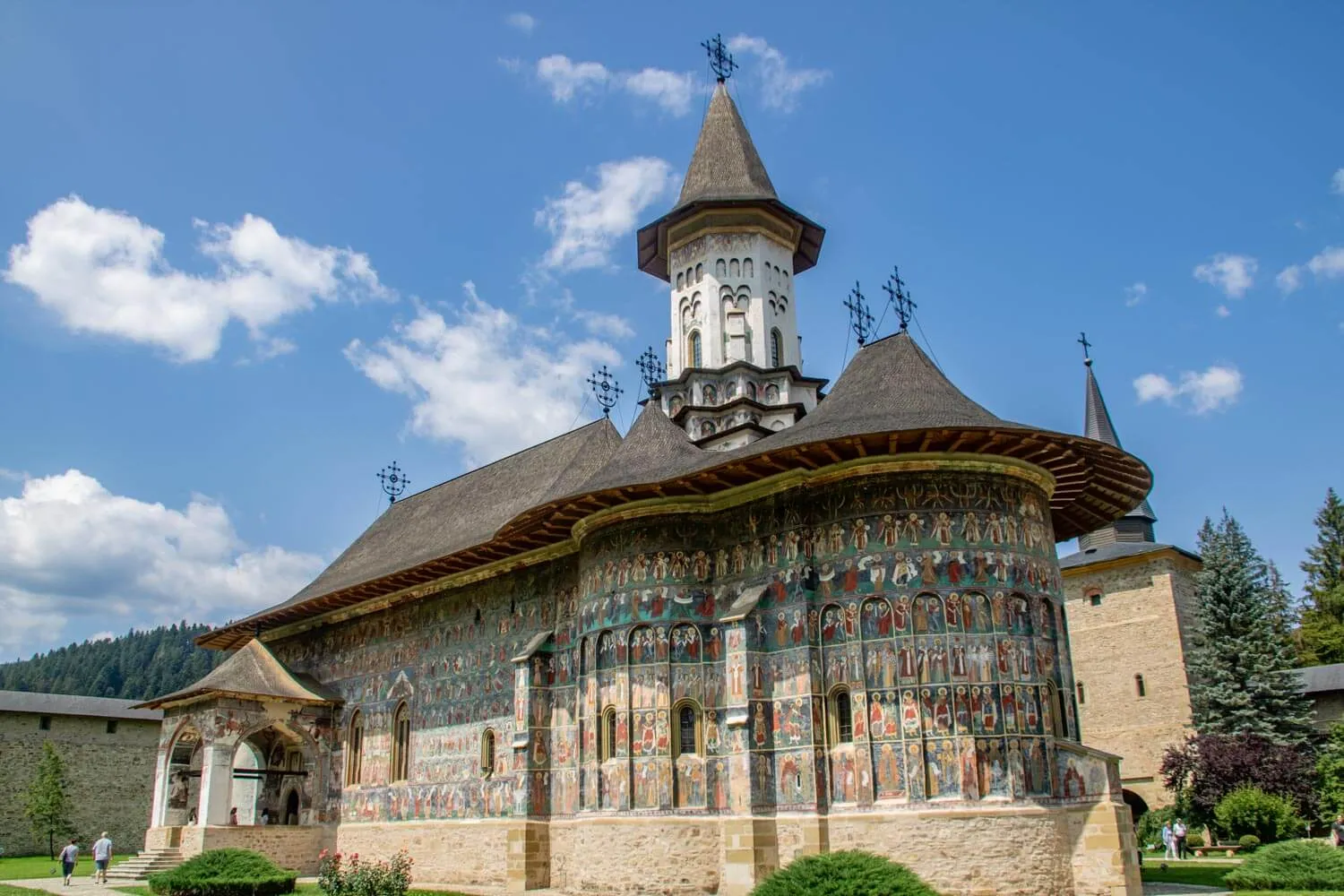
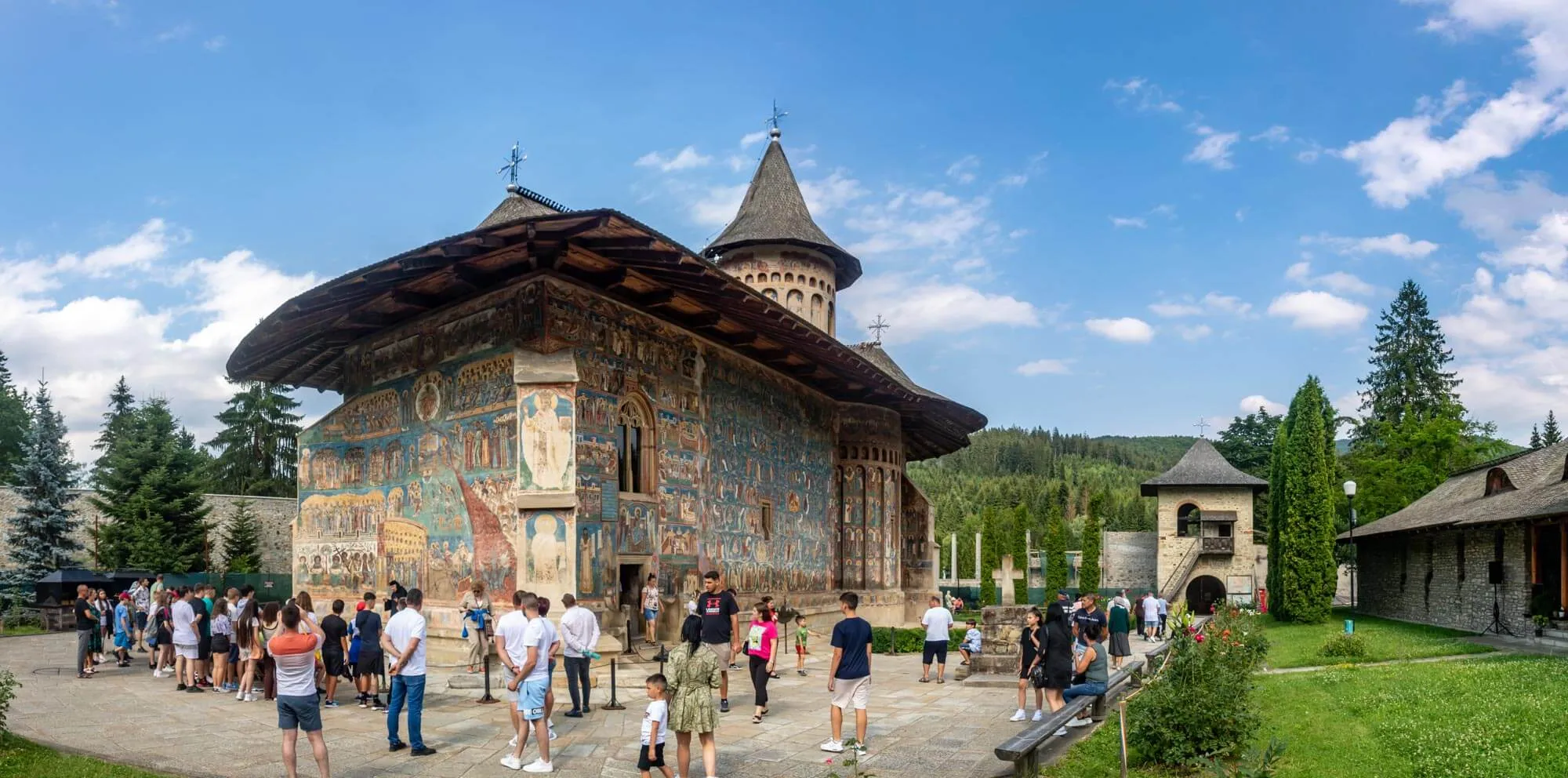
The Arbore Monastery (Mănăstirea Arbore) is a Roman Orthodox monastery in the village of Arbore, Suceava County. The monastery church is dedicated to the Beheading of Saint John the Baptist and is known for its fresco paintings which are typical for the historical Bucovina region. The monastery is one of the 8 churches and monasteries that make up the Churches of Moldavia UNESCO World Heritage Site.
History Of Arbore Monastery
The first documentation about the village of Arbore, then called Solca de Jos, dates back to 1418 when Alexander the Good (Alexandru cel Bun) was the ruler of Moldavia. In 1502, Luca Arbore, the son of nobleman Cârstea Arbore from Neamț, bought the village to build a royal court and a church on the estate.
Arbore has been the gatekeeper of the Suceava Fortress for almost 40 years and defended it bravely for three weeks during a siege by the Polish troops in 1497. He was also one of the most influential boyars of Stephen the Great (1457-1504), an important advisor of Bogdan III the Blind (1504-1507), and the political tutor of Ștefăniță Vodă (1517-1528).
For the construction of the church, he picked the site of an ancient hermitage, intending to make it a necropolis for the Arbore family. The construction started in April 1502 and was finished on 29 August of the same year.
After being accused of treason by the ruler Ștefăniță Vodă, Luca Arbore was beheaded at the princely court of Hârlău without a trial in April 1523. After his death, two of his sons, Toader and Nichita, were also killed.
According to an inscription in the nave, the interior painting of the church was partially redone in 1541. At this time, the exterior of the church was also painted by the craftsman Dragoș Coman, the son of a priest from Iași.
In the 17th and 18th centuries, the Arbore Church fell into disrepair and remained without a roof for a long time, which led to the deterioration of the interior painting under the influence of rain and wind. After the annexation of the Bucovina region by the Habsburg Empire in 1775, the Arbore Monastery was abolished and only the church remained as a parish. The monastic buildings were seized and untimately didn’t survive over time.
In 1867, a one-stort bell tower was constructed to the northwest of the church which still exists today. Throughout the 20th century, several restoration projects were carried out to save and restore the church, which is the only structure build by Luca Arbore that still exists today.
In 1993, UNESCO included the Arbore Church in the list of World Heritage Sites as part of the ensemble of Churches of Moldavia. On 21 October 2021, the Diocesan Council of the Archdiocese of Suceava and Rădăuți decided to reinstate the complex as a monastery, and on 7 January 2022, a new abbot was installed.
Description Of the Arbore Monastery
From the original monastery of 1502, only the Church of the Beheading of Saint John the Baptist still exists today, together with the bell tower from 1867.
The church is built of brick and stone from nearby quarries and has a rectangular plan without a spire. The structure has a length of 22 meters, a width of 9.1 meters, and a height of 8.5 meters. The lateral walls extend to the west for about 2.5 meters and are connected through a semicircular arch, creating an open space, which appears for the first time in Moldavian architecture. The niche might have been intended for a church bell.
The church has elegant proportions built on a false-three-lobed plan, with the two apses being carved into the thick side walls, rather than sticking out. The apse of the altar is semicircular and detached from the rest of the structure.
As the church was intended as a necropolis, there are several graves that can be found in the nave. To the right of the entrance door is the grave of the founder of the church, Luca Arbore. The carved stone canopy has a Gothic style and was modeled after the Wawel Cathedral in Kraków, where King Casimir IV of Poland is buried. Some of the other graves belong to his family, but most of the graves have had their inscriptions erased.
The internal and external paintings, which were completed in 1541, so years after the death of the founder, are of high artistic quality with elegant silhouettes and with warm and bright colors. The interior paintings include some remarkable portraints depicting the founder and his family, the Virgin Mary, and the Roman Emperor Constantine the Great.
Some of the exterior paintings have also deteriorated during the 18th and 19th century, when the church was uncovered for a long time. The paintings on the northern wall have faded away completely, and have only survived partly on the apse of the altar. The southern side only has some damage, and the western side has been preserved in full. The frescoes mostly depict typical biblical scenes seen on other churches as well, but the painter, Dragoș Coman, was rather secular and innovative and combined Eastern and Western elements and introduced new scenes and interpretations not seen before. One of the most notable works can be found on the western facade, which entirely consists of a group of miniatures and is considered as one of the best fresco paintings of the era of Stephen the Great and Petru Rareș.
How To Get To Arbore Monastery
The Arbore Monastery is located right next to the main road DN2K in the village of Arbore, which is a 37-kilometer drive from Suceava. Due to its remote location, the easiest way to get there is with your own transportation, by renting a car, or booking a guided tour.