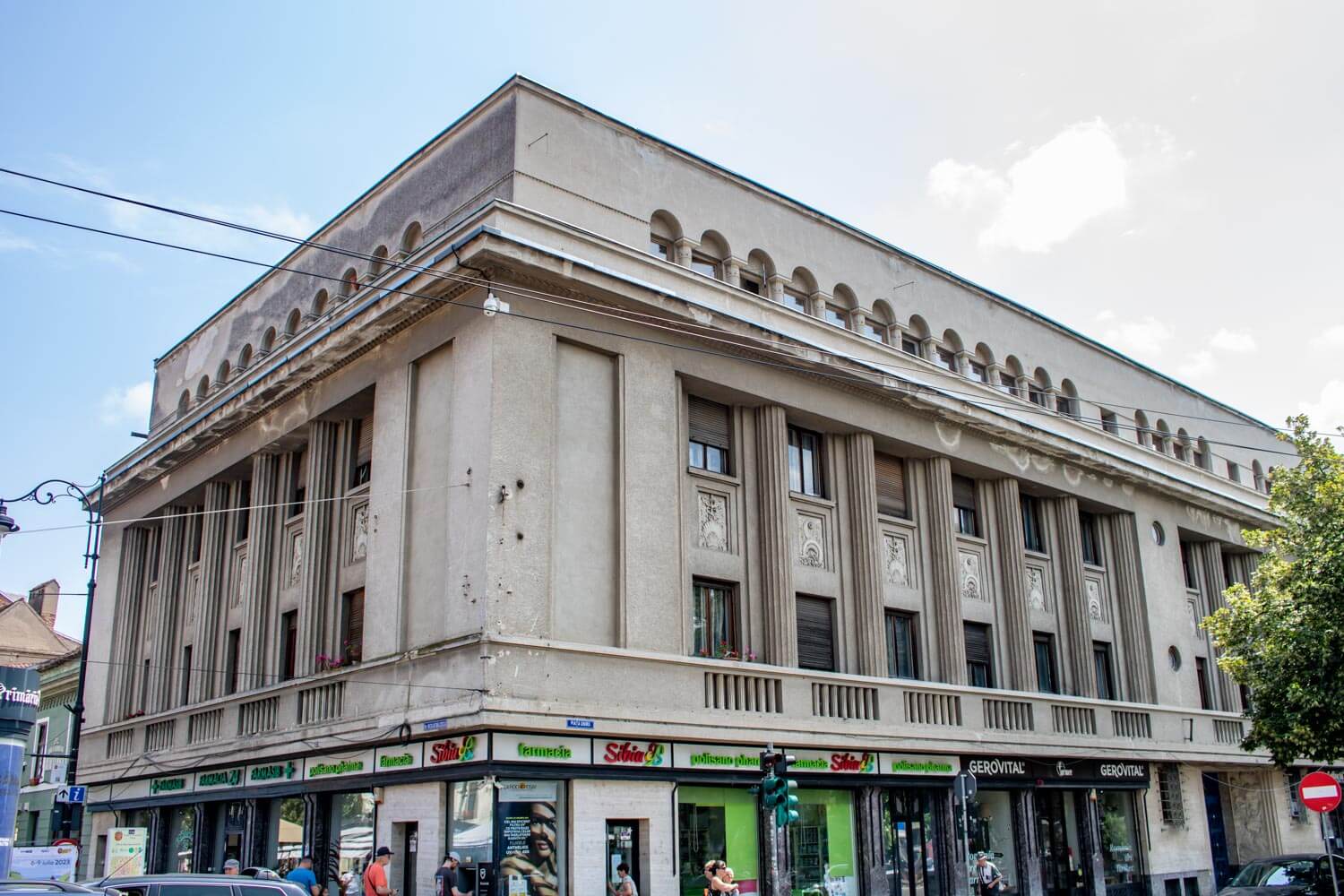
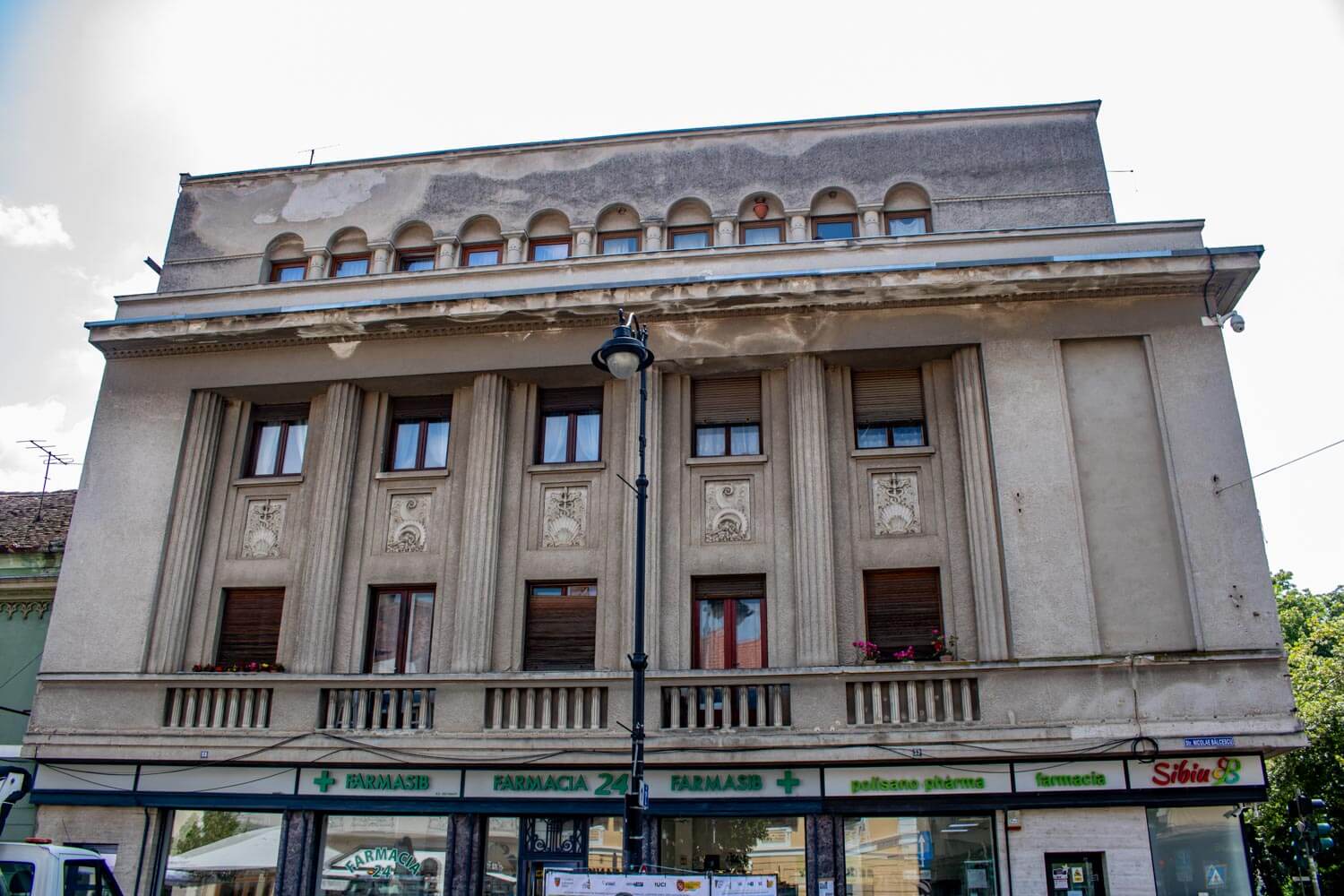
Prima Ardeleană Palace (Palatul Prima Ardeleană) is a landmark Art Deco building at the southern end of Strada Nicolae Bălcescu in Sibiu, where the pedestrianized historic center opens onto Piața Unirii.
The building was commissioned by the First Transylvanian Insurance Company (Societatea de Asigurări Prima Ardeleană), which replaced several older houses on the site with a much larger modern development. Construction began in August 1934 under engineer Tiberiu Eremie, following designs by architect Gheorghe Cristinel, and the completed building was inaugurated on September 1, 1935. The insurance company occupied offices on the first floor, while commercial premises were incorporated at street level and other parts of the building were used for offices and apartments.
Its appearance marked a sharp departure from the historic houses lining much of central Sibiu. Cristinel designed an L-shaped corner building in Art Deco style, with broad horizontal lines, stepped-back upper levels and large shop windows along the ground floor. Travertine surrounds, wrought-iron details and geometric decoration add to the façades, while the recessed main entrance is framed by figurative bas-reliefs characteristic of the 1930s. The building is regarded as one of the clearest surviving examples of Art Deco architecture in Sibiu.
Commercial and financial activity continued alongside the insurance offices during the interwar years. The Sibiu branch of the Central Bank for Industry and Commerce operated here until 1940, while a pharmacy that had occupied an earlier building on the site returned after construction and became known to generations of residents as Farmacia 24. After nationalization, the palace housed the Sibiu county representation of Sovromasigurare, the Soviet-Romanian insurance company, before its upper floors were increasingly used as apartments while shops continued to occupy the ground floor.
The exterior remains the main point of interest today, particularly the contrast between its streamlined 1930s architecture and the older streetscape immediately to the north. Its prominent corner position also makes it one of the most visible markers of Sibiu’s expansion and architectural modernization between the two world wars.