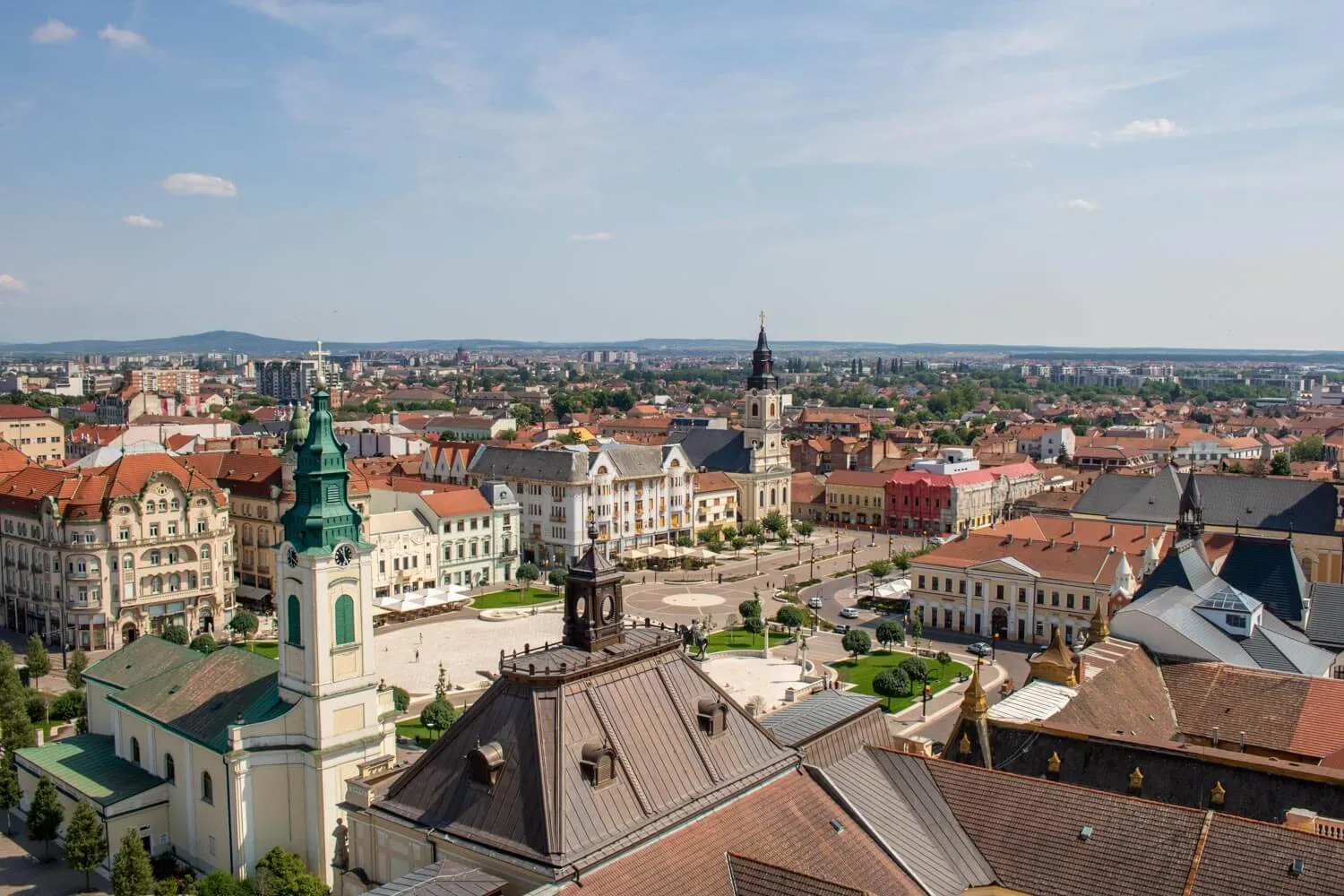
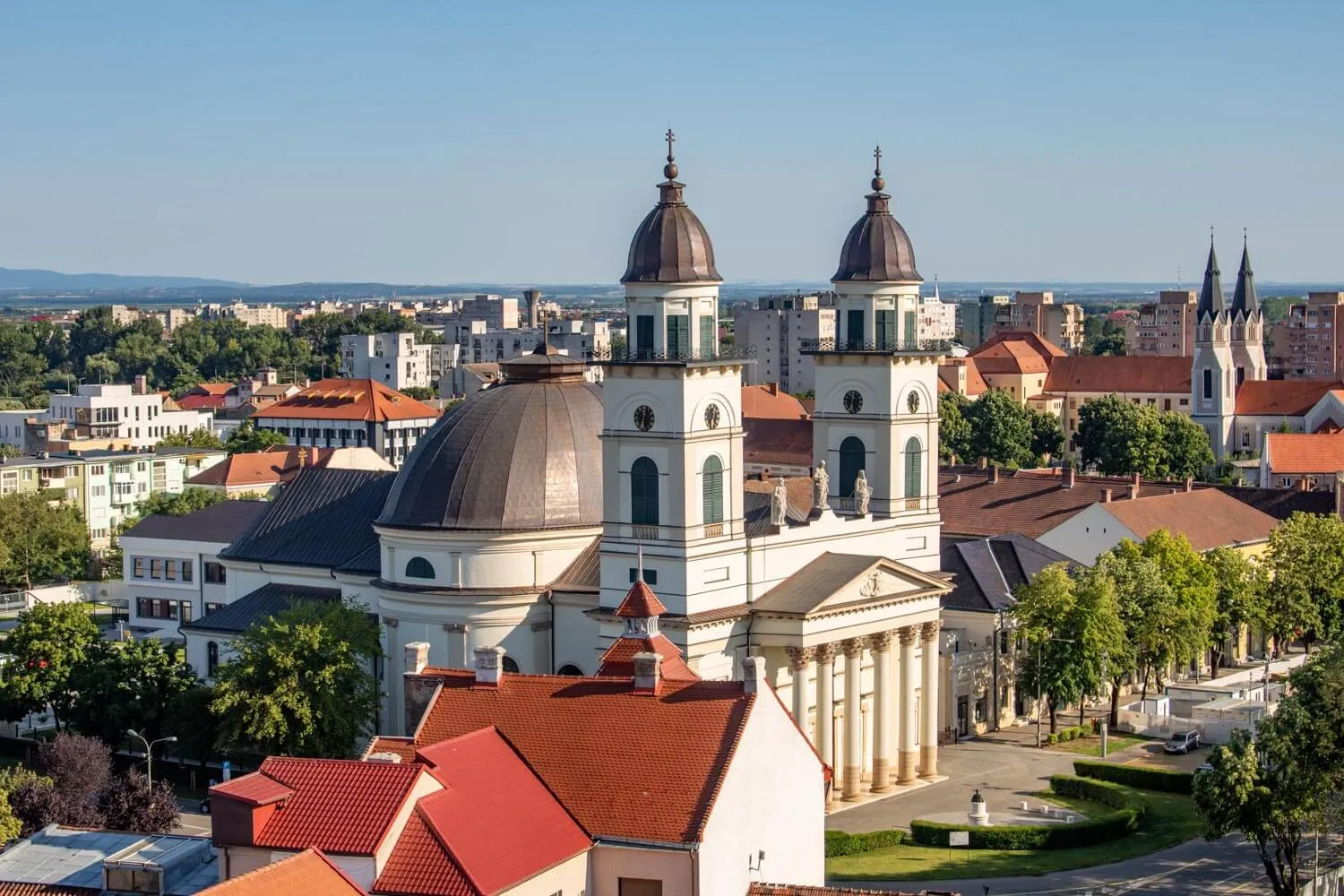
The Roman Catholic Cathedral of Satu Mare (Catedrala Romano-Catolică din Satu Mare) is a neoclassical cathedral on Liberty Square (Piața Libertății) in the historic center of Satu Mare. Dedicated to the Ascension of the Lord, it is the seat of the Roman Catholic Diocese of Satu Mare, with a monumental façade, twin bell towers, and a large central dome.
History
The cathedral has its origins in a Baroque parish church built during the second half of the 18th century. When Satu Mare became the seat of a newly established Roman Catholic diocese in 1804, the church was elevated to cathedral status and gradually enlarged to accommodate its new role.
The most significant transformation took place under Bishop János Hám, who commissioned a major reconstruction between 1830 and 1837. The earlier sanctuary was incorporated into a substantially larger neoclassical building, with a domed central space, side aisles, and an imposing new entrance façade. The cathedral was consecrated in August 1837.
The interior underwent further changes in 1904, when it was renovated and redecorated to mark the centenary of the diocese. During the Second World War, the cathedral suffered damage that required extensive repairs, completed in 1961.
Architecture And Interior
Facing Liberty Square, the cathedral’s monumental entrance is framed by six Corinthian columns supporting a triangular pediment. Above the portico, statues of Christ and the apostles Peter and Paul crown the façade, while Saints Stephen and Ladislaus, two important figures in Hungarian Christian history, are represented in niches below. The symmetrical bell towers and central dome give the cathedral its distinctive silhouette.
Inside, the broad central space opens beneath the dome, with richly decorated walls, columns, and religious paintings. The extended sanctuary preserves the layout of the earlier Baroque church and leads toward the main altar, where a painting of the Ascension of Christ illustrates the cathedral’s dedication. The marble altar, created by Félix Toman in 1905, is decorated with classical columns and sculptures of Saints Peter and Paul.
The interior also commemorates important figures in the history of the diocese. Bishop János Hám, who directed the cathedral’s 19th-century reconstruction, is buried here, while a memorial tomb honors Blessed János Scheffler, the bishop who died in communist imprisonment in 1952 and was beatified in 2011. An organ installed in 1925 stands in the gallery above the entrance.