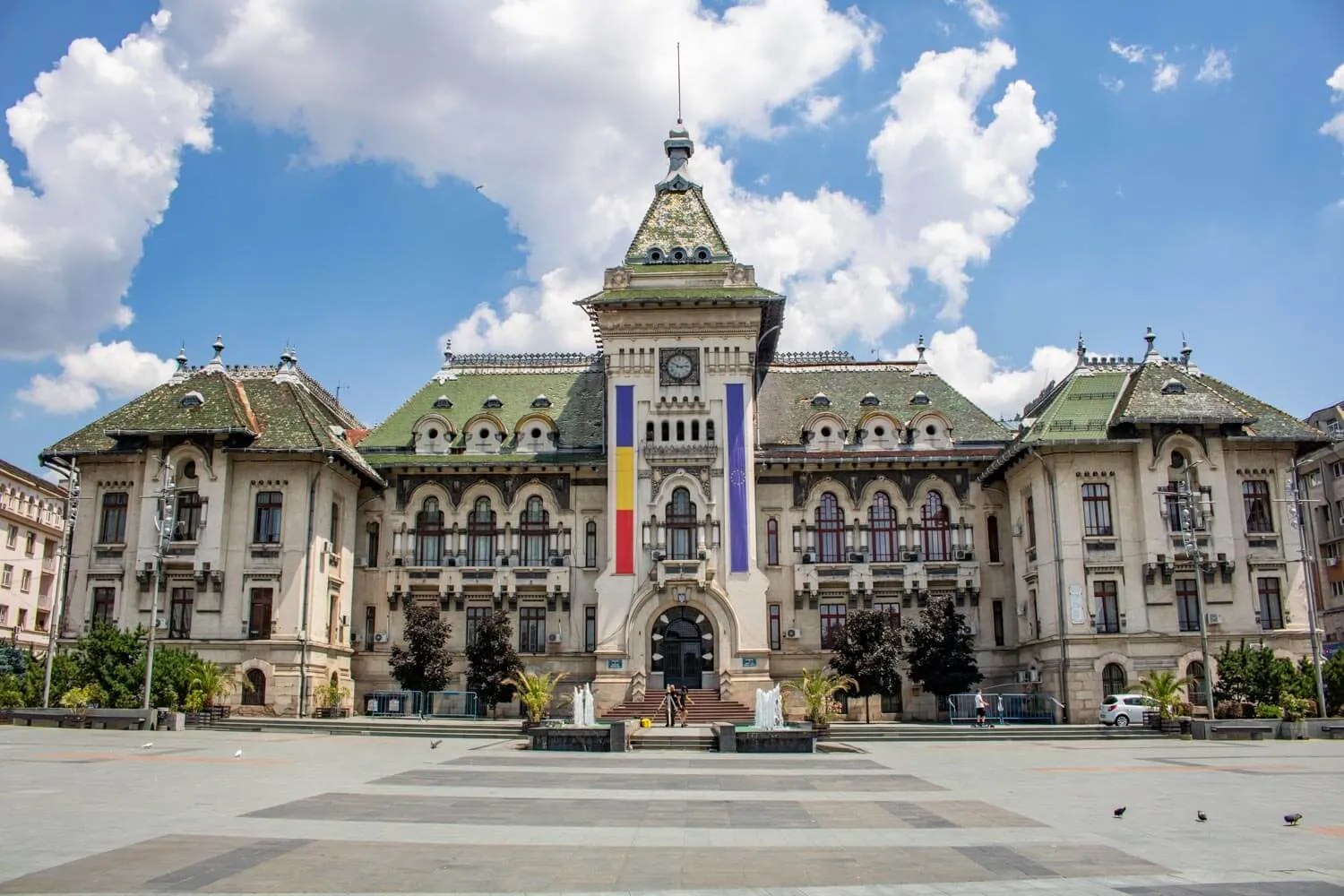
Trajan National College (Colegiul Național Traian) is a historic secondary school on Carol I Boulevard in Drobeta-Turnu Severin, founded in 1883 and housed in a monumental building constructed between 1890 and 1892. Designed by Romanian architect Alexandru Săvulescu, the building is one of the city’s prominent examples of late 19th-century institutional architecture.
The school opened on September 1, 1883, as a gymnasium with 79 students and two teachers, initially operating from rented premises and the former town hall. After several years of efforts to secure a permanent building, construction began in 1890 under the supervision of engineer C. C. Țăpârdea. The institution briefly received the name Neagoe Basarab Lyceum in 1891, but local residents successfully petitioned for it to be renamed Trajan Lyceum in 1892, honoring the Roman emperor whose bridge once crossed the Danube nearby.
Theodor Costescu, who served as director from 1892 to 1901, played a major role in developing the school into a leading educational institution. He introduced student uniforms in 1893, expanded the teaching facilities with modern scientific equipment, and established a substantial library that contained more than 5,000 volumes by 1903. The school also developed an orchestra and marching band, while a botanical garden was created in its grounds in 1899. One of its teachers, Alexandru Bărcăcilă, established a historical and archaeological collection in 1912 that eventually developed into the Iron Gates Region Museum. Construction of a boarding facility began in 1922, and the completed building subsequently became the museum’s headquarters.
The college building was designed in an eclectic architectural style with classical influences, featuring a long, symmetrical façade, two projecting end sections, and a prominent central entrance. The central pediment is particularly elaborate, with busts of the Roman poet Ovid and Romanian writers Vasile Alecsandri and Ion Heliade Rădulescu. Above them stand two allegorical female figures representing Moldavia and Wallachia, holding a wreath symbolizing Romanian unity. These sculptures reflect the national and cultural ideals that influenced public architecture in Romania during the late 19th century.
The school complex was enlarged during the 20th century, including the addition of a southeastern wing begun in 1937 and a new western building completed in 2003. The grounds also contain several monuments, including a bust of Mihai Eminescu by sculptor Gheorghe Anghel and a marble sculpture of Theodor Costescu with a student, created by sculptors M. Onofrei and Carol Umberto in 1972. The institution received its present name, Trajan National College, in 1999.