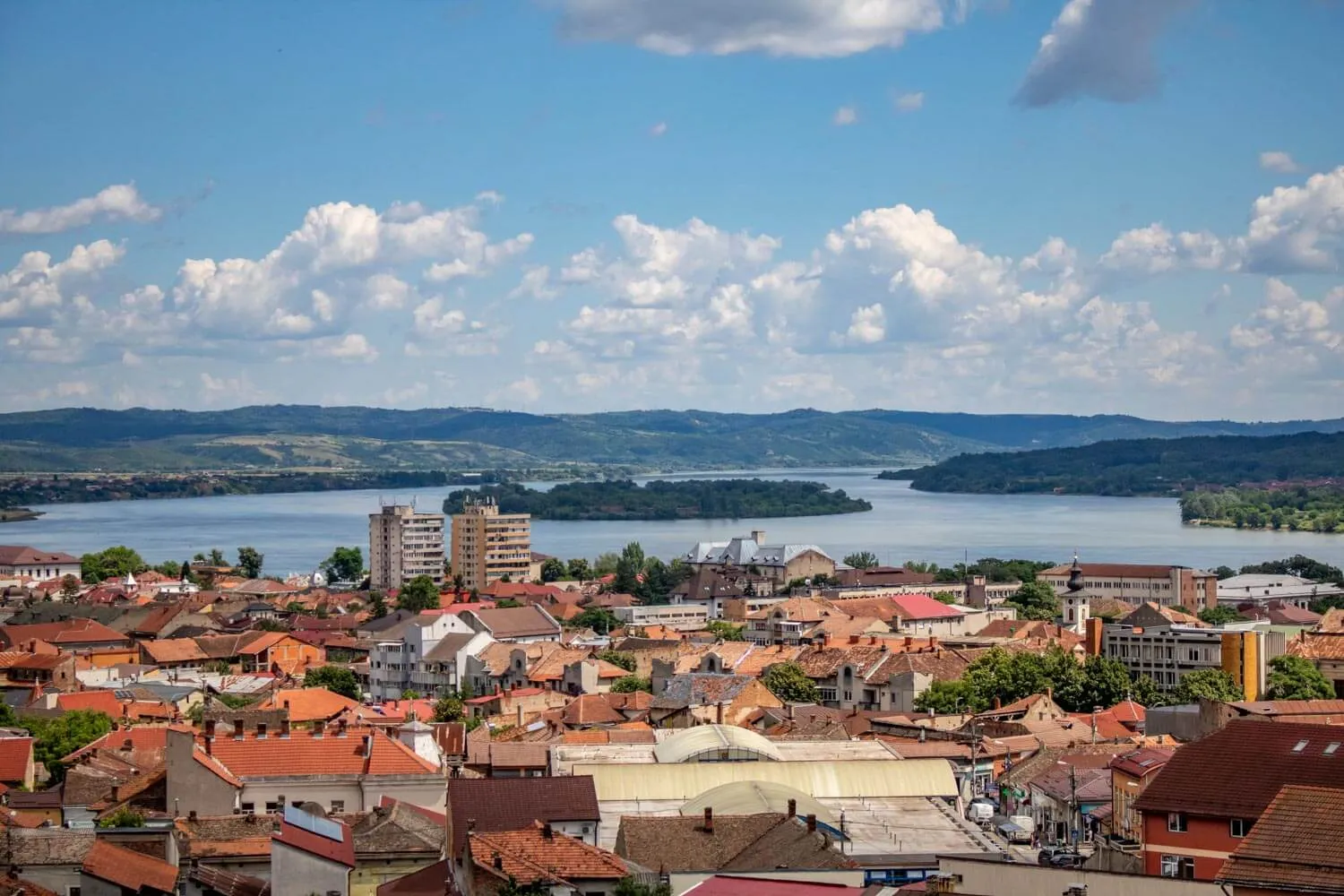
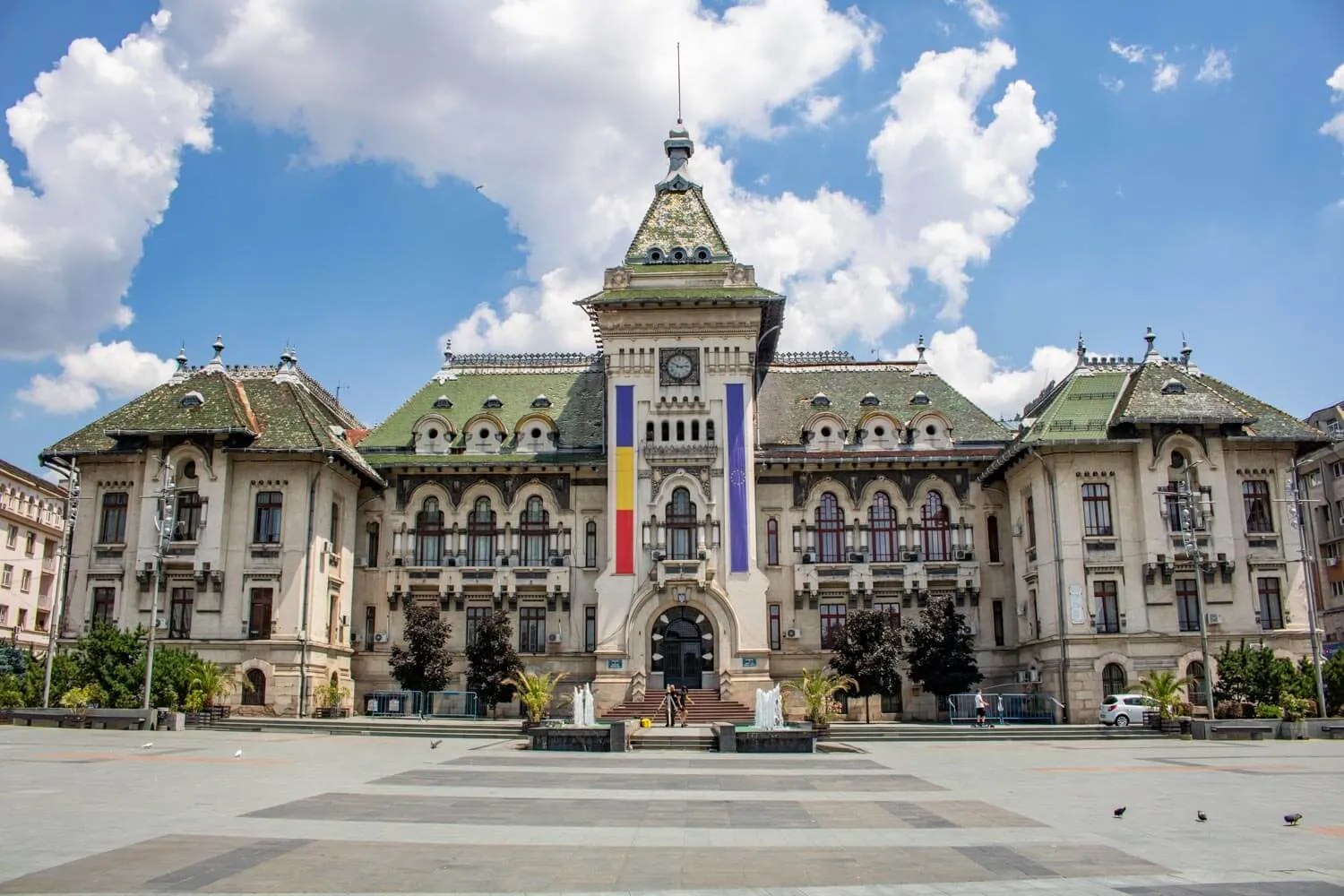
The Theodor Costescu Palace of Culture (Palatul Cultural „Theodor Costescu”) is a historic cultural center in Drobeta-Turnu Severin, housing a theater and facilities for concerts, exhibitions, and other cultural events. The monumental building is one of the city’s most prominent architectural landmarks and was conceived as a center for its artistic and intellectual life.
The project originated in 1909, when a group of teachers from the Trajan Lyceum proposed establishing a permanent theater in Turnu Severin. Their initiative developed into a much more ambitious cultural complex under the leadership of Theodor Costescu, the school’s former director, who had already played an important role in developing education and cultural institutions in the city. With support from the municipality and donations from local residents, construction began in 1913 according to plans by architect Grigore Cerchez, but progress was interrupted by the First World War. By 1916, the building had reached the roof level, although its interior was still unfinished.
After the war, rising costs and a shortage of funds threatened the completion of the project. Costescu organized a new fundraising campaign, securing contributions from former students, local residents, businesses, and public institutions. He also sold part of his personal property to cover construction expenses. The palace began receiving visitors in October 1924 and was formally inaugurated on November 30 of that year, although its large theater auditorium had yet to be completed.
Cerchez designed the palace in a monumental Neoclassical style, with a symmetrical composition and elaborate architectural decoration. The building was organized around a central theater auditorium, flanked by two wings containing six large halls arranged on three levels. The eastern wing accommodated the I. G. Bibicescu Library, a cinema, and a restaurant, while the western wing contained the Dr. C. I. Istrati Museum, a ceremonial hall, and an auxiliary auditorium. The theater was designed to accommodate approximately 700 spectators and incorporated an innovative revolving stage. Its construction proved particularly challenging, and the auditorium was not ready when the palace first opened.
The exterior features a long façade articulated by columns, pilasters, and large windows, with an imposing central section emphasizing the main entrance. Its classical decoration includes sculptural ornaments and griffin figures. Inside, the ceremonial spaces and auditorium reflect the scale of the original project, while the library developed from the collection donated by Ion G. Bibicescu, the former governor of the National Bank of Romania.
During the communist period, the building served as a house of culture, hosting performances, film screenings, exhibitions, and public events. After decades of deterioration, a major restoration program began in 2010, involving structural repairs, restoration of the façades, and modernization of the interior facilities. The palace now accommodates theatrical productions, concerts, exhibitions, festivals, and other cultural events.