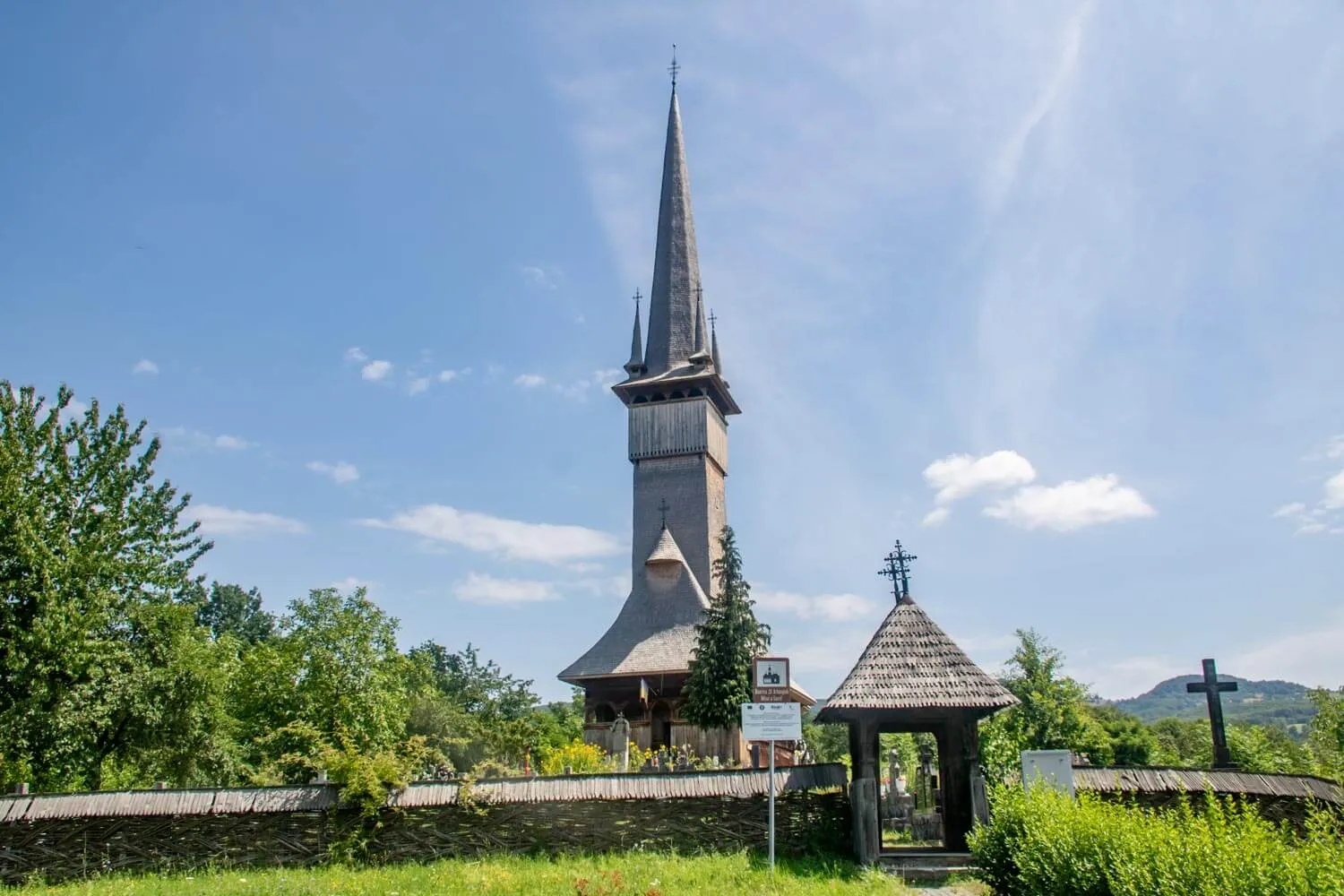
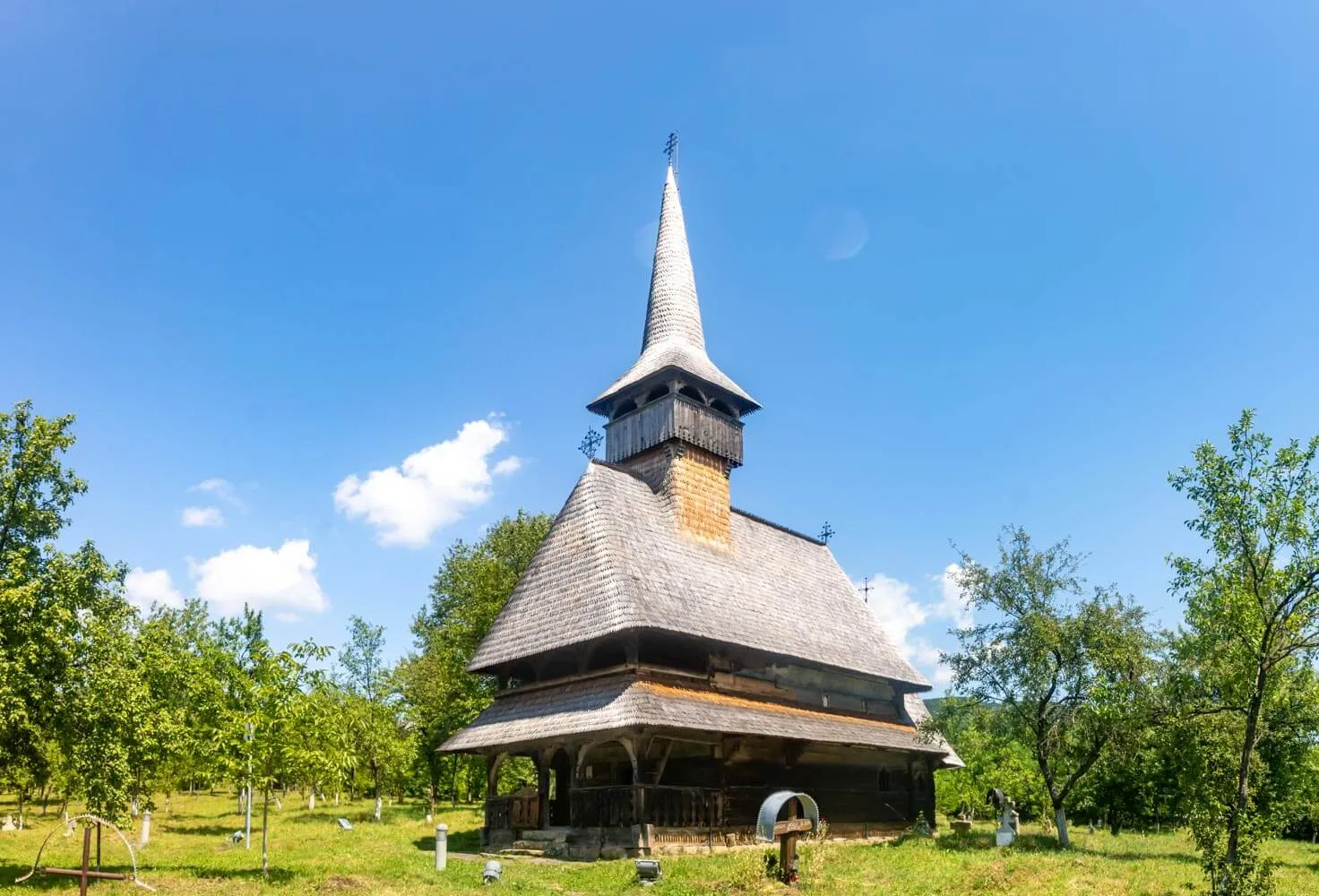
The Church of the Presentation of the Virgin in the Temple (Biserica Intrarea Maicii Domnului în Biserică) is a wooden church on Jbâr Hill in the village of Bârsana, Maramureș County. The church is also nicknamed the ‘walking church’ because it has been moved a few times in its long history. The historic building is also one of the eight wooden churches of Maramureș that are together listed as a UNESCO World Heritage Site.
The wooden church of Bârsana (biserica de lemn din Bârsana) was built in 1711 by the noble priest Ioan Ștefanca and his sons, with the help of other villagers to thank God for his protection during the Great Plague epidemic of the previous year. The initial location of the church was near the Slatinii stream, a tributary to the Iza River.
In 1739 it was moved to an old cemetery in the Iza River valley. This was a battlefield during the last invasion of the Tatars in 1717 and the victims were buried here. The church was brought here to perform liturgies in their memory. Around 1795, the church was moved a second time. This time the church was brought to the village where it was placed at a cemetery of victims of the Small Plague of 1742.
In 1806, the interior was repainted with Baroque and Rococo influences by the painter Hodor Toader from Vișeu-de-Mijloc. Later, the windows were enlarged and the porch was added.
The church has a rectangular plan with a two-level porch, a polygonal altar apse, and a double-eaved rooftop. Above the pronaos rises a bell tower with a square base and an open bell chamber with a pyramid-shaped roof. The internal paintings represent biblical scenes, including the Last Judgement, the Passion of Jesus, and scenes from Genesis.