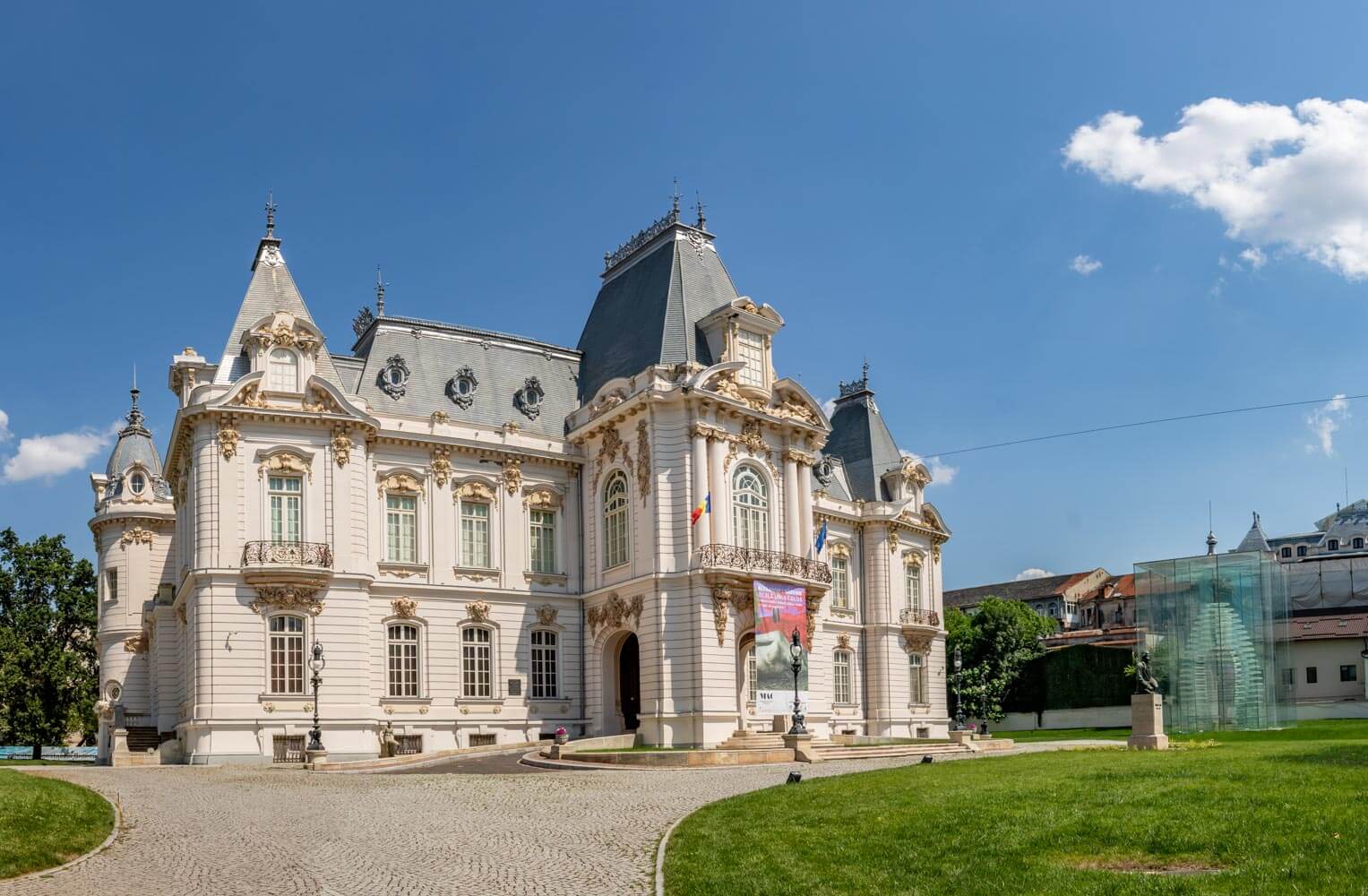
The Oltenia Museum of Natural Sciences (Muzeul Olteniei – Secția de Științele Naturii) is a natural history museum in central Craiova, housed in the historic Ramuri Palace (Palatul Ramuri). Built in the early 1920s as the headquarters of a publishing house and printing company, the building is a distinctive example of Neo-Romanian architecture. The museum explores the natural history of Oltenia through geological and zoological collections, reconstructed habitats, fossils, and exhibitions devoted to astronomy.
History Of The Building
The Ramuri Palace was designed by architect Constantin Iotzu and constructed between 1920 and 1921 by Italian builders Dalla Barba and Peressutti. It originally accommodated the Ramuri publishing house and printing works, which played an important part in Craiova’s literary and intellectual life during the early 20th century. The company published books and periodicals, including the influential literary magazine Ramuri, founded in 1905. The magazine attracted contributions from prominent Romanian writers and intellectuals, among them historian Nicolae Iorga, who also served as its director. A commemorative plaque on the façade recalls his work in the building.
The palace combines an imposing urban façade with elements inspired by traditional Romanian architecture. Its Neo-Romanian ornamentation includes trilobed arches, short columns supporting the upper balcony, and painted decorative motifs beneath the cornice. The varied window arrangements and projecting architectural details give the building an elaborate appearance. After the departure of the publishing house, the property accommodated several other organizations before eventually becoming a museum.
History Of The Museum
The museum originated in 1923, when the Craiova Scientific Circle, led by professor Marin Demetrescu, established the Natural History Museum of Craiova. Initially independent, it shared exhibition space with the Regional Museum of Antiquities and Ethnography, which had been founded in 1915. In 1928, the two institutions merged to form the Regional Museum of Oltenia, bringing natural sciences, history, archaeology, and ethnography together under a single organization. Following subsequent reorganizations, the institution adopted its present name, Oltenia Museum, in 1968.
For several decades, the natural sciences collections were displayed alongside those of the other museum sections, including at Casa Băniei and the former Madona Dudu school. In 1975, the natural sciences exhibitions closed because of insufficient space, although the collections continued to be maintained and expanded. The Oltenia Museum was allocated the former Ramuri Palace for its natural sciences exhibitions in 1984, and temporary exhibitions opened there in 1986. Between 2005 and 2012, extensive renovation and modernization transformed the building into a permanent exhibition venue, with updated displays and a planetarium.
Collections And Exhibitions
The museum’s exhibitions explore the geology, flora, and fauna of Oltenia, with particular attention to the region’s prehistoric wildlife and diverse ecosystems. On the ground floor, Oltenia – Terra Fossilis presents fossils discovered across the region, tracing the development of animal life through different geological periods. Among its most impressive exhibits are skeletal reconstructions of a mastodon discovered at Stoina, a mammoth from Leu, and a cave bear from Baia de Fier. The exhibition also includes fossils from Bugiulești, an important paleontological site where discoveries have helped reconstruct the animals and environments of Oltenia more than a million years ago.
The first floor explores the physical geography and ecosystems of Oltenia, from the Danube floodplain and lowland forests to the hills and mountains of the Southern Carpathians. Dioramas recreate four characteristic natural environments using preserved animals, plant specimens, and representations of their habitats. The displays illustrate the transition from the wetlands of the Danube to the forests and alpine landscapes of the Parâng Mountains, showing how differences in terrain, climate, and vegetation influence the distribution of wildlife. An accompanying collection of rocks and minerals presents specimens from Romania and other parts of the world, while interactive exhibits introduce ecological concepts and biodiversity conservation.
The upper floor is devoted to The Universe and Our Solar System (Universul și Sistemul nostru Solar), an exhibition covering the structure of the universe, galaxies, stars, planets, and space exploration. Among the exhibits are fragments of a meteorite that fell near Sopot in Dolj County in 1927. The adjoining planetarium, inaugurated in 2012, uses projected presentations to recreate the night sky and take visitors on virtual journeys through the solar system and beyond.
The museum also organizes temporary exhibitions and educational activities based on its extensive scientific collections, which include insects, birds, mammals, botanical specimens, minerals, and fossils.
In Craiova, the Oltenia Museum also operates the Museum of History and Archaeology and the Museum of Ethnography.