Rome Square (Piața Roma) is a small public square at the edge of the historic old town of Bucharest. The square lies at the intersection of Lipscani Street (Strada Lipscani) with the Ion C. Brătianu Boulevard (Bulevardul Ion C. Brătianu).
History Of Rome Square
In the early days, long before Ion C. Brătianu Boulevard became a busy traffic artery of the modern city, Rome Square was a large public square on Lipscani Street in the old town.
In the middle of the square stood a replica of the Capitoline Wolf in Rome, a gift to Bucharest from the city of Rome, hence the name of the square. The statue was donated in 1906, at the 1800th anniversary of the Roman conquest of Dacia, now Romania.
Although the square has changed drastically in shape and appearance since then, the statue is still there. Between 1997 and 2010 it was placed on Roman Square, but it has since been relocated back to its original location.
Nowadays, there is not much left of the original square as most of the space is taken up by the traffic of the wide and busy Ion C. Brătianu Boulevard. Only a small part of the western side of the square is left where the pedestrianized old town starts. On the eastern side of the main thoroughfare nothing reminds of the old square as the its merely a sidewalk along the busy road.
Sights And Landmarks On Rome Square
Although Rome Square itself is not a touristic attraction, there are a few intesting sights and landmarks to see.
The main attraction on Rome Square and the only reminder of the old days of the square is of course the Statue of the Capitoline Wolf, also called Lupa Capitolina in Italian. The bronze sculpture depicts a she-wolf suckling the twin brothers Romulus and Remus, the mythical founders of Rome.
The two parts of Lipscani Street, cut-through by the busy Ion C. Brătianu Boulevard, are connected via the Latin Passage (Pasajul Latin). This is a pedestrian underpass that is decorated with bas-reliefs depicting scenes from the history of Romania, parts of Trajan‘s Column, and historic maps, including a map of the Roman Empire, a map of Dacia during the reign of Emperor Trajan, and a map of Bucharest under the reign of Constantin Brâncoveanu.
A few steps away from the square into Lipscani Street you can find the Gabroveni Inn (Hanul Gabroveni), built in 1739 by Prince Constantin Mavrocordat and one of the few remaining old inns of Bucharest.
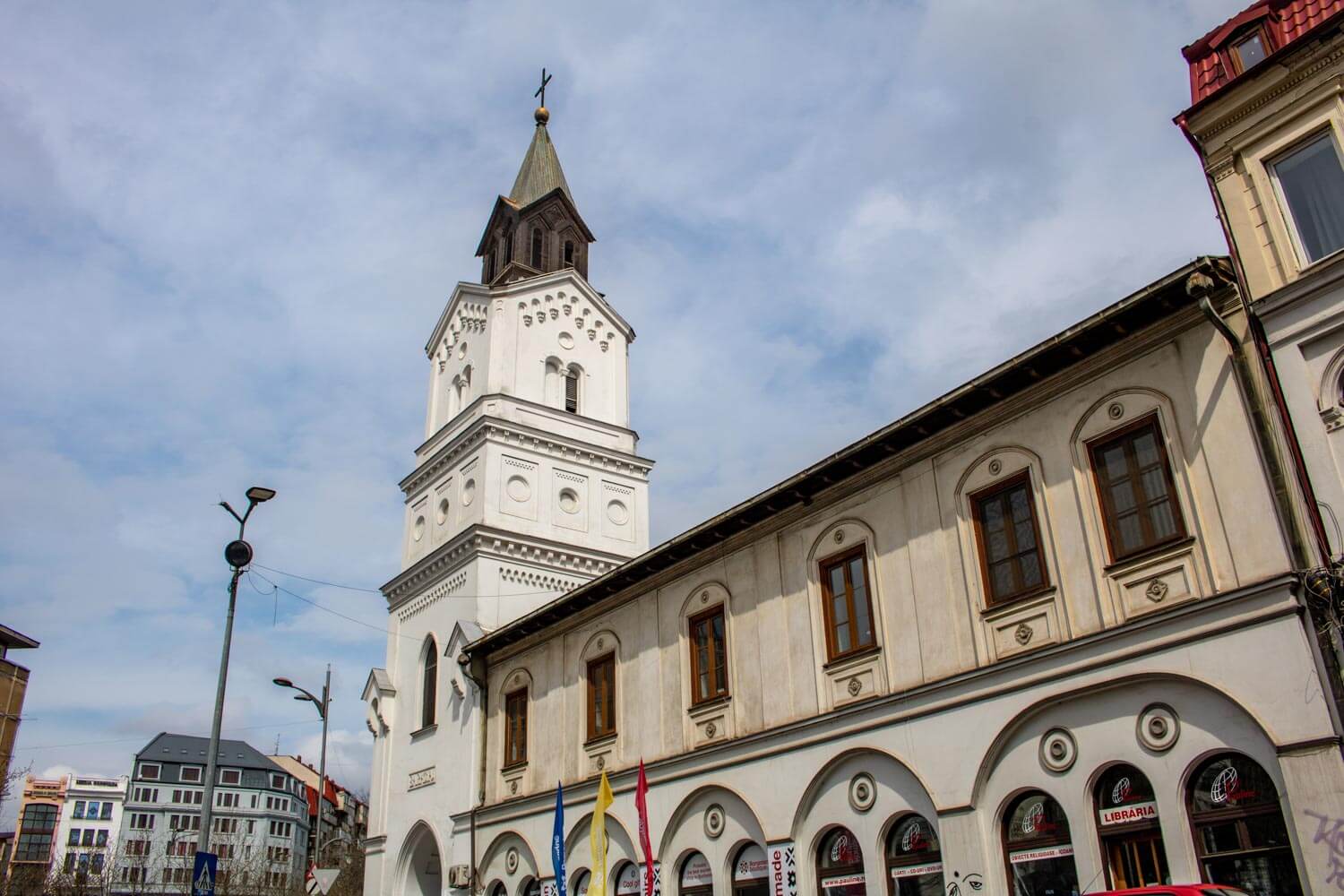
On the eastern side of Ion C. Brătianu Boulevard stands the historic Bărăția Church (Biserica Bărăția), the oldest catholic church in the city, dating back to the 14th century.
To the south of the church, on the corner of Ion C. Brătianu Boulevard and Bărăției Street is a small square that is now called Time Square (Piața Timpului). Here you can find the Bucharest Walk of Fame, a project of the Metropolis Theater inspired by the Hollywood Walk of Fame in Los Angeles to honor actors with their own star on a floor tile.
To the north you can visit the New Saint George Church (Biserica Sfântul Gheorghe Nou), built in 1705 by Constantin Brâncoveanu to replace an older church.