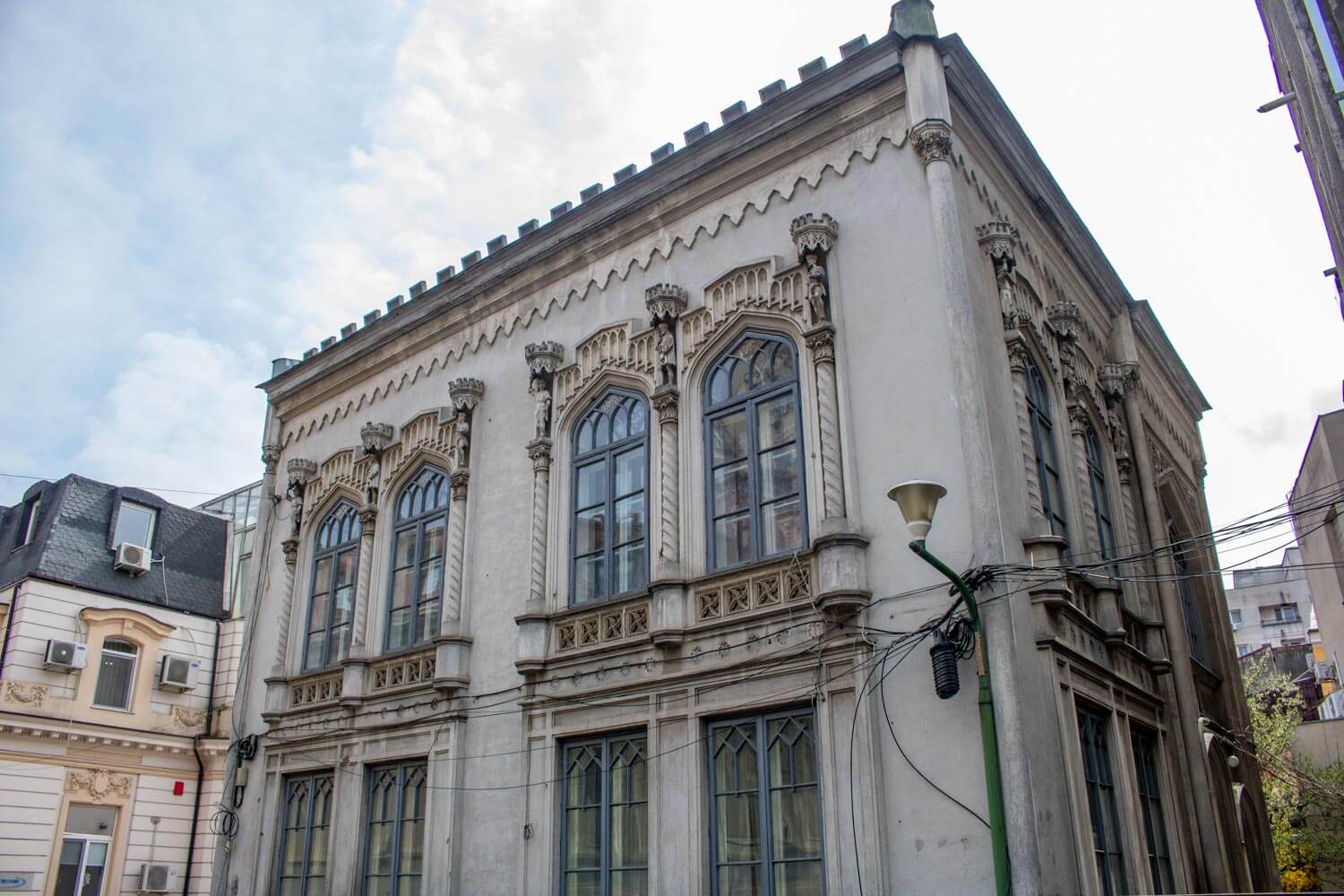
The Choral Temple (Templul Coral) is a synagogue in the Jewish quarter of central Bucharest. The temple belongs to the Jewish community of Bucharest and it’s the largest jewish place of worship in the city.
The synagogue was designed by the architects I. Enderle and Gustav Freiwald and was constructed between 1864 and 1866. The Moorish-Byzantine-style temple is an almost identical copy of the Leopoldstädter Tempel in Vienna which no longer exists today. The inauguration of the synagogue had to be postponed because the building was damaged by Romanian nationalists who protested against the granting of Romanian citizenship to Jews. With the help of a monetary contribution from King Carol I repairs were carried out and the temple was inaugurated by rabbi Antoine Lévy on 6 July 1867.
Over the years, several restorations and additions changed the appearance of the synagogue. In 1892, buttresses were added to the exterior and a second level was added to the internal gallery. Following the designs of the architects Iuliu Leoneanu and Grigore Hirs, a new wing was added in 1932 to host a library, archives, a room for worshipers, and a conference hall. Additional strairs were placed inside the synagogue and several of the decorations were replaced around the same time.
In 1940, the Choral Temple was damaged by an earthquake and in 1941 more damage was caused by the far-right legionnaires of the Iron Guard. In 1945 a complete renovation took place under the supervision of Iuliu Leoneanu. Another restoration took place in 2008. A monument in the form of a large menorah was placed in front of the entrance to commemorate the victims of the Holocaust. Another large Holocaust Memorial is located on the banks of the Dâmbovița River, to the east of the old town.
The Choral Tempel is one of the few synagogues in Bucharest that are still in use for religious services. To visit the Choral Tempel as a tourist, you need to buy a ticket at the entrance gate.