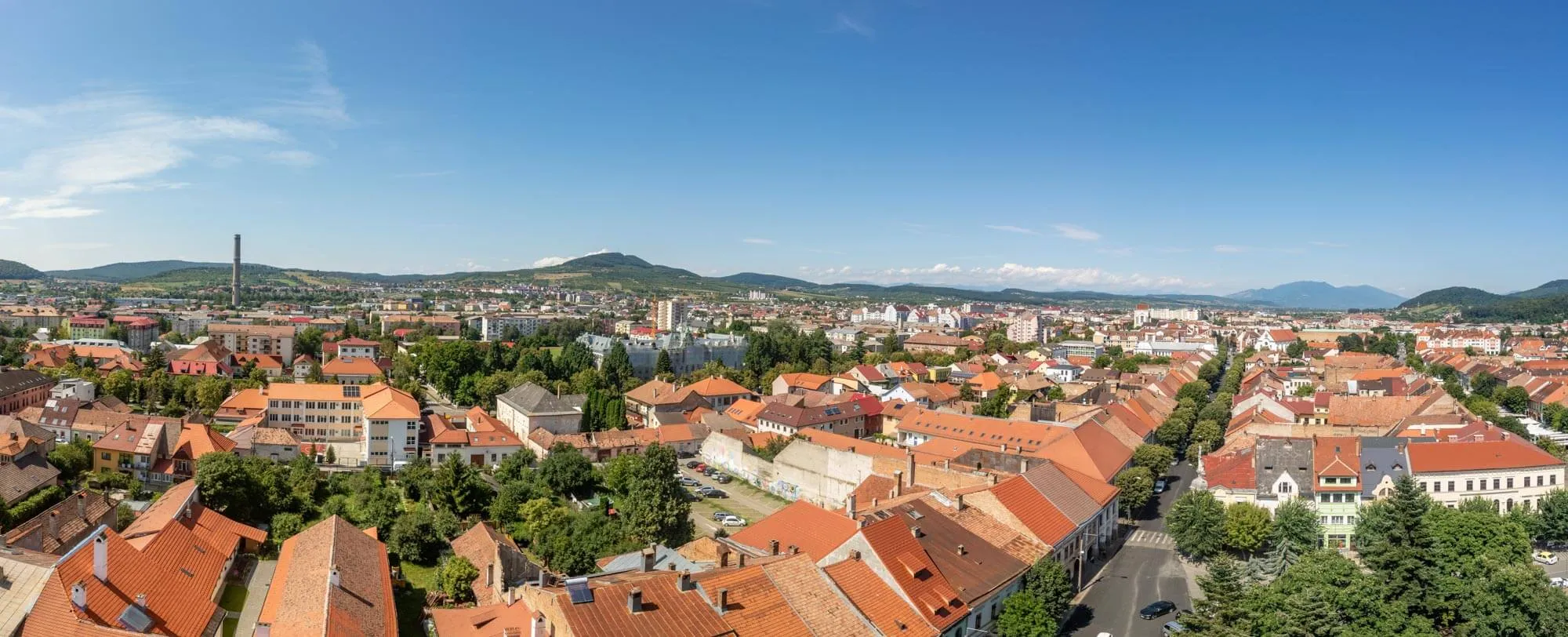
Petru Rareș Square (Piața Petru Rareș) is a civic square in Bistrița, developed during the 1970s as part of the city’s new administrative center. Named after the 16th-century ruler of Moldavia, the square is dominated by the Bistrița Administrative Palace, built between 1970 and 1972 to accommodate the county’s Communist Party leadership and government institutions.
The square became an important location during the Romanian Revolution of December 1989. On December 22, thousands of demonstrators gathered outside the Administrative Palace, then the headquarters of the County Communist Party Committee, demanding the end of Nicolae Ceaușescu‘s regime. Representatives of the protesters entered the building, while others addressed the crowd from its balcony as the communist authorities lost control of the city.
The area is divided by roads into several paved and landscaped spaces. In front of the Administrative Palace stands the Flower of Transylvania, a colorful modern sculpture incorporated into a fountain, alongside the bronze Statue of Petru Rareș. Across the main road, the Column of Remembrance commemorates the region’s fallen heroes in a small park with trees, lawns, and walking paths. The surrounding buildings include the Grand Hotel Coroana de Aur and the former residence of Corneliu Mureșan, Bistrița’s first Romanian mayor.
Petru Rareș Square is also used for official commemorations and military ceremonies, particularly around the Column of Remembrance and the Administrative Palace.