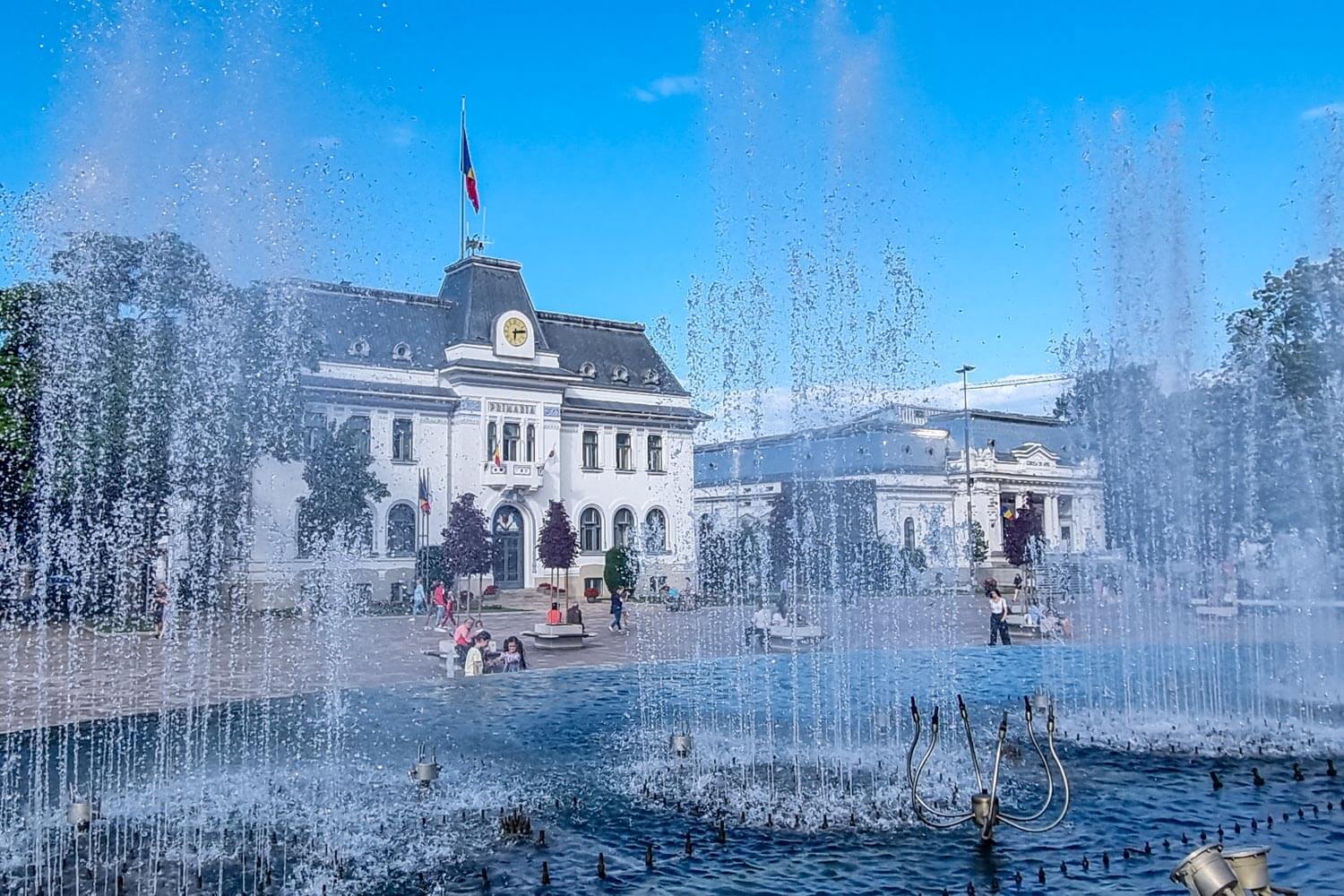
The Rudolf Schweitzer-Cumpăna Art Gallery (Galeria de Artă Rudolf Schweitzer-Cumpăna) is an art museum in central Pitești, housed in the former City Hall building dating from 1886. Part of the Argeș County Museum, the gallery holds a collection of more than 1,000 works of Romanian painting and sculpture, ranging from the 19th century to contemporary art.
The Former City Hall
The building was constructed in 1886 to provide Pitești with a purpose-built municipal administration building, replacing the inadequate premises in which the town authorities had previously operated. The project followed efforts to modernize the local administration during the reign of Alexandru Ioan Cuza, with politician Mihail Kogălniceanu supporting the construction of a new City Hall during a visit to Pitești. After the necessary financing was secured in 1885, construction proceeded quickly, and the new Communal Palace (Palatul Comunal) was inaugurated on October 30, 1886.
Designed by architect Ion N. Socolescu, the building combines an eclectic architectural style with strong neoclassical influences. Its symmetrical façade is dominated by a raised entrance reached by a staircase of Albești stone, above which an open terrace is supported by limestone columns with Corinthian capitals. Inside, a spacious entrance hall leads to rooms arranged on either side, while a monumental marble staircase provides access to the upper floor. The former council chamber is particularly notable for its decorated ceiling, painted by artist Iosif Materna, recalling the building’s original civic function.
The building served as Pitești City Hall until 1970, when the municipal administration relocated to the former Financial Administration building nearby. The old Communal Palace was then transferred to the Argeș County Museum and converted into an art gallery, which opened in 1971. A comprehensive restoration completed in 2025 included structural reinforcement, repairs to the façades, and conservation of the interior decoration. During the work, restorers uncovered and restored extensive sections of the original 19th-century painted ceilings and ornamental finishes.
The Art Gallery
The Pitești Art Gallery was established in the late 1960s and began operating in the former City Hall in 1971. It was subsequently named after Rudolf Schweitzer-Cumpăna (1886-1975), a painter born in Pitești who donated 147 paintings and graphic works to his hometown. After studying art in Germany, Schweitzer-Cumpăna developed a distinctive painting style characterized by vigorous brushwork, rich colors, and thick layers of paint. His subjects frequently included Romanian rural life, peasants, animals, landscapes, and portraits, inspired in part by his travels through the villages of Argeș County.
Schweitzer-Cumpăna’s donation became an important part of the gallery’s collection, which gradually expanded to include paintings and sculptures by some of Romania’s leading artists. Covering the late 19th and 20th centuries, the paintings represent a broad range of artistic styles, from the work of Nicolae Grigorescu and Ștefan Luchian to that of Theodor Pallady, Gheorghe Petrașcu, and Nicolae Tonitza. The upper-floor galleries display works by these artists alongside rooms dedicated to Schweitzer-Cumpăna’s own paintings and graphic works.
The ground-floor galleries focus on modern and contemporary Romanian art, including works by Ion Sălișteanu, while the sculpture collection includes pieces by Ovidiu Maitec, Gheorghe Iliescu-Călinești, and other Romanian sculptors. The gallery also hosts temporary exhibitions featuring works by contemporary artists.