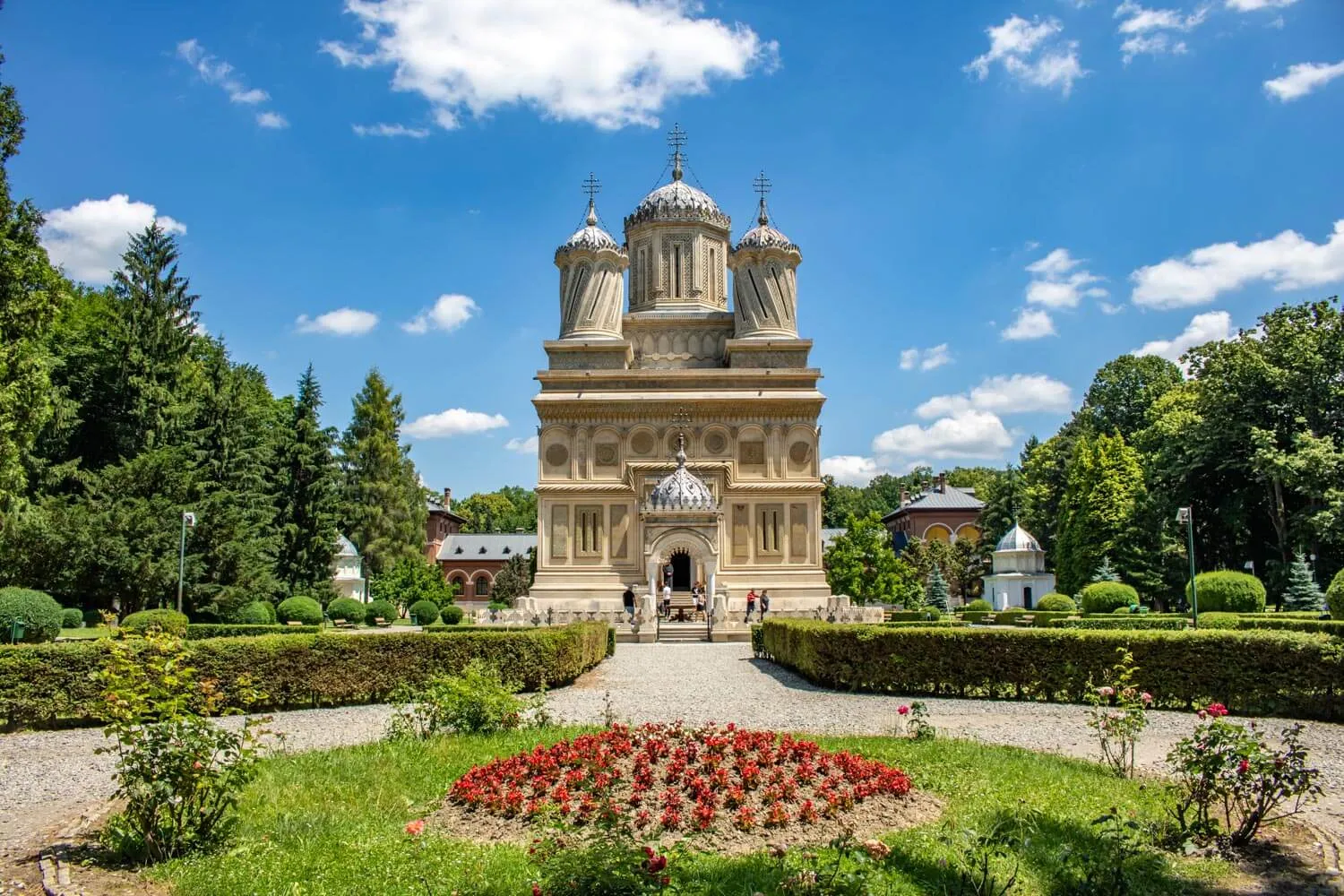
The Princely Church of Saint Nicholas (Biserica Domnească Sfântul Nicolae) is a 14th-century Romanian Orthodox church within the Princely Court of Curtea de Argeș. Built during the reigns of the first rulers of Wallachia, it is one of the country’s earliest surviving princely churches and is particularly celebrated for its extensive medieval frescoes. Its Byzantine architecture and richly painted interior date from the formative period of the Wallachian principality, when Curtea de Argeș served as a political and religious center.
History
The church was built on the foundations of an earlier, smaller religious building dating from the 13th century, whose traces were uncovered during archaeological excavations. Construction of the present church began under Basarab I, the founder of the Wallachian ruling dynasty, and continued under his successors Nicolae Alexandru and Vladislav Vlaicu. Although the precise construction chronology is disputed, the building was largely completed by the 1360s, with its original frescoes painted during the reign of Vladislav Vlaicu in the second half of the century.
The church served the adjoining princely residence as a place of worship and burial for members of the ruling dynasty. Following the recognition of the Metropolitanate of Wallachia in 1359, Curtea de Argeș also became an important ecclesiastical center. The church is regarded as an early metropolitan cathedral, although its precise role during the first decades of the metropolitanate is not fully established.
As the princely court declined, the church continued to function as a place of worship, undergoing repairs and alterations over the following centuries. Its interior paintings were renewed in several campaigns, particularly during the 18th and 19th centuries, when new layers were applied over parts of the medieval frescoes. Architectural changes included the addition of two small towers above the narthex in 1827 and a porch in 1875, considerably altering the building’s original appearance.
By the late 19th century, the church had deteriorated sufficiently for demolition and reconstruction to be considered. Instead, a major restoration was undertaken under architect Gheorghe Cerchez, beginning in 1911. The later additions were removed, the medieval architecture was consolidated, and conservators began uncovering the earlier wall paintings. Among those involved was painter and restorer Dumitru Norocea, whose work contributed to the rediscovery of the church’s exceptional artistic heritage.
Architecture And Interior
The church follows a Byzantine cross-in-square plan, with a single central dome supported by four substantial masonry pillars. These divide the main worship space into a series of vaulted bays, while three apses project from the eastern end. The exterior is comparatively restrained, with alternating courses of brick and stone creating horizontal patterns across the walls. This contrasts with the richly sculpted façades of Curtea de Argeș Monastery‘s later cathedral.
Inside, the principal attraction is the extensive collection of wall paintings, including large sections of the original 14th-century decoration. These frescoes belong to the Byzantine artistic tradition of the Palaiologan period and depict hundreds of religious scenes across the walls, arches, pillars, and vaults. Their detailed narrative compositions include episodes from the lives of Christ and the Virgin Mary, the lives of saints, and portraits of Wallachian rulers. Later paintings from the 18th and 19th centuries can also be seen, sometimes directly beside exposed sections of the medieval originals.
The narthex contains a particularly important cycle illustrating the life and miracles of Saint Nicholas, together with scenes of the Last Judgment and a Deesis composition depicting Christ with the Virgin Mary and Saint Nicholas. The latter also includes a kneeling portrait of Prince Nicolae Alexandru, providing a rare visual record of the early Wallachian dynasty. The different painting campaigns are especially apparent here, where the removal of later layers has revealed earlier compositions beneath them.
In the main worship space, the frescoes include a large Dormition of the Virgin Mary, scenes from the Passion of Christ, and an extensive series of biblical narratives. Among the most unusual is a depiction of the census preceding the Nativity, showing the Virgin Mary visibly pregnant. The church also preserves a princely votive portrait of Vladislav Vlaicu and Lady Ana, while the iconostasis contains 18th-century paintings. The central dome carries an image of Christ Pantocrator, repainted in the 19th century above earlier representations of prophets.
The church also contains several important medieval burials. During restoration work in 1920, archaeologists discovered an elaborate princely tomb containing precious clothing ornaments, jewelry, and a decorated belt buckle. The identity of the person buried there has been debated, with different historians proposing Vladislav Vlaicu, Radu I, or another member of the ruling family. The most important objects recovered from the tomb are now preserved in the National Museum of Romanian History in Bucharest.
Another significant discovery in 1920 was an inscription scratched into the medieval plaster recording the death of Basarab I at Câmpulung in 1352. This provided valuable evidence for establishing the chronology of Wallachia’s earliest rulers. The church also contains later tombstones belonging to members of the Brătianu family, whose contributions helped finance repairs during the 19th century.