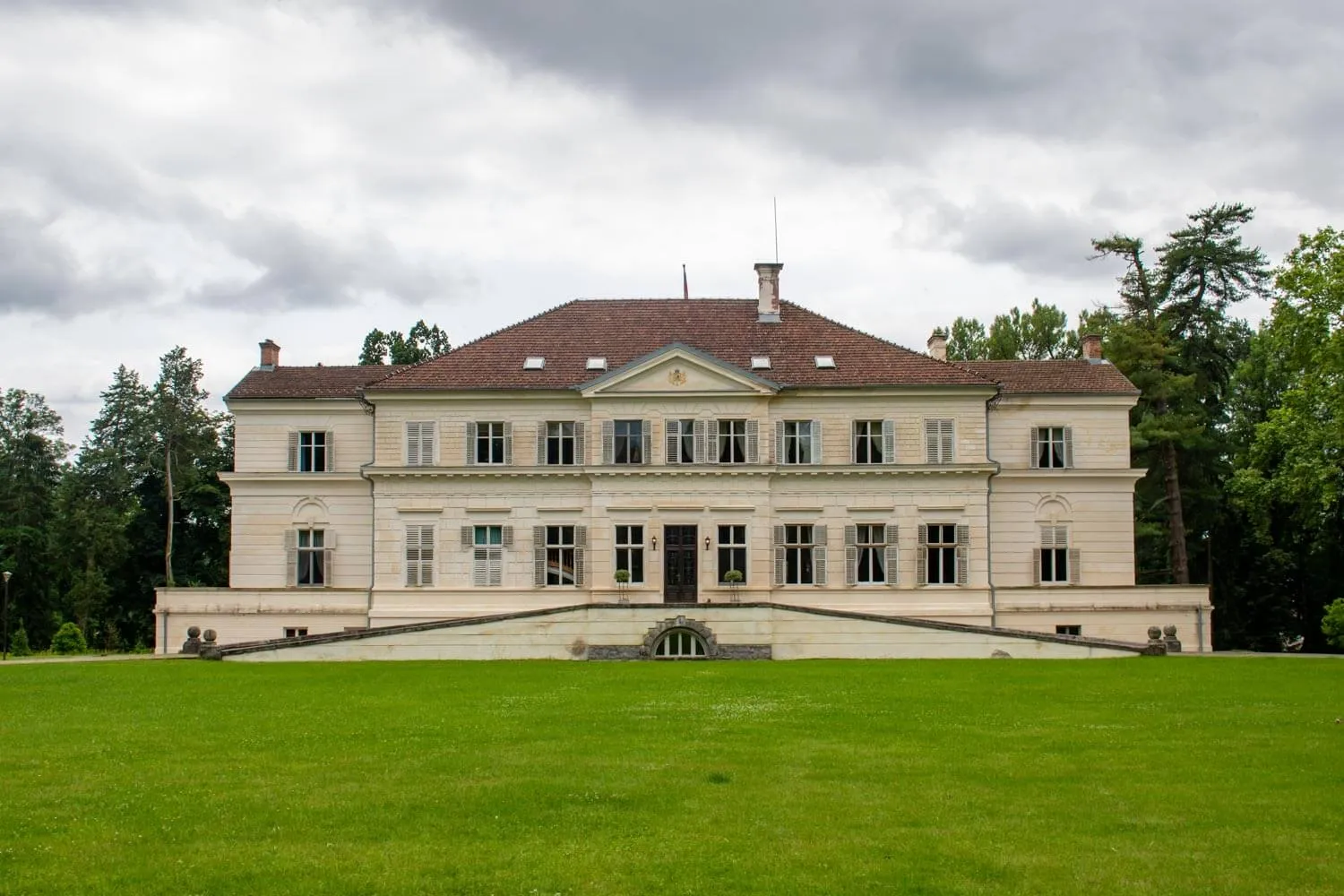
Săvârșin Castle (Castelul Săvârșin) is a historic royal residence in the village of Săvârșin, Arad County, set within an extensive park on the northern side of the Mureș Valley. Originally the country estate of several Hungarian noble families, the castle was purchased by King Michael I of Romania in 1943 and serves as a private residence of the Romanian Royal Family. Although the castle’s interior is not generally open to visitors, parts of the estate can be explored, including the Royal Park, restored outbuildings, and a museum dedicated to King Michael’s passion for automobiles.
History Of Săvârșin Castle
The estate’s history dates back to at least the 17th century, when it belonged to the Forray family. An earlier residence stood on the site during the 18th century and was damaged during the peasant uprising of 1784. Between 1805 and 1816, the Forray family constructed a new Neoclassical castle, which subsequently passed through the Nádasdy and Hunyady families. Renovations carried out between 1895 and 1910 gave the building much of its present appearance, while the surrounding grounds were developed into a landscaped country estate.
In the early 20th century, the estate was acquired by the Mocioni family, from whom King Michael I purchased it in 1943. The king and his mother, Queen Helen, transformed Săvârșin into a comfortable country residence, with Queen Helen overseeing improvements to the interiors and gardens between 1943 and 1945. Their use of the property ended after King Michael’s forced abdication in December 1947 and the confiscation of the castle by the communist authorities in 1948.
During the communist period, the building served various institutional purposes, including as a sanatorium and hospital. It was later used as a state protocol residence, including by Nicolae Ceaușescu. Following a lengthy restitution process, the castle was returned to King Michael in 2001, allowing the Royal Family to return to Săvârșin after more than five decades.
An extensive restoration undertaken between 2007 and 2015 repaired the building and recreated much of the interior decoration introduced by Queen Helen in the 1940s. The work was directed by Crown Princess Margareta and Prince Radu, who also oversaw the restoration of the surrounding estate. Following King Michael’s death in 2017, Săvârșin passed to his eldest daughter, Margareta, Custodian of the Romanian Crown.
Architecture And Visiting The Royal Estate
The castle is a two-story Neoclassical residence with a symmetrical façade, pale exterior walls, shuttered windows, and a central portico supported by columns. A broad staircase leads to the main entrance, above which a balcony and triangular pediment emphasize the building’s formal design. The restored interiors include reception rooms, a library, dining rooms, and private apartments, furnished and decorated to reflect the royal residence of the 1940s.
The Royal Park (Parcul Regal) extends around the castle, combining open lawns with mature trees, ornamental gardens, and paths leading to a lake with a small island. Features include Queen Helen’s rose garden, a wisteria-covered archway, a hidden garden, an 18th-century pavilion, and a tennis court dating from 1945. The gardens were carefully restored as part of the wider rehabilitation of the estate.
Several former service buildings form the Royal Village (Satul Regal), where visitors can explore the Royal Automobile Museum and King Michael’s Automobile Workshop. The collection reflects the king’s lifelong interest in mechanics and motor vehicles, with historic cars, tools, and memorabilia displayed in restored estate buildings. The Royal Village also includes a Tea House, guest accommodation, and other buildings that once supported the daily operation of the residence.
The estate opened to the public in 2021, allowing visitors to explore the Royal Park and several restored service buildings known as the Royal Village. Visits to the park are organized in guided groups, while the Royal Automobile Museum, King Michael’s workshop, and other exhibitions can also be visited as part of a trip to the estate. The castle itself is a private royal residence and is not included in public tours.