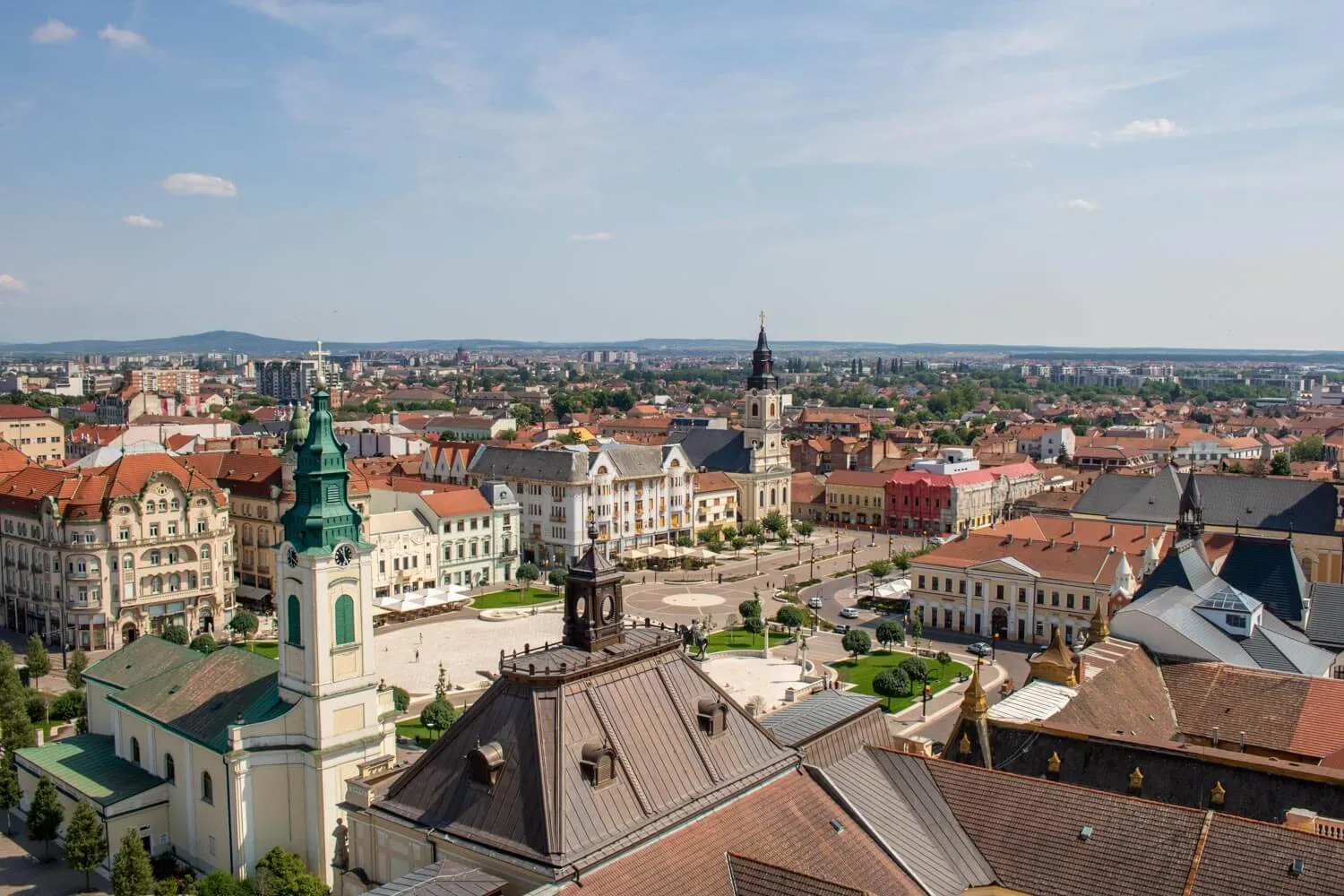
Avram Iancu Square (Piața Avram Iancu) is a historic public square in the center of Arad, extending south from the Ioan Slavici Classical Theater. Developed during the 18th century, it was once the city’s main commercial and administrative center and is surrounded by historic buildings representing several periods of Arad’s architectural development.
The square began taking shape during the first half of the 18th century, as Arad developed into an important trading town under Habsburg rule. Originally known as Town Hall Street (Strada Primăriei), it was named after the old municipal building that stood on the site of the present Domány Palace. Merchants and craftsmen established their businesses around the square, which gradually became the center of the city’s commercial and civic activities. Its importance increased during the 19th century, particularly after Arad received the status of a free royal city in 1834, when celebrations were held here to mark the occasion.
Later known as Liberty Square (Piața Libertății), the area also became a setting for major political gatherings. In October 1918, thousands of residents assembled here during the events surrounding the collapse of Austria-Hungary and the formation of the Romanian National Council. The square’s appearance changed considerably during the 19th and early 20th centuries, as older houses were replaced or remodeled with more elaborate façades. Among the surviving buildings are the Domány Palace, built on the site of the former Town Hall, and the Mátyás Rozsnyai Palace, whose Secession decorations reflect the prosperity of Arad’s merchant and professional classes.
The square has also undergone several changes to its monuments. A Holy Trinity column erected in 1746 commemorated the end of a plague epidemic, while the Hungarian Statue of Liberty was unveiled here in 1890 in memory of thirteen revolutionary generals executed in Arad in 1849. The latter monument was dismantled in 1925 and eventually reassembled in the Romanian-Hungarian Reconciliation Park. In 1960, the Romanian Soldiers Monument by sculptor Gavril Covalschi was inaugurated in the center of Avram Iancu Square, commemorating Romanian soldiers who fought during World War II.
The central part of the square is arranged as a public garden, with paved paths crossing between lawns, planted areas, and benches. The Romanian Soldiers Monument stands at the intersection of the main paths, facing the theater at the northern end. Around the square, historic buildings with Baroque, Neoclassical, Eclectic, and Secession features retain their commercial ground floors, where shops, cafés, and restaurants contribute to the activity of the surrounding streets.