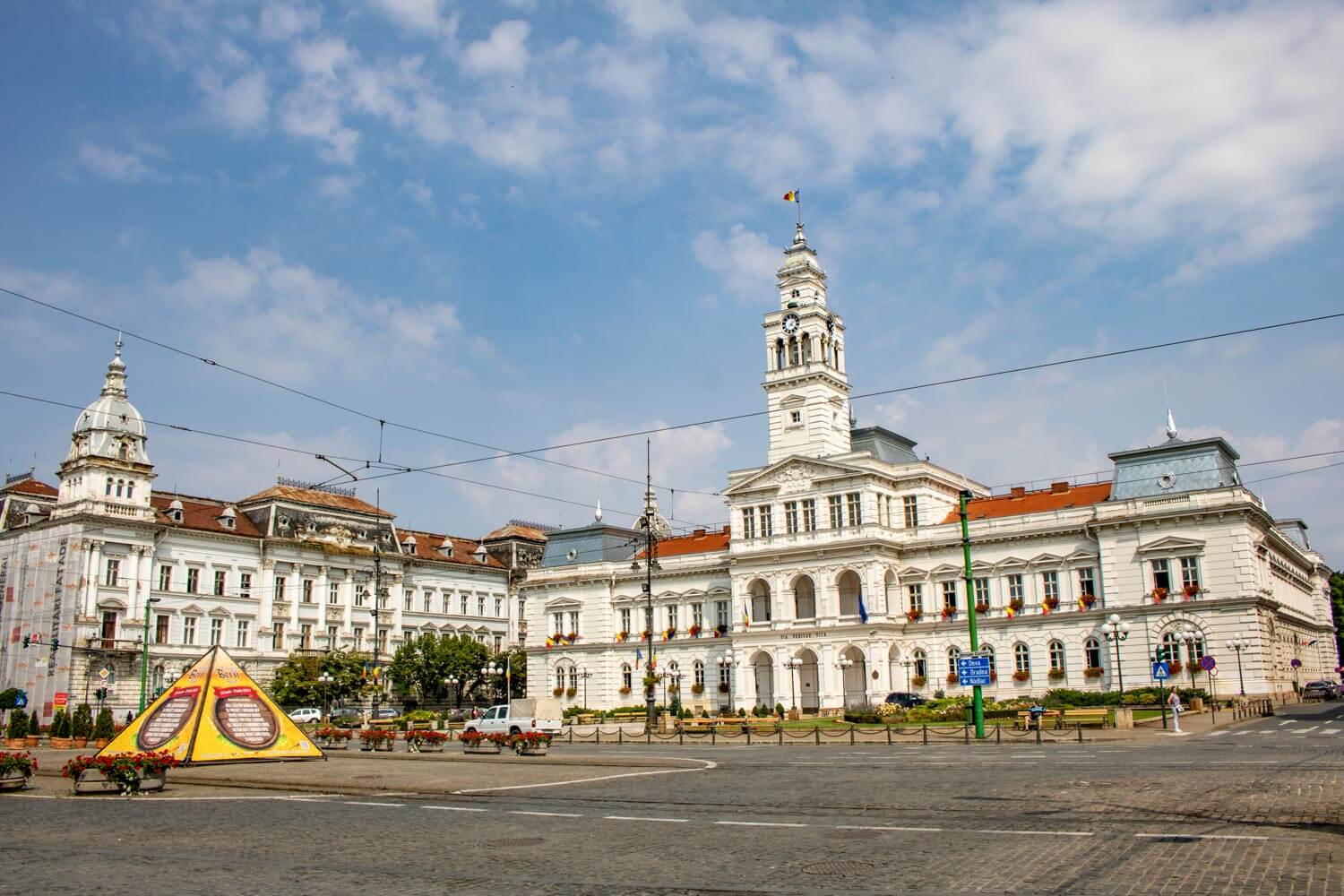


The Arad Administrative Palace (Palatul Administrativ din Arad) is a monumental Neo-Renaissance building in the center of Arad, serving as the seat of the municipal government and the Arad County Prefecture. Constructed between 1872 and 1876, the palace is one of the city’s most prominent architectural landmarks, distinguished by its symmetrical façade and imposing central clock tower.
The development of the palace was part of the northward expansion of Arad during the 19th century. The original town hall stood on Avram Iancu Square, but as the city’s commercial and administrative center shifted, the municipal authorities decided to construct a larger building along the developing main boulevard. An architectural competition attracted 17 proposals and was won by Hungarian architect Ödön Lechner. However, his design proved too expensive, prompting the municipality to commission local architect Francisc Pekar to revise the plans. The revised project reduced the scale of the building while retaining its monumental appearance.
Construction was completed in 1876, and the palace was inaugurated in 1877. Its architecture combines Neo-Renaissance and classical elements, with decorative influences from Flemish town halls. The building has a U-shaped layout surrounding an inner courtyard, while its main façade is dominated by a 54-meter-high clock tower. The clock was imported from Switzerland and installed in 1878. Above the main entrance, an ornamental pediment displays the coat of arms of Arad.
The interior is equally elaborate, with a spacious entrance hall and a monumental red marble staircase leading to the ceremonial hall on the upper floor. The hall features richly decorated walls, ornamental stucco, balconies supported by columns, and a painted ceiling. The staircase is illuminated by stained-glass windows created by Romanian artist Sever Frențiu, depicting the seasons and months of the year through allegorical figures.
The palace overlooks Revolution Square (Piața Revoluției), where a large representation of Arad’s coat of arms is incorporated into the pavement. The square also contains a monument commemorating those who lost their lives during the Romanian Revolution of December 1989.