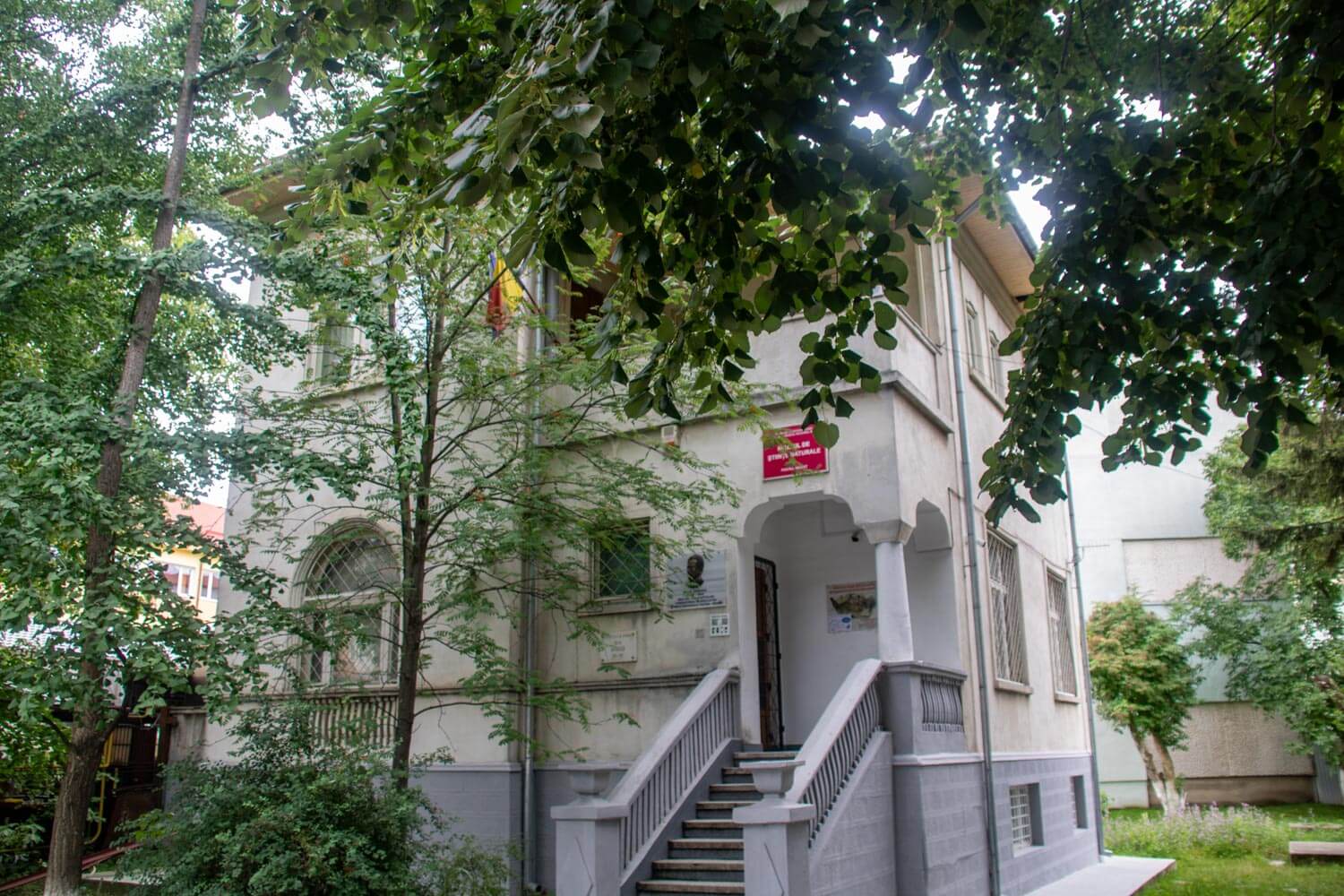
The Piatra Neamț Museum of Natural Sciences (Muzeul de Științe Naturale Piatra-Neamț) is a natural history museum in Piatra Neamț, dedicated to the geology, fossils, plants, and animals of Neamț County. Its collections cover the region’s geological development and natural environments, with a particularly important collection of fossil fish discovered in the mountains surrounding the city.
The museum was established on September 1, 1960, as a natural sciences department of the Archaeological Museum, under the direction of Mihai Ciobanu. The following year, historian Iulian Antonescu and his wife Eugenia donated a building specifically for the creation of a natural sciences museum. After several years of adapting the premises, assembling scientific collections, and preparing the exhibitions, the museum became an independent institution in 1965 and opened its permanent exhibition to the public on November 15, 1969.
The geological and paleontological exhibits trace the formation of the Earth’s crust and the evolution of life through successive geological periods. Displays of minerals, crystals, and igneous, sedimentary, and metamorphic rocks introduce the region’s geological structure, while fossils and reconstructed prehistoric landscapes illustrate the environments of earlier eras. The museum’s most distinctive collection consists of Oligocene fossil fish, dating from approximately 34 to 23 million years ago. The first specimens were collected in the 1880s by Leon C. Cosmovici from the Cozla Hill and Pietricica Hill, and subsequent research expanded the collection with discoveries from Cernegura, Agârcia, and other nearby sites. These exceptionally preserved fossils document the marine life of the ancient Paratethys Sea, with numerous specimens representing rare or scientifically significant species.
The biological exhibitions present the plants and animals of Neamț County through preserved specimens, display cases, and detailed habitat dioramas. Forests, meadows, caves, and agricultural landscapes are represented alongside mountain ecosystems, including scenes from Ceahlău National Park and the Cheile Șugăului area. The dioramas use natural materials to recreate vegetation, terrain, and animal habitats, while other displays feature insects, birds, mammals, and botanical specimens. A section devoted to nature conservation introduces the county’s protected species, nature reserves, and natural monuments.